Last updated: 31 March 2026
The Department for Science, Innovation and Technology — DSIT — was created in February 2023 when the government split the old Department for Digital, Culture, Media and Sport (DCMS) and brought digital, tech, and science policy together under a single secretary of state. The restructure was significant: it signalled that the UK government views digital and technology as a strategic national priority, not a policy afterthought.
For HR and L&D leaders, DSIT matters because its priorities shape the funding landscape, the regulatory environment, and the skills expectations that employers will face over the next three to five years. Organisations that plan their workforce development strategy in isolation from DSIT’s agenda will find themselves behind the curve — both on readiness and on access to funded provision.
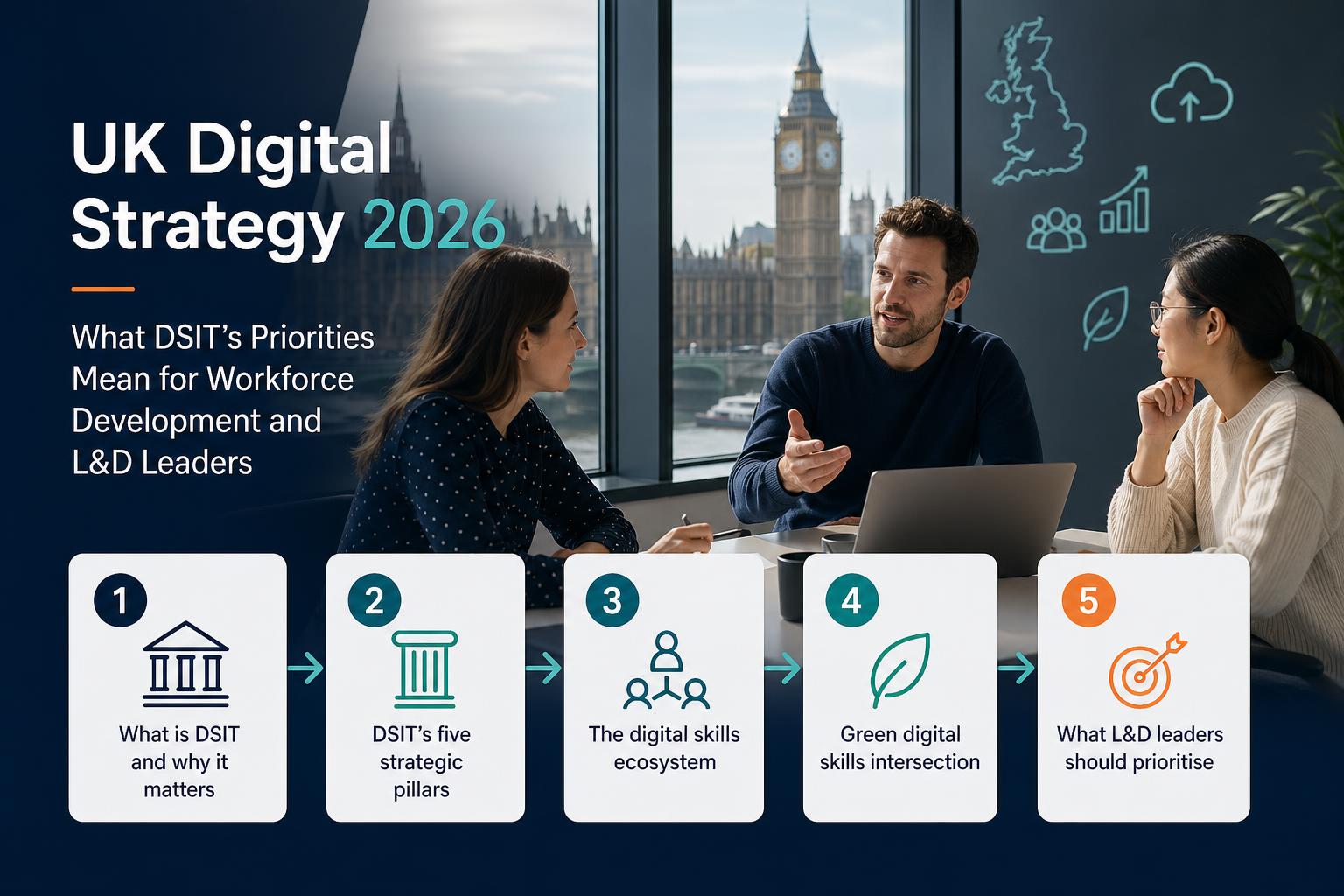
This guide translates DSIT’s five core strategic pillars into their workforce implications, and ends with a practical checklist L&D leaders can use to assess alignment.
HR directors and L&D leaders planning workforce development strategy for 2026–2028; training providers seeking to position their digital and AI provision in response to government priorities; and employers in sectors directly affected by DSIT’s programmes (public sector, financial services, health, manufacturing, professional services).
What Is DSIT and Why Does It Matter?
DSIT is responsible for:
- Digital policy and technology regulation (including AI regulation direction)
- Science and research funding (Innovate UK, UKRI)
- Digital infrastructure (broadband rollout, 5G strategy)
- Cyber security strategy (in partnership with NCSC)
- Space and quantum technology
- Data policy and the use of data across the public sector
The department does not directly fund most adult education — that sits primarily with the Department for Education (DfE) and the ESFA. But DSIT commissions Skills Bootcamp contracts for digital and AI roles directly through its own spending, publishes the AI Opportunities Action Plan, and sets the policy framework that determines which digital skills are treated as national priorities.
When DSIT prioritises AI literacy, it means Skills Bootcamp contracts get commissioned for AI provision. When DSIT identifies a cyber security workforce gap, it means new apprenticeship standards get developed and funding bands get increased. DSIT is the upstream demand signal — L&D leaders who read it correctly can position ahead of the curve.
DSIT’s Five Strategic Pillars for Workforce
Pillar 1: AI Skills and Adoption
DSIT’s AI strategy is anchored in the AI Opportunities Action Plan, published in January 2025. The Plan sets out the government’s ambition for the UK to be a leading destination for AI investment and a country in which AI is used productively across the economy.
The workforce implications are significant. The Plan explicitly calls for:
- AI Skills Boost — a government-funded programme to increase AI literacy across the workforce, with free or subsidised AI skills training available to employed adults
- Expansion of AI Skills Bootcamps — increased DSIT contract value for providers delivering intensive AI upskilling to employed adults and jobseekers
- AI in education — embedding AI tools in FE and HE teaching, creating a pipeline of AI-familiar graduates and apprentices
- AI Growth Zones — regional clusters (including regions such as Manchester, Leeds, and Bristol) where AI infrastructure and talent investment is concentrated
For L&D leaders, the immediate implication is that AI literacy is no longer optional — it is a funded government priority with explicit expectations attached. Organisations that cannot demonstrate a credible AI literacy programme will increasingly be out of step with the regulatory and procurement environment.
Pillar 2: Digital Infrastructure and Hybrid Work
DSIT’s Project Gigabit programme is the largest broadband infrastructure investment in UK history, targeting full-gigabit coverage for at least 85% of UK premises by 2025, with nationwide coverage targeted by 2030. The 5G strategy runs alongside it, with shared rural network deployment extending 4G and 5G coverage to previously excluded areas.
The workforce implication is less obvious but important: infrastructure investment directly enables the remote and hybrid digital work models that now define how a large proportion of knowledge workers operate. Organisations with workforces in previously poorly connected areas can increasingly expect those employees to be able to work digitally — which raises the bar on digital skills expectations for those roles.
For training providers, digital infrastructure improvements mean that online and blended delivery is increasingly viable even for learners in rural or previously offline-dependent locations — expanding the accessible market for digital skills provision.
Pillar 3: Digital Regulation and Workforce Compliance Implications
DSIT is developing the UK’s AI regulatory framework. Unlike the EU’s AI Act (which creates binding legal obligations by AI risk category), the UK’s current approach is principles-based rather than prescriptive — but it is moving towards firmer expectations for organisations deploying high-risk AI systems.
Key regulatory themes with workforce training implications include:
- Human oversight requirements — organisations deploying AI in consequential decision-making (hiring, credit, healthcare triage) will need to demonstrate that humans are trained to oversee AI outputs appropriately
- Accountability and transparency — employees who work with AI tools will need to understand what those tools are doing, where they can be wrong, and how to escalate concerns — this is a training requirement
- Online Safety Act compliance — organisations publishing user-generated content or operating social platforms face specific compliance training requirements for relevant roles
Article 4 of the EU AI Act has applied since 2 February 2025 to providers and deployers within the Act’s territorial scope. “EU-facing” is not a complete scope test, and the Commission does not prescribe one training programme or certificate. Map systems, roles and Article 2 first, then choose proportionate literacy measures and separate UK legal, contractual and sector requirements.
Pillar 4: Cyber Security Workforce
The National Cyber Security Centre (NCSC) operates under DSIT’s oversight and has been explicit about the UK’s cyber security workforce gap. The UK needs an estimated 14,000 additional cyber security professionals per year to meet demand — and that figure does not include the much larger number of employees in non-specialist roles who need baseline cyber awareness to protect organisations from the most common attack vectors.
DSIT’s Cyber Essentials scheme provides a baseline certification standard for organisations. Its workforce implications:
- Cyber Essentials certification is now a prerequisite for many government and public sector contracts. Organisations without it are excluded from procurement. Achieving it requires employees to be trained and aware of the five technical controls — firewalls, secure configuration, access control, malware protection, and patch management
- Cyber awareness training for all employees is expected as a baseline governance measure — with phishing simulation, password management, and incident reporting skills the most commonly cited gaps
- Specialist cyber roles — Security Operations Analyst, Cyber Intrusion Analyst, and Penetration Tester — are explicitly identified in DSIT’s cyber skills strategy as shortage occupations requiring increased apprenticeship and Skills Bootcamp provision
For training providers, cyber security is one of the most consistently funded areas in DSIT’s Skills Bootcamp commissioning. Providers who can demonstrate employer demand and quality delivery in cyber provision are well positioned in procurement.
Pillar 5: STEM Pipeline — T-Levels, Degree Apprenticeships, and the Long Game
DSIT works with DfE on the long-term STEM pipeline that will supply the UK’s digital and technology workforce over the next decade. The two most relevant mechanisms for workforce development leaders are:
- T-Levels in digital — two-year technical qualifications equivalent to three A-levels, with substantial industry placement components. T-Levels in Digital Production, Design and Development, and Digital Business Services are producing a cohort of digitally skilled school leavers whose expectations and capabilities differ from previous generations
- Digital degree apprenticeships — Level 6 and 7 apprenticeships in software engineering, data science, digital technology solutions, and AI are the primary mechanism through which organisations can grow specialist digital talent internally, fully funded through the Growth and Skills Levy for levy-paying employers
The strategic implication: organisations that build relationships with T-Level providers now — through industry placements — are building a talent pipeline and an employer brand in the digital skills market simultaneously.
The Digital Skills Ecosystem DSIT Is Building
Taken together, DSIT’s investments create a connected progression pathway from foundational digital literacy to degree-level digital expertise. Understanding this ecosystem helps L&D leaders see where each of their workforce populations fits:
- Essential Digital Skills Qualifications — funded through AEB for adults without basic digital skills
- Level 3 Digital Entitlement — free first Level 3 digital qualification for adults without a Level 3 qualification
- AI Skills Boost short courses — free or subsidised AI literacy courses for all employees
- Skills Bootcamps — intensive 12–16-week programmes for employed adults moving into or deepening digital roles
- Digital apprenticeships (Level 3–5) — structured programmes for employees in digital roles, funded through Growth & Skills Levy
- Degree apprenticeships (Level 6–7) — the top of the pipeline, producing specialist digital talent in software engineering, data science, and AI
No single organisation needs all six levels — but every organisation with a meaningful digital workforce has employees who sit somewhere on this pathway.
Green Digital Skills: The Emerging Intersection
DSIT’s agenda intersects with the UK’s net zero commitments in ways that are beginning to surface as specific skills requirements. Three areas to watch:
- Net zero reporting and digital disclosure — TCFD-aligned climate reporting and Scope 1/2/3 emissions tracking increasingly require employees who can use digital data collection and reporting tools
- Digital twins in manufacturing — the use of digital replicas of physical assets for process optimisation is a growing capability requirement in advanced manufacturing, enabled by IoT and AI
- Smart grid and energy management systems — the energy sector’s digital transformation requires technicians and engineers with both electrical and digital skills — a combination the current apprenticeship system is only beginning to address
Green digital skills are not yet a mainstream funded training category, but DSIT’s alignment with the Department for Energy Security and Net Zero on this agenda means it is coming. Training providers who build provision now — and can articulate the green digital skills demand clearly in procurement bids — will be ahead of this wave.
What L&D Leaders Should Prioritise in Response
Translating DSIT’s agenda into an L&D programme is not about chasing every government initiative. It is about identifying the three or four areas where DSIT’s priorities intersect with your organisation’s strategic needs — and building funded, structured provision there.
Based on the five pillars above, the highest-priority areas for most L&D leaders in 2026 are:
- AI literacy — foundational, role-differentiated, and connected to actual tools your organisation uses. This is both a DSIT priority and a regulatory expectation in development
- Cyber awareness — baseline training for all employees (phishing, password, incident reporting) plus deeper capability for roles with system access
- Data skills — from basic data literacy (interpreting dashboards, understanding data quality) up to analyst-level capability for data-intensive roles
- Green digital — early investment, particularly for manufacturing, energy, and logistics organisations where digital and sustainability convergence is fastest
How Training Providers Should Position
For training providers bidding for Skills Bootcamp contracts or positioning as strategic partners to employers, DSIT’s agenda provides an explicit alignment framework. Procurement evaluators will be looking for evidence that providers understand the policy context their provision sits within. Specifically:
- Reference the AI Opportunities Action Plan when positioning AI Skills Bootcamp provision — show you understand the government’s ambition, not just the contract specification
- Demonstrate employer demand evidence that maps to DSIT’s identified shortage areas (AI, cyber, data, green digital)
- Show how your provision connects to the broader progression ecosystem — what comes before your Bootcamp for learners who need it, and what comes after
- Position your quality assurance and learner outcome data in the context of DSIT’s productivity and economic growth objectives — not just completions
DSIT-Aligned L&D Strategy Checklist
Use this checklist to assess how well your current workforce development strategy is aligned to DSIT’s 2026 priorities.
AI and Digital Capability
- We have an AI literacy programme in place or in development for all employees, differentiated by role level
- Our AI training covers the responsible use requirements building in UK and EU regulation — not just tool proficiency
- We have accessed or are actively pursuing DSIT-funded AI training routes (AI Skills Boost, Skills Bootcamps)
- We have a named owner for AI workforce capability within L&D or HR
Cyber Security Awareness
- All employees complete baseline cyber awareness training annually
- Phishing simulation is part of our cyber training programme
- We have or are working towards Cyber Essentials certification
- Employees in high-access roles (IT, finance, HR systems) receive enhanced cyber training
Data Skills
- We have assessed our workforce for data literacy baseline — ability to interpret data, spot anomalies, use reporting tools
- Employees in data-intensive roles have access to structured data skills development (not just tool training)
- We are using or considering apprenticeship funding for data analyst or data technician roles
Pipeline and Future Capability
- We are considering or have T-Level industry placements in digital subjects
- We are using or considering digital degree apprenticeships for specialist talent development
- Our L&D strategy covers green digital skills if relevant to our sector
- We regularly review DSIT and Skills England priorities to update our workforce development strategy
Frequently Asked Questions
What is DSIT’s role in digital skills?
DSIT is the UK government department responsible for digital policy and technology regulation. In the context of digital skills, DSIT commissions Skills Bootcamp contracts for digital and AI roles, leads the AI Opportunities Action Plan and AI Skills Boost programme, oversees cyber security workforce strategy through NCSC, and sets the policy framework that determines which digital skills attract government investment. While the Department for Education holds the adult education budget, DSIT’s priorities shape what provision gets commissioned and funded.
What does the UK digital strategy mean for training?
For training providers, DSIT’s digital strategy creates a demand signal: providers who align their offer to DSIT’s identified priorities — AI, cyber, data, green digital — are best positioned in Skills Bootcamp procurement. For employers, the strategy sets rising expectations: AI literacy, cyber awareness, and data skills are moving from competitive advantages to baseline requirements, with funded routes available to develop them.
How does DSIT’s AI agenda affect employers?
Three ways: through skills expectations (AI literacy is now a government-funded priority with explicit workforce targets); through regulatory direction (human oversight, accountability, and transparency requirements for AI deployment are building, affecting compliance training obligations); and through public sector adoption pressure (DSIT-driven AI deployment across NHS, HMRC, and DWP affects employers in those supply chains and the public sector workforce directly).
Sources & further reading
- Department for Science, Innovation and Technology - official GOV.UK page (gov.uk) — Department for Science, Innovation and Technology - official GOV.UK page (gov.uk)
- AI Opportunities Action Plan - GOV.UK (gov.uk) — AI Opportunities Action Plan - GOV.UK (gov.uk)
- NCSC - Cyber Essentials: overview and requirements (ncsc.gov.uk) — NCSC - Cyber Essentials: overview and requirements (ncsc.gov.uk)