Last updated: 29 March 2026
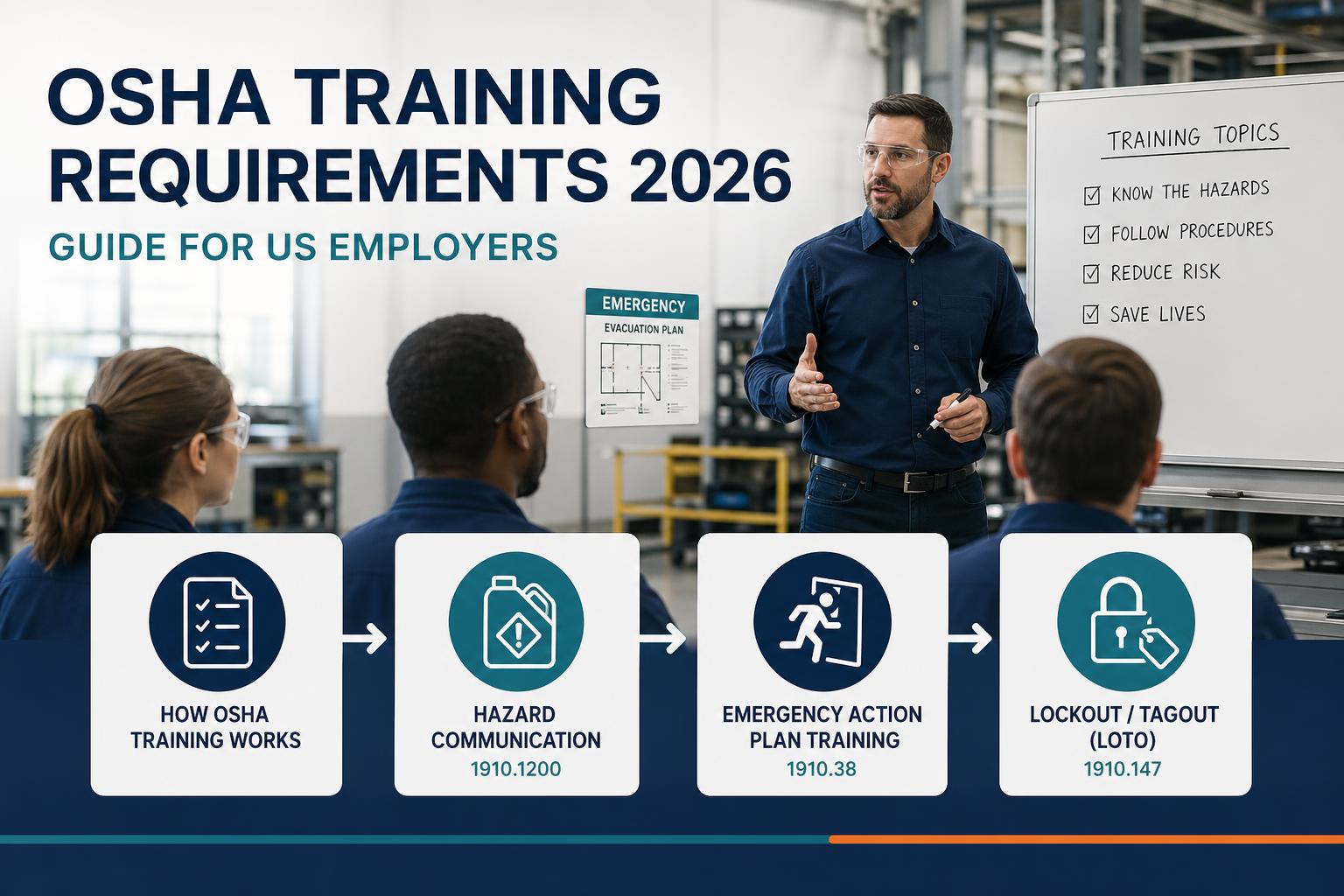
How OSHA training requirements work
OSHA training requirements are embedded in specific standards rather than in a single training regulation. Each standard that includes a training requirement specifies: who must be trained, what the training must cover, when training must occur (initial and/or periodic), and in some cases the qualifications of the trainer.
The absence of a specific training regulation does not mean training is optional. Under the General Duty Clause (Section 5(a)(1) of the OSH Act), employers must address recognized hazards — and training is OSHA’s most commonly cited control for ensuring employees understand hazards and procedures. Failing to train employees on a recognized hazard is a citable violation even where no specific training standard exists.
State OSHA plans
28 states operate their own OSHA programs (State Plans) that must be “at least as effective” as federal OSHA. Some states — notably California (Cal/OSHA), Washington (WISHA), and Michigan (MIOSHA) — have more stringent requirements than federal OSHA in certain areas. This guide covers federal OSHA requirements; verify California, Washington, and Michigan requirements separately if you have employees in those states.
Hazard Communication Standard (HazCom / GHS) — 29 CFR 1910.1200
HazCom applies to any employer whose employees may be exposed to hazardous chemicals in the workplace — which includes office employers who use cleaning products, ink, and other common workplace chemicals.
Training requirements
Employees must be trained on: the HazCom standard’s requirements, how to detect the presence or release of hazardous chemicals in the workplace, the physical and health hazards of the chemicals in their work area, measures to protect themselves, and how to read and use Safety Data Sheets (SDS) and GHS-compliant labels.
Timing
Training must occur at the time of initial assignment and whenever a new hazardous chemical is introduced to the work area. OSHA does not mandate periodic refresher training under HazCom, but recommends refreshers when procedures change or incidents suggest the training is not effective.
Documentation
Maintain records of who was trained, when, and on which hazardous chemicals. SDS for all chemicals used must be accessible to employees during their shift.
Emergency Action Plan training — 29 CFR 1910.38
Any employer with 10 or more employees in a workplace with an Emergency Action Plan (EAP) must train employees on the plan. Employers with fewer than 10 employees may use an oral EAP in lieu of a written one, but employee training is still required.
Training requirements
All employees must be trained to understand the emergency action plan. Employees designated as having specific roles under the EAP (floor wardens, first responders, assembly point marshals) must receive role-specific training. Training must cover: alarm signals, evacuation routes, assembly points, and who to report to.
Timing
Training at initial hire. Retraining when the plan changes or when drills reveal employee confusion about procedures. A drill or tabletop exercise counts as training for purposes of the standard.
Lockout/Tagout (LOTO) — 29 CFR 1910.147
LOTO applies to employers where employees service or maintain machines or equipment where unexpected energization could cause injury. Most office employers are not covered. Manufacturing, warehousing, utilities, and facilities maintenance teams are the primary audience.
Training requirements
Three categories of employee require different training:
- Authorized employees (those who perform LOTO): full training on the energy control procedure, types of energy, specific lockout/tagout methods, and their responsibilities
- Affected employees (those whose job requires them to operate or use equipment subject to LOTO): awareness training on when and why equipment is locked/tagged out
- Other employees in areas where energy control is used: awareness that they must not attempt to restart or re-energize locked/tagged equipment
Timing
Before initial assignment to roles where LOTO applies. Retraining when there is reason to believe an authorized employee does not have the required knowledge or skills, or when a new hazard or energy control procedure is introduced.
Periodic inspection
OSHA requires at least an annual certification of each energy control procedure, including review of the procedure with each authorized employee. This annual review is not a training refresher per se but in practice functions as one.
Personal Protective Equipment — 29 CFR 1910.132
Where PPE is required as a control measure, employees must be trained before they are required to use the equipment.
Training requirements
Training must cover: when PPE is necessary, what PPE is necessary, how to properly don, doff, adjust, and wear PPE, the limitations of PPE, and proper care, maintenance, and disposal. For specific PPE types (respiratory protection, hearing protection, eye and face protection, fall protection), additional standard-specific training requirements apply.
Retraining
Retraining is required when: the employee does not demonstrate the required understanding or skill, changes in the workplace make previous training obsolete, or changes in the types of PPE being used. OSHA inspectors look for written certification that training occurred — the employee’s name, the date of training, and the subject of the training.
Bloodborne Pathogens — 29 CFR 1910.1030
Bloodborne pathogen training is required for employees with occupational exposure to blood or other potentially infectious materials — primarily healthcare workers, first aid responders, and those who handle regulated waste. Office employers with designated first aid responders must train those employees.
Training requirements
Annual training for all employees with occupational exposure. Training must be provided at no cost to the employee and during working hours. Content must include: an accessible copy of the OSHA standard, general explanation of bloodborne pathogens and associated diseases, methods of exposure prevention, use of PPE, and the employer’s exposure control plan.
Trainer qualifications
Training must be conducted by or under the supervision of a person who is knowledgeable in the subject matter as it relates to the workplace. OSHA does not require a specific credential but documentation of trainer qualifications is advisable.
Powered Industrial Truck (Forklift) — 29 CFR 1910.178
Forklift training applies to warehousing, distribution, manufacturing, and any operation where powered industrial trucks are used. It is one of the most frequently cited OSHA standards.
Training requirements
Operators must receive training on: truck-related topics (stability, capacity, pre-operation inspection), workplace-related topics (surface conditions, load handling, pedestrian traffic), and practical hands-on training with the specific type(s) of truck they will operate. Classroom or online training alone does not meet the standard — practical evaluation with actual equipment is required.
Refresher training
Refresher training and evaluation required when: the operator is observed operating the truck unsafely, an accident or near-miss occurs, an evaluation reveals the operator is not operating safely, or the operator is assigned to a different type of truck. An evaluation of each operator is required at least every 3 years.
Walking-Working Surfaces and Fall Protection — 29 CFR 1910.21—30
OSHA’s updated walking-working surfaces standard (2017) includes training requirements for fall protection. Applies to general industry employers where employees work at heights or on elevated surfaces.
Training requirements
Employees who use personal fall protection systems must be trained by a qualified person on: the nature of fall hazards in the work area, correct procedures for erecting, maintaining, disassembling, and inspecting fall protection systems, and limitations of each type of fall protection system used.
Retraining required when: changes in the workplace, changes in fall protection equipment or systems, employee demonstration of inadequate knowledge or use of fall protection equipment.
Documentation and recordkeeping
OSHA does not have a single regulation specifying how training must be documented, but several standards (LOTO, bloodborne pathogens, PPE) require written certifications. As a practical matter, document all OSHA-required training with:
- Employee name and job title
- Date of training
- Training content covered (or title and version of training program)
- Trainer name and qualifications (where required)
- Employee acknowledgment/signature
Retention period: OSHA’s injury and illness recordkeeping standard requires 5-year retention for 300 logs. For training records, no universal retention period is specified, but employment lawyers recommend a minimum of 3 years from the date of training or the employment relationship’s end, whichever is later.
Store training records so they can be produced to an OSHA inspector on short notice. During an inspection, the compliance officer will request training records for the standard being inspected. If records are not immediately available, it creates the appearance of non-compliance even if training occurred.
What OSHA inspectors look for
OSHA compliance officers conduct two types of inspections relevant to training: programmed inspections (scheduled by industry or hazard focus areas) and complaint inspections (triggered by employee complaints). During either type, they will:
- Ask employees directly whether they have received training on specific topics — verbal confirmation from employees is evidence, and employee uncertainty is a citation trigger
- Request written training records — missing records for mandated training areas are citable even if training occurred verbally
- Review training content for completeness against the standard’s required elements — training that covers only some required content elements is partially non-compliant
- Look for evidence that training was understood — knowledge verification (quiz, skill demonstration) is not universally required but is the best evidence of effective training
The most common OSHA training citation pattern: training records exist but are incomplete (missing dates, employee signatures, or specific hazard coverage), and employees interviewed during the inspection cannot demonstrate the knowledge the training was supposed to produce. Comprehensive records and observable employee behavior are both needed.
Sources and further reading
- OSHA, Training Requirements in OSHA Standards (OSHA 2254-09R) — official publication listing training requirements by standard (osha.gov)
- OSHA, Voluntary Training Guidelines — OSHA’s guidance on effective training program design (osha.gov)
- OSHA, Most Frequently Cited Standards (annual) — updated list of top 10 cited standards by industry (osha.gov)