Last updated: 29 March 2026
The federal baseline and why states filled the gap
Federal law — Title VII of the Civil Rights Act — prohibits sexual harassment but does not mandate employer-provided training. The Supreme Court’s Faragher/Ellerth decisions created an affirmative defense for employers who can demonstrate reasonable care to prevent and correct harassment, which implicitly rewards training programs but does not require them.
The gap between “recommended” and “required” became politically untenable after 2017. Seven states responded by passing explicit training mandates. A handful of cities (notably New York City) added local requirements on top of state law. The result is a patchwork that mid-market HR teams with employees in multiple states find genuinely difficult to track.
This guide covers the requirements in effect as of January 2026. State laws in this area continue to evolve — Illinois and New York have both amended their requirements since initial passage — so confirm current requirements with employment counsel for your specific situation.
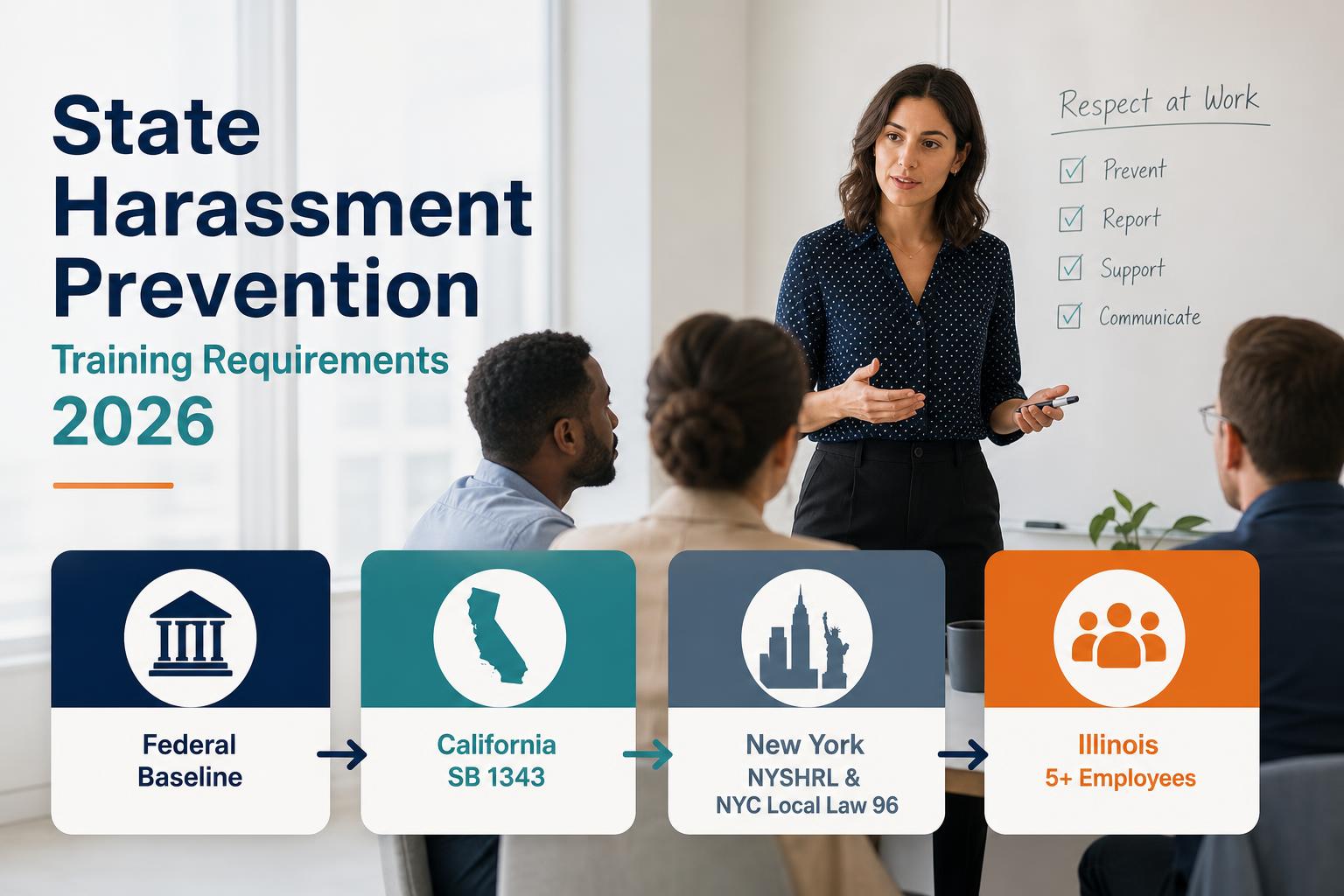
California: SB 1343
California’s SB 1343 (effective 2020) is the most comprehensive state mandate in the US.
Who is covered
All employers with 5 or more employees. This is a very low threshold that catches almost all mid-market companies with any California presence.
What is required
Supervisors must receive 2 hours of sexual harassment prevention training. Non-supervisory employees must receive 1 hour. Training must include content on:
- Definition of sexual harassment under FEHA and Title VII
- Remedies available to victims
- Strategies to prevent harassment
- Practical examples using scenarios
- Abusive conduct prevention (added by AB 2053)
- Harassment based on gender identity, gender expression, and sexual orientation (added by SB 396)
Frequency
Every two years. New employees and new supervisors must be trained within 6 months of hire or promotion into a supervisory role.
Delivery
Classroom, e-learning, or webinar. E-learning must include an opportunity for questions answered by a trainer within 2 business days. The content must be interactive.
Recordkeeping
Employers must maintain records of training for a minimum of 2 years, including the names of trainees, dates, and the training materials used.
New York: NYSHRL and NYC Local Law 96
New York State and New York City both have mandatory training requirements, and they apply simultaneously to NYC employers.
New York State (NYSHRL, effective 2019)
All employers in New York State, regardless of size, must provide annual sexual harassment prevention training to all employees. New hires must be trained “as soon as possible.” The state provides a model training program that employers may use (or must use as a floor — employer programs must be “at least as thorough”).
Required content includes: federal and state laws, types of sexual harassment, remedies, complaint procedures, bystander intervention, and the employer’s specific complaint policy.
New York State does not specify a minimum duration, but in practice most compliant programs run 1—1.5 hours to cover all required content.
New York City (Local Law 96, effective 2019)
NYC employers with 15 or more employees must provide annual training to employees who work more than 80 hours per year in NYC, whether full-time, part-time, or seasonal. Training must be at least one hour for non-supervisory employees and include interactive content. NYC’s Stop Sexual Harassment Act model training may be used.
The 80-hour threshold is important for mid-market employers: it catches part-time and seasonal workers that other state requirements exclude.
Illinois: 5-employee threshold
Illinois’s Workplace Transparency Act (effective 2020) requires annual sexual harassment prevention training for all employers with one or more employees in Illinois. Restaurants and bars have additional requirements under the EACH Act.
What is required
Annual training for all employees covering: definition of sexual harassment under Illinois law, examples of prohibited conduct, the employer’s internal reporting process, legal remedies, and responsibilities of supervisors. The Illinois Department of Human Rights (IDHR) provides a model training program.
Restaurants and bars
The Preventing Sexual Harassment in the Restaurant and Bar Industry Act (EACH Act) imposes additional requirements including specific training on the conduct of bartenders, hosts, and front-of-house staff. If you operate food service in Illinois, verify you’re meeting the sector-specific requirements, not just the general mandate.
Recordkeeping
Employers must maintain training records and produce them to the IDHR upon request. There is no specified minimum retention period in the statute, but employment lawyers typically recommend at least 3 years.
Connecticut: 2-hour supervisor requirement
Connecticut’s sexual harassment training law (effective 2020, amended 2022) applies to all employers with 3 or more employees.
What is required
All supervisors must complete 2 hours of sexual harassment training. For employers with 3 or more employees, all employees must also complete training. New employees must be trained within 6 months of hire. The training must be interactive.
Required content covers: definition and examples of sexual harassment, remedies under state and federal law, the role of supervisors, how to report harassment, and the employer’s specific complaint procedure.
Frequency
Connecticut does not mandate periodic refresher training after initial completion, but the Connecticut CHRO recommends every 3 years. If you are in Connecticut, initial training is a hard requirement; recurring training is currently best practice rather than mandated.
Delaware: interactive training requirement
Delaware’s Discrimination in Employment Act amendments (effective 2019) require sexual harassment training for employers with 50 or more employees in Delaware.
What is required
All employees must receive interactive sexual harassment training within one year of hire. Supervisors must receive additional training on their specific obligations including how to handle complaints, document incidents, and prevent retaliation.
The “interactive” requirement means training must include either live facilitation or mechanisms for employee questions — passive video watching alone does not meet the Delaware standard.
Frequency
Every 2 years for all employees. Delaware does not specify a duration but the content requirements make sub-1-hour training difficult to achieve compliantly.
Maine: new employee timing rule
Maine’s sexual harassment training requirement (effective 1991, updated subsequently) applies to all employers with 15 or more employees in Maine.
What is required
New employees must receive sexual harassment training within one year of hire. The training must cover: the employer’s sexual harassment policy, the complaint procedure, remedies available, and legal protections against retaliation. Supervisors receive additional training on their specific responsibilities.
What makes Maine distinctive
Maine’s 1-year onboarding window is the most generous of the mandate states — most require 6 months or less. However, Maine’s Human Rights Commission has made clear that waiting until month 11 is not considered good faith compliance. For practical purposes, treat the Maine requirement as a 90-day onboarding target.
Washington: HB 1524, effective January 1, 2026
Washington is the most recent addition to this list and the one most likely to catch multi-state employers out, because it is industry-specific rather than headcount-based. Employers who screen state mandates by employee count will miss it entirely.
Who is covered
HB 1524 requires all managers and supervisors at covered employers to complete sexual harassment and assault prevention training. Covered employers include hotel, motel, retail and security guard employers, along with property services contractors. The underlying protections extend to workers such as janitors, security guards, housekeepers and room service attendants who work alone.
Why the isolated-worker framing matters
Washington’s approach came out of protections for employees who work alone, where the risk profile differs from a shared office floor. That framing shapes the content expectation: training aimed at a conventional workplace setting will not obviously address the situations the statute is concerned with. Generic modules are a weaker fit here than in the headcount-threshold states.
Practical implication
If you operate hotels, retail sites, security services or property services in Washington, this applies regardless of how small the Washington footprint is. A national employer with a handful of Washington sites is in scope on the strength of those sites alone.
Other jurisdictions to watch
Beyond the states with broad private-sector mandates, two further categories are worth tracking.
Contractor-specific mandates. Virginia requires training for state contractors rather than for private employers generally. Obligations of this kind arrive through procurement terms rather than employment law, which means they frequently reach the contracts team long before they reach HR.
Recommended but not mandated. Colorado formally recommends training without requiring it. Recommendations of this kind matter more than they appear to: where a state has published an expectation, failing to meet it is unhelpful in litigation even though no statutory penalty attaches.
City-level ordinances add a further layer in several jurisdictions, New York City being the most established example. Screening at state level alone will miss them.
Managing multi-state compliance
For mid-market companies with employees in two or more of these states, the compliance matrix becomes complex quickly. The most practical approach is to build to the most demanding common standard and apply it universally.
The highest-common-denominator approach
California’s requirements (2-hour supervisors, 1-hour employees, biennial, interactive, specific content coverage, new hire within 6 months) are the most demanding across duration, content, and frequency. A program that meets California fully will also meet New York, Illinois, Connecticut, Delaware, and Maine for the standard employee population.
The exception is New York City’s 80-hour threshold for part-time workers — ensure your tracking system identifies all employees who clear that bar, not just full-time headcount.
State-specific policy content
Even using a universal training base, you still need to reference state-specific complaint procedures and remedies in the training. The California, New York, Illinois, and Connecticut model programs each include state-specific legal citations. Your training content must either include state-specific modules for each jurisdiction or use sufficiently general language that doesn’t contradict any state’s requirements.
The most compliant approach: a shared core program with a 10—15 minute state-specific module appended based on the employee’s work location. Most LMS platforms and training authoring tools can handle this with a simple branching structure.
Recordkeeping requirements
All mandate states require employers to maintain training records. The specifics vary:
- California: 2-year minimum retention of names, dates, materials, and qualifying trainer credentials
- New York State: No specified period but the Division of Human Rights recommends 3 years; records must be produced on request
- New York City: Records for the current calendar year plus 3 prior years
- Illinois: No specified period; IDHR can request records
- Connecticut: Training records available to employees on request
- Delaware: No specified minimum retention period
- Maine: No specified minimum retention period
The practical standard: maintain training completion records for all employees for at least 3 years, including completion date, training title and version, employee name and role, and the employee’s state of work. Completion records should be exportable from your LMS by state on demand — regulators give short notice windows when requesting records.
Common compliance gaps mid-market HR teams miss
The part-time and seasonal worker gap
New York City’s 80-hour annual threshold, California’s 5-employee threshold, and New York State’s “all employers regardless of size” rule all capture workers that standard LMS completion tracking often misses. If your training completion reports are filtered to full-time employees, you likely have a gap.
The new supervisor gap
Most states require supervisors to receive additional or longer training. A common gap is employees who are promoted to supervisory roles mid-cycle: they have their “all employee” completion on record but have never completed the supervisor-specific content. Build a promotion trigger in your HR system that automatically enrolls newly promoted supervisors.
The content currency gap
California added gender identity and gender expression requirements in 2018. New York State updated its model program in 2023. Illinois updated its model in 2022. If your training content was last reviewed in 2019, it may not meet current content standards even if completion records show 100% compliance. Review training content annually against current state model programs.
The remote worker location gap
Where an employee works — not where your company is headquartered — determines which state’s requirements apply. A remote employee hired in Illinois who has never set foot in New York is subject to Illinois law, not your HQ state. If your HR system tracks employee location by office assignment rather than actual work location, you may be applying the wrong state’s requirements.
The attestation gap
LMS completion records show that an employee opened and completed a course. They don’t always capture that the employee understood the content, received specific information about your internal complaint procedure, or acknowledged your harassment policy. California specifically requires that employees receive a copy of the employer’s harassment prevention policy. Build a policy acknowledgment step into your completion workflow.
Sources and further reading
- California DFEH, Sexual Harassment and Abusive Conduct Prevention Training — official SB 1343 guidance and model training content (dfeh.ca.gov)
- New York State Division of Human Rights, Sexual Harassment Prevention Training Model — current model program and FAQs (dhr.ny.gov)
- Illinois IDHR, Sexual Harassment Prevention Training Requirements — model training and EACH Act guidance (illinois.gov/agencies/idhr)