Last updated: 31 March 2026
Why Most AI Training Programmes Are Flying Blind
Ask most HR directors how their organisation is approaching AI skills development and you’ll get one of two answers. Either they’re running an all-staff AI awareness course — usually a generic e-learning module that covers what large language models are and why hallucinations happen — or they’re leaving it entirely to departments to figure out on their own. Neither approach holds up.
The all-staff e-learning approach treats a software analyst, a clinical nurse, a customer service agent, and a finance director as if they have the same AI skills needs. They don’t. The requirements for a frontline admin worker who uses an AI drafting assistant to handle routine correspondence are fundamentally different from those of a procurement manager whose team is evaluating AI contract analysis tools, or a chief technology officer who is accountable for the organisation’s AI governance policy. Training them on the same content at the same depth is wasteful at best and produces a false sense of compliance at worst.
The departmental self-determination approach produces the opposite problem: inconsistency. Some teams develop genuine AI capability while others remain effectively AI-illiterate. Regulatory risk becomes unmanageable because there is no central view of what AI tools are in use, who has been trained on them, or whether that training was adequate.
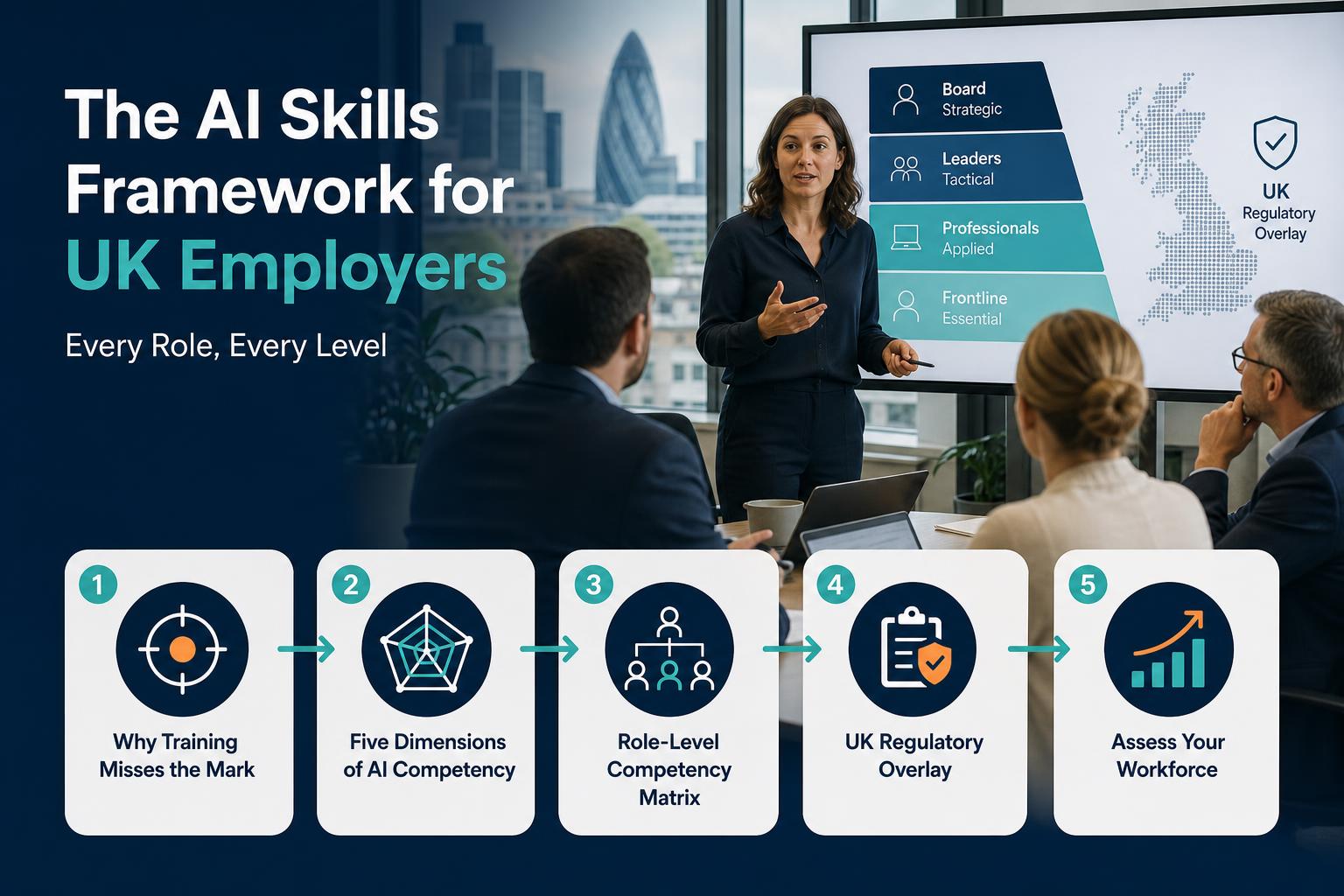
What both approaches lack is a framework: a structured, role-calibrated view of what AI competency actually means at each level of the organisation, what training achieves each level of competency, and how to assess where each employee currently sits against it. This article provides that framework. It is designed to be practical — something an HR or L&D team can use immediately to audit their current position, prioritise their gaps, and build a coherent training programme — not a theoretical model requiring months of internal validation before anything gets done.
Research published by the Department for Education in 2025 found that only 23% of UK employers had a formal plan for AI skills development. McKinsey’s 2025 State of AI report found that fewer than 30% of organisations using generative AI had assessed whether employees using those tools had the skills to use them safely. The gap between AI tool adoption and AI skills investment is widening — and regulatory frameworks are beginning to close it by force.
The Five Dimensions of AI Competency
Before mapping skills to roles, it is necessary to define what “AI competency” actually means. There are five distinct dimensions, each of which manifests differently depending on role level. Understanding these dimensions — and recognising that they are not interchangeable — is the conceptual foundation of the framework.
AI Literacy
Understanding what AI systems are, how they work at a conceptual level, what they can and cannot do reliably, and what their characteristic failure modes are. This is the foundational layer that all other dimensions build on. Without it, employees cannot exercise appropriate judgment about AI outputs or escalate concerns intelligently.
AI Tool Use
The practical ability to use AI tools relevant to your role — with appropriate prompting technique, sensitivity to output quality, and judgment about when to use AI assistance versus when to work independently. This is role-specific: what counts as proficient AI tool use for a content writer is entirely different from what it means for a data analyst or a warehouse supervisor.
AI Governance
Understanding the legal, ethical, and organisational policy obligations that govern AI use. This includes UK GDPR and automated decision-making constraints, EU AI Act Article 4 obligations where applicable, Equality Act considerations around algorithmic bias, and your organisation’s own AI use policy. Governance competency is often the most neglected dimension in employer training programmes.
Data Literacy
The ability to critically evaluate AI outputs — understanding that AI systems reflect the data they were trained on, that output confidence does not equal accuracy, and that the quality of an AI-generated output depends on the quality of the inputs. Data literacy prevents blind trust in AI systems and is the practical safeguard against the most common AI errors in the workplace.
AI Collaboration
Working effectively alongside AI systems and in teams where some outputs are AI-generated. This includes knowing when to delegate to an AI tool versus when to complete work independently, how to combine AI-generated and human-generated work without quality loss, and how to maintain accountability for outputs in a mixed human–AI workflow. As AI becomes embedded in more team processes, this dimension becomes increasingly critical.
These five dimensions interact but are not substitutable. An employee can have strong AI tool use skills and poor AI governance awareness — a common and dangerous combination. A senior leader can have sophisticated AI governance understanding but almost no practical AI tool use experience, leaving them unable to evaluate what their teams are actually doing. The framework addresses each dimension at each role level, rather than treating “AI competency” as a single spectrum from novice to expert.
Role-Level Competency Matrix
The following matrix maps all five competency dimensions across four role levels: frontline and operational staff, functional specialists, managers and team leads, and senior leaders and executives. For each cell, the description reflects what the competency looks like in practice at that level — not an abstract definition, but observable workplace behaviours and training outcomes.
| Dimension | Frontline / Operational | Functional Specialist | Manager / Team Lead | Senior Leader / Executive |
|---|---|---|---|---|
| AI Literacy |
|
|
|
|
| AI Tool Use |
|
|
|
|
| AI Governance |
|
|
|
|
| Data Literacy |
|
|
|
|
| AI Collaboration |
|
|
|
|
Table 1: AI Skills Competency Matrix — five dimensions across four role levels. Training route suggestions are indicative; actual requirements depend on role, sector, and AI systems in use. © Training Intelligence (TIQ) Ltd 2026.
The UK Regulatory Overlay
The competency framework above is a practical governance aid, not a statement that every employer has the same legal training duty. The rules that apply depend on matters such as where the organisation and affected people are located, whether personal data is processed, the purpose and risk of the AI system, and the sector in which it is used. Map those facts first and take legal or data-protection advice where the answer is material or unclear.
EU AI Act Article 4 — AI Literacy Obligation
Article 4 of the EU AI Act has applied since 2 February 2025. Providers and deployers within the Act’s territorial scope must take measures, to their best extent, to ensure a sufficient level of AI literacy among relevant staff and other people dealing with AI systems on their behalf. A UK organisation is not automatically in scope merely because it uses AI: test the territorial rules in Article 2, including whether systems or outputs are placed or used in the EU. The European Commission says the approach is flexible and proportionate and that Article 4 does not prescribe a course, certificate, governance structure or documentation format. An AI inventory, role-based needs assessment, learning records and review cycle are useful ways to manage and evidence the work, but they are practical controls rather than a mandated template. National enforcement of Article 4 begins on 2 August 2026.
UK Data Protection Law — Automated Decision-Making
The Data (Use and Access) Act 2025 changed the UK rules for significant decisions made solely by automated processing, and all of its data-protection provisions are now in force. The rules distinguish a solely automated decision — one with no meaningful human involvement — from genuine decision support. Appropriate safeguards can include telling the person about the decision, enabling representations, human intervention and challenge, while special-category data remains more restricted. Employers using AI in recruitment, performance management or other significant decisions should check the current ICO guidance, identify a lawful basis and complete a DPIA where required. Role-based training can help people provide meaningful oversight; it does not by itself make the processing lawful.
Equality Act 2010 — Algorithmic Bias
The Equality Act 2010 applies when an employer or service provider uses an AI system; technology does not remove duties concerning direct and indirect discrimination. Historical or unrepresentative data can create discriminatory outcomes in recruitment, pay, promotion and access to services even without deliberate intent. Training relevant specialists and managers to recognise, test and escalate bias is a sensible risk control. The Act does not, however, create a universal prescribed AI-training course or duration, so combine learning with appropriate testing, human oversight, impact assessment and governance.
Skills England — Digital and AI Skills Priorities
England has several distinct skills programmes, but they should not be blended into a generic promise of funded AI training. The approved Growth and Skills Levy products are apprenticeships, foundation apprenticeships and the specific apprenticeship units listed by Skills England. Skills Bootcamps and the adult digital entitlement have separate eligibility, commissioning and availability rules. AI Skills Boost also points adults towards free partner learning. Check the exact learner, employer, product and start-date rules before treating any route as funded.
Map each system and use case to the laws that actually apply, then choose proportionate controls. Role-calibrated learning, an inventory, needs assessment and completion records can support governance and due diligence, but they do not replace lawful processing, risk assessment, technical controls, meaningful human oversight or sector-specific requirements.
How to Assess Your Workforce Against the Framework
A framework is only useful if it connects to a practical assessment process. There are four approaches to assessing your workforce against the AI skills framework described above, each with different coverage, depth, and resource requirements. Most organisations will want to combine at least two.
Self-Assessment Survey
A structured self-assessment survey is the fastest way to get broad baseline coverage across a large workforce. The survey should be organised around the five competency dimensions, with four to six questions per dimension calibrated to the role level of the respondent. For each dimension, questions should ask employees to rate their current confidence on a simple scale (typically 1–5), describe their current actual use of AI tools, and identify specific areas where they feel under-equipped. Confidence ratings are imperfect — the Dunning–Kruger effect means that the most overconfident respondents are often those with the largest actual gaps — so the survey should always include behavioural anchors (“I regularly check AI-generated outputs for factual errors before sharing them” is more useful than “I am confident in my data literacy”). Run the survey with role-level segmentation built in so that you can immediately see where the gaps concentrate.
Manager Observation Indicators
Manager observation provides the behavioural evidence that self-assessment cannot. A simple observation checklist — built around the role-level competency descriptors in the matrix above — gives line managers a structured language for what good AI-competent practice looks like in their team. Indicators might include: does the employee check AI outputs before using them? Do they ask appropriate questions when AI recommendations seem unexpected? Do they disclose AI assistance in line with team policy? Do they use AI tools for appropriate tasks without being prompted? A light-touch version of this checklist can be integrated into the existing supervision or performance review cycle without requiring a separate AI assessment process.
Skills Audit in the Performance Review Cycle
A formal AI skills audit can create a useful documented evidence base. Choose the cadence according to risk and change: an annual review may suit stable use cases, while a new system, role or material incident should trigger an earlier review. Combine self-assessment data, manager observation and a structured development discussion. The output can be a simple profile showing the current level on each dimension, an agreed target and the learning pathway. Where Article 4 applies, these records may help demonstrate the measures taken, although the legislation does not prescribe an annual audit or a particular evidence format.
Using AI Tools to Benchmark — Carefully
There is an irony in using AI to assess AI skills, and it is worth being explicit about the limitations. AI-powered assessment platforms can process self-assessment and behavioural data quickly, identify patterns and generate individual or team-level gap analyses. They also inherit the quality limits of their inputs and may introduce privacy, monitoring, fairness and transparency risks. Use them to generate hypotheses about gaps, then use proportionate human review to validate, document and act on the findings. Complete the appropriate data-protection and employment-law checks before analysing worker data.
Mapping the Framework to UK-Funded Training Routes
One of the practical advantages of a structured AI skills framework is that it makes it straightforward to identify which gaps can be closed through UK government-funded training routes — significantly reducing the net cost of closing them. The following mapping covers the four main levels of the framework.
Foundation: AI Literacy for All Staff
Frontline AI literacy can be delivered internally or through external provision. Free courses are available through AI Skills Boost partners, but employers still need to add their own approved systems, data boundaries, human-review rules and escalation routes. The adult digital entitlement and Skills Bootcamps are separate programmes with their own eligibility and availability; neither should be described as an automatic AI literacy route. Article 4 does not require an accredited course or certificate.
Practitioner Level: Functional Specialists
The functional specialist level may be served by a locally commissioned Skills Bootcamp where the curriculum, learner and employer rules fit. Skills Bootcamps last up to 16 weeks. For an existing employee, the published employer contribution is normally 10% for an organisation with 1–249 employees and 30% for one with 250 or more. Availability and content vary by area and contract.
Do not treat “Growth and Skills Levy short course” as a generic funding category. The live apprenticeship-unit catalogue contains exact approved products. The current AI units are specifically for qualifying employed leaders, while engineering and construction units have different occupational purposes. Match the person to the product page before discussing funding.
Specialist Level: The Level 4 AI and Automation Practitioner Apprenticeship
For a genuine occupational role focused on improving work through AI and automation, check the Level 4 AI and Automation Practitioner apprenticeship. Skills England lists ST1512 version 2.1 with a typical duration of 18 months, 420 minimum compliance hours and maximum funding of £18,000. Version 2.1 applies to starts from 22 May 2026 and uses a revised assessment plan: a project is mandatory and the assessment organisation selects any additional method needed from the published list. Apprentices may be assessed at an appropriate point during the programme. Confirm the assessment specification and funding route before enrolment.
Leadership Level: April 2026 AI Apprenticeship Units
The approved AI leadership products are three standalone Level 5 apprenticeship units: AU0009 for strategy and opportunity, AU0010 for adoption, procurement and governance, and AU0011 for delivery and organisational transformation. Each requires at least 30 eligible live delivery hours and has maximum funding of £750. They are for employed learners aged 19 or over in qualifying leadership roles; they are not automatically added to an Operations Manager or Senior Leader apprenticeship and are not a zero-cost entitlement.
Map each gap to a job task and learner before checking whether an approved route fits. Public funding should follow a valid occupational or programme need; it should not determine the curriculum. Record which gaps require internal or commercial training because no eligible funded product matches them.
A Practical 30-Day Quick-Start for HR and L&D Teams
The full AI skills framework described in this article is substantial. For HR and L&D teams who need to make immediate progress rather than spending three months on programme design, the following 30-day quick-start provides the minimum viable version of the framework — enough to establish a baseline, identify the highest-priority gaps, and begin closing them through funded training routes.
Days 1–10: Prioritise
- Map your AI tools inventory — which tools are in use, in which functions, by whom
- Identify the three role groups with the highest AI exposure and risk
- Run a 15-question self-assessment survey with those three groups using the five-dimension framework
- Brief line managers in those groups on the observation indicators relevant to their team
- Map each gap to an exact route: a locally available Skills Bootcamp, an approved apprenticeship unit where the learner fits, ST1512 for a genuine AI and automation occupation, or commercial/internal training
Days 11–20: Pilot
- Design or commission the minimum viable training for the highest-priority gap in each of the three target groups
- Confirm funding routes and employer co-investment figures before committing to provision
- Deliver foundation AI literacy and AI governance training to the highest-risk frontline group — keep it short (2–3 hours), role-specific, and assessment-backed
- Document the needs assessment, training rationale and completion data in your internal AI literacy and governance record where appropriate
Days 21–30: Measure
- Run a post-training confidence check using the same survey instrument — confidence gains indicate knowledge transfer but are not sufficient on their own
- Ask line managers to observe three to five specific AI-related behaviours over the following two weeks using the observation checklist
- Identify the next two gap-priority groups and begin the prioritise–pilot cycle again
- Schedule the formal skills audit for the next performance review cycle and brief HR business partners on the process
- Set a 90-day review date to evaluate whether the pilot training is producing observable behaviour change
The 30-day quick-start is not a substitute for the full framework — it is the first sprint in a rolling programme. The key discipline is the 30-day rhythm: each cycle should produce documented evidence of the needs assessment, the training delivered, and the initial outcomes. After three cycles, you will have coverage of your highest-risk role groups and a documented evidence base that stands up to regulatory scrutiny. After six months, you will have the data to build a credible multi-year AI skills roadmap aligned to the organisation’s AI strategy.
Frequently asked questions
What is an AI skills framework for employers?
An AI skills framework defines the AI-related competencies that employees need at each role level — from frontline staff to board members — and maps those competencies to training pathways that close identified gaps. A well-designed employer AI skills framework covers five dimensions: AI literacy (understanding AI concepts, capabilities and limitations), AI tool use (applying relevant AI tools with appropriate judgment), AI governance (legal, ethical and policy obligations), data literacy (interpreting AI outputs critically), and AI collaboration (working effectively alongside AI systems). The framework is not a certification scheme; it is a practical management tool for HR and L&D teams to prioritise, plan and evidence AI capability development.
Does the EU AI Act require UK employers to have an AI skills framework?
No. Article 4 does not prescribe a named framework, course, certificate or documentation format. It applies only where the organisation is a provider or deployer within the AI Act's territorial scope. A role-based framework can be a useful voluntary way to plan proportionate measures, but EU customers, employees or personal-data processing do not by themselves settle territorial scope.
How do you assess your workforce against an AI skills framework?
Combine a short self-assessment with observed tasks, system-specific scenarios and manager evidence where proportionate. Reassess after material changes to systems, roles, risk or policy; there is no universal annual legal interval. Treat confidence scores as one input rather than proof of competence.
What UK-funded training routes can close AI skills gaps identified by the framework?
Options include free AI Skills Boost partner courses, a locally commissioned Skills Bootcamp where its content and entry rules fit, and an apprenticeship for a genuine occupational training need. ST1512 version 2.1 is the current Level 4 AI and Automation Practitioner standard. AU0009, AU0010 and AU0011 are separate Level 5 units for qualifying employed leaders aged 19 or over, not general staff courses or components added to another apprenticeship. Funding depends on the exact product and start-date rules.
Sources & further reading
- EU AI Act (Regulation (EU) 2024/1689), Article 4: AI literacy obligation — eur-lex.europa.eu
- ICO: Guidance on AI and automated decision-making under UK GDPR — ico.org.uk
- ICO: Data (Use and Access) Act 2025 changes to data protection — ico.org.uk
- European Commission: AI literacy questions and answers — digital-strategy.ec.europa.eu
- GOV.UK: AI Skills Boost explainer — gov.uk
- Skills England: AI and Automation Practitioner (ST1512) — skillsengland.education.gov.uk
- GOV.UK: Growth and Skills Levy employer guidance — find-employer-schemes.education.gov.uk