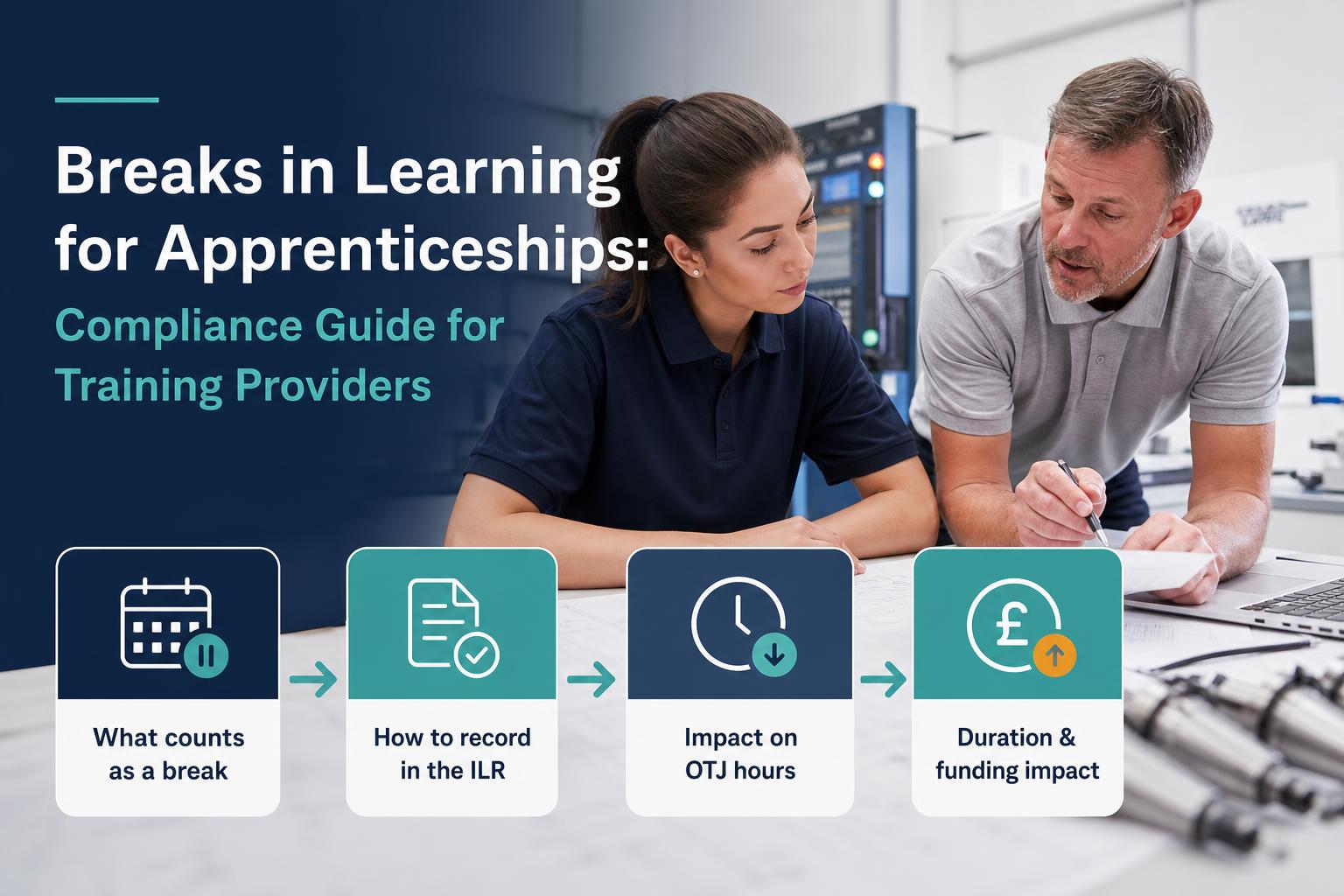
A break in learning is a controlled pause, not an informal “inactive” status. The provider must decide whether the rules require a break, record it promptly, stop drawing funding during the pause and keep a credible route back to the same apprenticeship.
Provider-led and apprentice-led breaks
A provider-led break is driven by the delivery pattern and the active-learning rules. An apprentice-led break can be requested where the person plans to return to the same programme later. The reason and expected duration should be discussed with the employer; examples in the rules include medical treatment, parental leave and other personal reasons.
An apprentice-led break may occur with or without a break in employment. Record the reason, expected duration, last evidenced learning activity, planned contact arrangements and proposed return checks. Do not promise an open-ended funding position: monitor whether the apprentice still intends and is able to return.
When a provider-led break is required
The trigger depends on the documented delivery model:
- Front-loaded or block release: where that model is agreed with the employer and recorded in the training plan, use a break when no off-the-job active learning is planned within a three-calendar-month period.
- All other models: use a break when no off-the-job active learning is planned within a calendar month.
For an ordinary delivery model, if learning was planned but does not occur in one month, a retrospective break is not needed if eligible active learning takes place in the following month. If there is none for two consecutive calendar months, record a retrospective break and re-plan all missed activity.
English or maths activity alone does not avoid this trigger. The rules refer specifically to active learning for the occupational apprenticeship.
When not to record a break
Do not use a break for annual leave, public holidays or a short absence where the apprentice can continue off-the-job active learning. A term-time-only apprentice does not require a break solely for August under the stated exception.
Do not use the general break route simply because employment or the apprenticeship agreement ended. Use the specific employer-change, redundancy or withdrawal rules. The correct treatment affects both funding and the time allowed to find a new employer.
ILR records and funding during the break
Use the last date of evidenced learning before the break as the learning actual end date and record the break in the ILR promptly. Use the current ILR specification rather than copying a code from an older article or MIS screenshot.
Payments from the employer's apprenticeship service account and government-employer co-investment stop while the apprentice is on a break. Certain additional, hiring or care-leaver payments can be delayed until the learner returns and reaches the applicable cumulative days in learning.
If no qualifying delivery is taking place and a break is required, delaying the ILR update can create an overpayment and recovery risk.
Return-to-learning checklist
When the apprentice returns to the same apprenticeship:
- confirm the apprentice, employer and provider still agree that the programme is suitable;
- record the restart in the ILR using the current-year guidance;
- revise the apprenticeship agreement and training plan for the duration of the break;
- make the separate episodes of learning clear;
- review prior progress and the remaining occupational content;
- re-plan any missed training and assessment;
- confirm employer release time and revised review dates; and
- retain the original plan and all signed versions in the evidence pack.
The apprentice returns to the funding rules that applied before the break. The overall apprenticeship duration and required off-the-job volume can remain the same as if there had been no break; the break does not automatically create a new 20% calculation. The elapsed calendar end date may move while the required active programme remains properly evidenced.
Minimum duration and standard-specific hours
For a new start from 1 August 2026, the apprenticeship practical period must last at least eight months after prior learning is taken into account, and the exact standard or assessment plan may require longer. The learner must also receive the applicable standard-specific minimum off-the-job volume, adjusted only under valid prior-learning rules.
Across multiple episodes of the same apprenticeship, evidence the total time spent and the eligible hours delivered. Do not convert the break itself into active learning time.
When employment ends or changes
A change of employer has its own rules. For starts governed by the 2026/27 rules, an apprentice may continue funded activity for up to 30 days after employment ends while seeking a new employer. If no restart has occurred after four weeks, the provider records a break. If the learner has not restarted within the next eight weeks—a total of 12 weeks from employment ending—the provider must withdraw the apprentice.
Redundancy has separate exceptions and support periods. Check the exact rule before coding the record, particularly where only a short portion of the programme remains.
Provider control checklist
- The learner's original funding year and standard version are recorded.
- The delivery model and active-learning cadence match the signed training plan.
- The last evidenced learning date supports the ILR entry.
- The reason, expected duration and return plan are documented.
- Account payments are paused during the break.
- The apprentice and employer receive scheduled welfare and return contacts.
- The revised agreement, training plan and ILR agree on return.
- Remaining content and assessment are re-planned without double funding.
- Employer-change and redundancy cases use their specific rules.
Because the ILR specification and funding rules can change by year, use this workflow as a control framework and verify the final coding against the official documents for the learner's start date.
Frequently asked questions
When must a provider record a break in learning?
For starts governed by the 2026/27 rules, a break is required when no off-the-job active learning is planned within a calendar month for ordinary delivery models, or within three calendar months for an agreed front-loaded or block-release model. The rules include limited exceptions and a retrospective rule where planned learning does not occur.
Does a returning apprentice need a new OTJ calculation?
A break does not automatically create a new percentage calculation. On return to the same apprenticeship, the overall duration and required off-the-job volume can remain as though there had been no break. Re-plan remaining training where needed and continue to use the rules and standard version that applied before the break.
What documents change when an apprentice returns?
Record the break and restart in the ILR, revise the apprenticeship agreement and training plan to reflect the break, make the multiple episodes of learning clear, and re-plan remaining training or assessment where required. Use the current ILR specification for the exact field and code treatment.
Can a break in learning be used after employment ends?
Not as a general substitute for the change-of-employer, redundancy or withdrawal rules. For a qualifying employer change, the 2026/27 rules use a specific timeline: after four weeks without a new employer the provider records a break, and if the apprentice has not restarted within the following eight weeks the provider must withdraw them.
Sources & further reading
- Apprenticeship funding rules 2026 to 2027 — GOV.UK — Apprenticeship funding rules 2026 to 2027 — GOV.UK
- Funding rules by apprenticeship start year — GOV.UK — Funding rules by apprenticeship start year — GOV.UK
- Submit learner data guidance and current ILR resources — GOV.UK — Submit learner data guidance and current ILR resources — GOV.UK