Last updated: 7 March 2026
ILR outcome and withdrawal codes: a reference guide for training providers
Getting ILR completion status, outcome, and withdrawal reason codes right is not a minor administrative detail — it directly affects funding reconciliation, ESFA audit outcomes, and the accuracy of your provider data dashboard. Wrong codes lead to overpayments that must be repaid, misleading performance data, and audit findings that consume staff time to resolve. This guide explains each code category, when to use each code, and the most common errors seen in provider data.
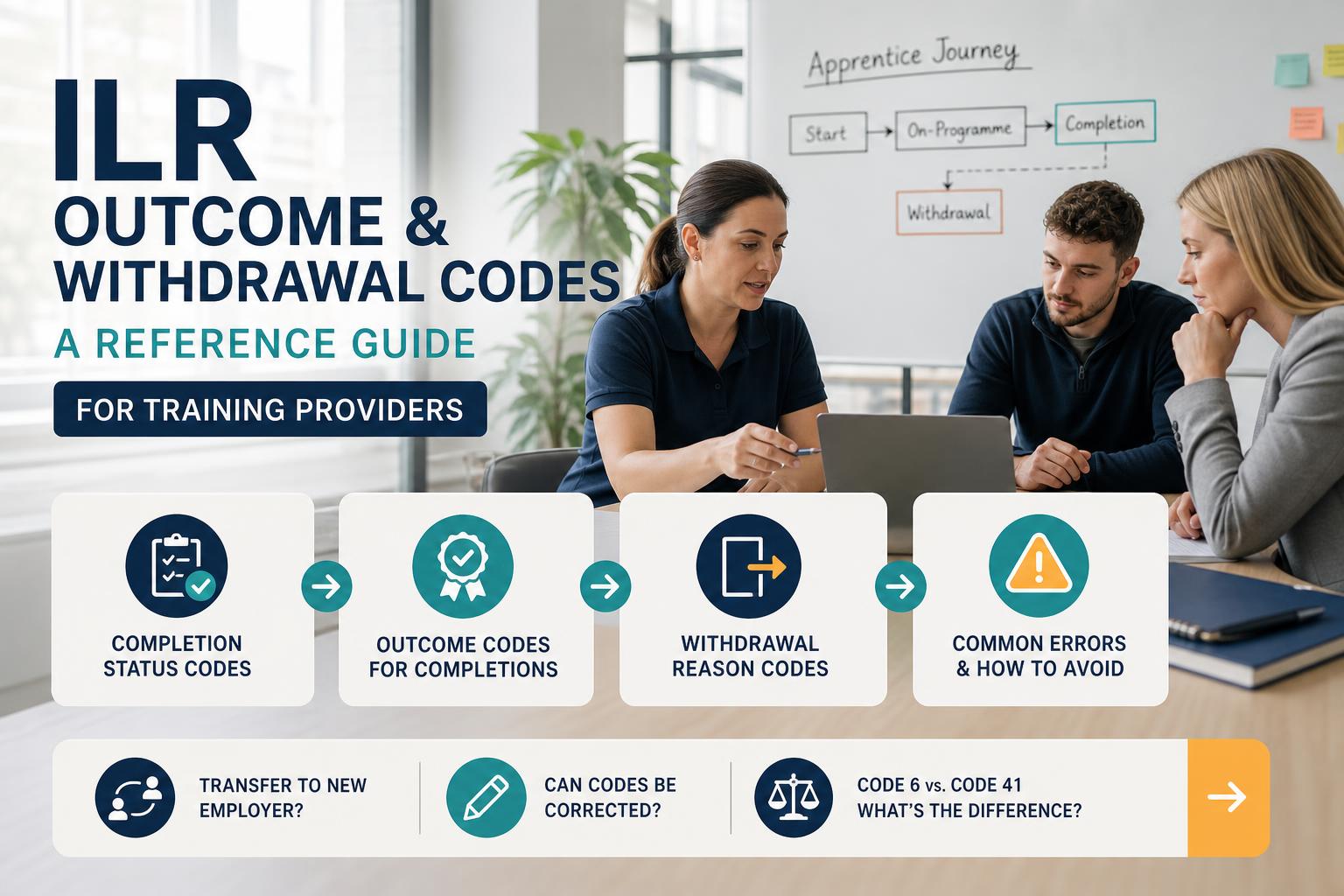
Why outcome codes matter
Every learner record in the Individualised Learner Record carries a set of codes that describe what happened at the end of their programme: whether they completed, withdrew, or are still in learning; whether they achieved the qualification; and if they withdrew, why. These codes are not just internal labels — they are the basis on which ESFA calculates your funding reconciliation, benchmarks your performance data, and determines whether payments made during the programme were legitimate.
During an ESFA financial audit or a data deep-dive, one of the first things auditors check is whether completion status and outcome codes are consistent with the supporting evidence in the learner's file. A learner recorded as having completed with achievement, but with no evidence of EPA results or qualification certificates on file, is a red flag. Equally, a learner recorded as withdrawn with code 40 (other) when the file clearly shows redundancy should have been coded 6 is an indication of poor MIS discipline that can escalate to a wider review.
Accurate coding also feeds your own management information. If your MIS reports show an unusually high rate of "other" withdrawals, it is often because staff are defaulting to a catch-all code rather than selecting the correct one — which obscures the real picture of why learners are leaving and makes it harder to intervene effectively.
Completion status codes
The completion status field describes the current or final state of the learning aim. There are four values in active use for apprenticeships:
Code 1 — Continuing. The learner is still on programme and the learning aim is active. This is the code for all learners who have not yet reached their planned end date and have not withdrawn or taken a formal break. It should not appear on records that have clearly reached or passed their planned end date without being updated.
Code 2 — Completed. The learner has reached the end of their planned programme. Completion does not automatically mean the learner passed the end-point assessment — it means the training delivery phase has concluded. The outcome code (see below) tells you what happened at EPA. Code 2 should be set when the learner finishes their programme, regardless of EPA outcome.
Code 3 — Withdrawn. The learner has left the programme before completing it and will not return. This is the code to use for any early departure — redundancy, personal circumstances, employer closure, or any other reason. The withdrawal reason code (a separate field) then explains why. Code 3 must be accompanied by an actual end date set to the last day of active learning.
Code 6 — Temporarily withdrawn (break in learning). The learner has paused their programme and is expected to return. Code 6 is not a withdrawal — it is a temporary status. It should only be used when there is a genuine, agreed plan for the learner to return. Using code 6 as a holding status for learners who have effectively left is a common compliance error. If there is no confirmed return plan, use code 3.
Outcome codes for completions
Where completion status is 2 (completed), an outcome code must be recorded. This field records what was achieved by the end of the programme:
Code 1 — Achieved. The learner completed the programme and achieved the apprenticeship standard — that is, they passed the end-point assessment. This is the code to use for learners who have successfully completed all components and received their apprenticeship certificate. EPA results evidence should be on file.
Code 2 — Partial achievement. The learner completed some elements of the programme but did not achieve the full apprenticeship standard. This might apply where, for example, a learner passed some EPA components but not others, or achieved a component qualification but not the overall standard. It is relatively uncommon in well-managed programmes — if you see a high rate of code 2, it is worth reviewing whether EPA preparation is adequate or whether the code is being used as a default for situations that should be a withdrawal.
Code 3 — No achievement. The learner completed the planned programme duration but did not achieve the apprenticeship standard — for example, they failed the end-point assessment and did not resit within the programme window. Code 3 is distinct from a withdrawal: the learner reached the end of the programme, they simply did not pass. Ensure that the EPA attempt and result evidence is retained on file.
Withdrawal reason codes
When completion status is 3 (withdrawn), a withdrawal reason code is required. The table below sets out the most frequently used codes for apprenticeship programmes. Always verify against the current year's ESFA ILR specification, as codes are occasionally revised between academic years.
| Code | Description | When to use |
|---|---|---|
| 2 | Learner moved to a different provider | The learner is continuing their apprenticeship with a different training provider. Use this where the apprenticeship itself continues — only the provider relationship ends. The learner's record at your organisation is withdrawn; the new provider opens a new record. |
| 3 | Learner left the UK | The learner has permanently or indefinitely relocated outside the UK and cannot continue the programme. Evidence of relocation should be retained on file. |
| 5 | Learner not able to continue — learner circumstances | The learner is unable to continue due to personal health, disability, or other circumstances that are not employment-related. This covers long-term illness that ends the programme, not a temporary break. If a return is planned, use code 6 (break in learning) instead. |
| 6 | Made redundant | The learner has been made redundant and there is no confirmed plan to continue the apprenticeship with a new employer. If a new employer is in the process of being found and the learner will return, a break in learning (completion status 6) may be more appropriate while the transfer is arranged. |
| 7 | Other employment reasons | The learner has left the programme for employment-related reasons that are not redundancy. Examples include voluntary resignation, employer closing the apprenticeship programme for business reasons unrelated to redundancy, or the employer-learner relationship breaking down. |
| 10 | Gone into employment | Used in non-apprenticeship contexts where a learner leaves a programme because they have secured employment. For apprenticeships this code is rarely the primary reason — use more specific codes where available. |
| 28 | Apprenticeship standard not appropriate | The standard does not match the learner's job role, or it becomes apparent after enrolment that the standard is not an appropriate fit for the employer's requirements. This code should prompt a review of initial assessment and enrolment processes if it appears with any frequency. |
| 29 | Transfer to a different employer | The learner is moving to a new employer and will continue the apprenticeship, but with a different employer. This is different from code 2 (change of provider) — here the provider may remain the same but the employer changes. Ensure a Transfer of Apprenticeship process is followed and the new employer agreement is in place. |
| 40 | Other | Use only when no other code applies. This should be a genuinely residual category. If your data shows a high proportion of code 40 withdrawals, it is a sign that more specific codes are not being consistently applied. Staff training and MIS prompts can reduce inappropriate use of this code. |
| 41 | Break in learning | Note: in some ILR specification versions, break in learning is captured via completion status 6 rather than withdrawal reason code 41. Always refer to the current year's ESFA ILR specification to confirm which field and code to use for the academic year in question. Do not use this as a substitute for a proper break in learning record. |
Common errors and how to avoid them
Using the wrong code for transfer versus withdrawal. One of the most frequent errors is applying a withdrawal code when a learner transfer is in progress. When a learner moves to a new employer and will continue the apprenticeship, this is not a withdrawal — it is a transfer. The correct approach is to follow the Transfer of Apprenticeship process: the current record is closed with the appropriate transfer code, and a new record is opened. Treating a transfer as a withdrawal means the learner's record shows an early departure from the programme, which affects both your performance data and the learner's evidence trail.
The reverse error also occurs: a learner who has genuinely left — redundant with no new employer confirmed — is recorded as a transfer because it feels more optimistic. If there is no confirmed new employer and no active transfer process in place, the record should be withdrawn.
Using the break in learning code for redundancy. Completion status 6 (break in learning) is intended for temporary pauses with a confirmed return plan. It is sometimes used for learners who have been made redundant, on the basis that the provider hopes to find them a new employer. Using a break in learning status to avoid recording a withdrawal is a compliance risk. If redundancy has occurred and there is no confirmed new employer, the withdrawal process should be followed. A break in learning may be appropriate for a short defined period while an employer transfer is actively being arranged, but it should not be used indefinitely.
Leaving records on code 1 (continuing) past the planned end date. Records that are not updated when a learner completes or withdraws remain on status 1 (continuing), which means funding continues to be drawn. This is an overpayment risk. Providers should run regular data quality checks — at least monthly, and before each ILR submission — to identify records where the planned end date has passed but the status has not been updated.
Defaulting to code 40 (other). Staff under time pressure often select "other" rather than working through the code list. This is understandable but creates data quality problems that compound over time. Implementing MIS prompts or a short decision guide for staff completing withdrawals can significantly reduce inappropriate use of code 40.
When to update codes and the ILR submission window
Codes should be updated in the ILR as soon as the relevant event occurs — not held until the next submission window. Your MIS will hold the updated record and it will flow through in the next ILR return to ESFA. The practical rule is: when a learner completes, withdraws, or begins a break in learning, update their record on the same day or within the same week. Delaying updates increases the risk of funding being drawn for periods where no delivery is taking place, and creates discrepancies between your internal records and the ILR submission.
ESFA's ILR submission calendar sets out the dates by which data must be submitted for each return period. For funding reconciliation purposes, the most critical returns are R06 (February), R10 (June), and the final R14 (October) close. Errors identified before the final return for an academic year can be corrected in-year. Errors that carry into the following year require formal corrections and may trigger claw-back calculations.
When corrections are needed — because a code was entered incorrectly, or because circumstances have changed — update the record in your MIS and ensure the correction is included in your next ILR submission. Document the reason for the change in the learner's file. If the correction affects funding already claimed, you may need to make a voluntary disclosure to ESFA rather than waiting for the discrepancy to surface in an audit.
Frequently asked questions
What is the difference between withdrawal code 6 (made redundant) and code 41 (break in learning)?
Code 6 (made redundant) is a withdrawal code — it closes the learner's record and ends funding. It is used when the learner loses their job and there is no confirmed plan to continue the apprenticeship. Code 41 (break in learning) — or completion status 6, depending on the ILR specification version — is used when the learner temporarily pauses their programme with a realistic plan to return, such as during a planned period of redundancy followed by a new employer being identified. The critical distinction is whether the learner has a confirmed return path. If no return is planned or confirmed, use the withdrawal route and apply code 6.
Can ILR outcome and withdrawal codes be corrected after submission?
Yes. Codes can be corrected in the next ILR submission window. Providers should identify and correct errors as soon as they are discovered — typically through internal data audits or when preparing for ESFA data returns. Corrections to completion status, outcome, or withdrawal reason codes should be accompanied by a note in the learner's file explaining the reason for the change. ESFA may request evidence to support corrections during an audit, so documentation is important. Persistent or systematic coding errors may trigger a financial audit.
Which code should I use when an apprentice transfers to a new employer mid-programme?
A transfer to a new employer while continuing the same apprenticeship is not a withdrawal. The learner's record at the original employer should be closed with the appropriate transfer outcome, and a new learning aim record opened at the new employer. If the apprentice has left one employer with no new employer confirmed, use completion status 3 (withdrawn) and withdrawal reason code 29 (transfer to different employer) if a transfer is being actively arranged, or code 40 (other) if the situation does not fit another code. Always refer to the current year's ESFA ILR specification for the definitive code list, as codes and their definitions are reviewed annually.
Sources
Sources & further reading
- ILR Specification, Validation Rules and Appendices 2024 to 2025 — ESFA, GOV.UK — ILR Specification, Validation Rules and Appendices 2024 to 2025 — ESFA, GOV.UK
- ESFA Apprenticeship Funding Rules — GOV.UK — ESFA Apprenticeship Funding Rules — GOV.UK
- ESFA ILR Guides and Resources — GOV.UK — ESFA ILR Guides and Resources — GOV.UK