Last updated: 15 July 2026
Why progress-review evidence can be weak
A progress review can meet a calendar deadline yet add little value if it does not show what has changed since the previous discussion, what the apprentice is learning, which barriers exist and what each party will do next. That weakness matters for delivery and funding evidence before it matters for inspection.
The 2026 to 2027 funding rules require reviews to check previous actions and training, collect or agree evidence, assess overall progress against the training plan, document off-the-job training slippage, discuss concerns or new information and agree next actions. Pastoral discussion can be relevant, particularly where wellbeing affects learning, but it should lead to an appropriate response rather than generic notes.
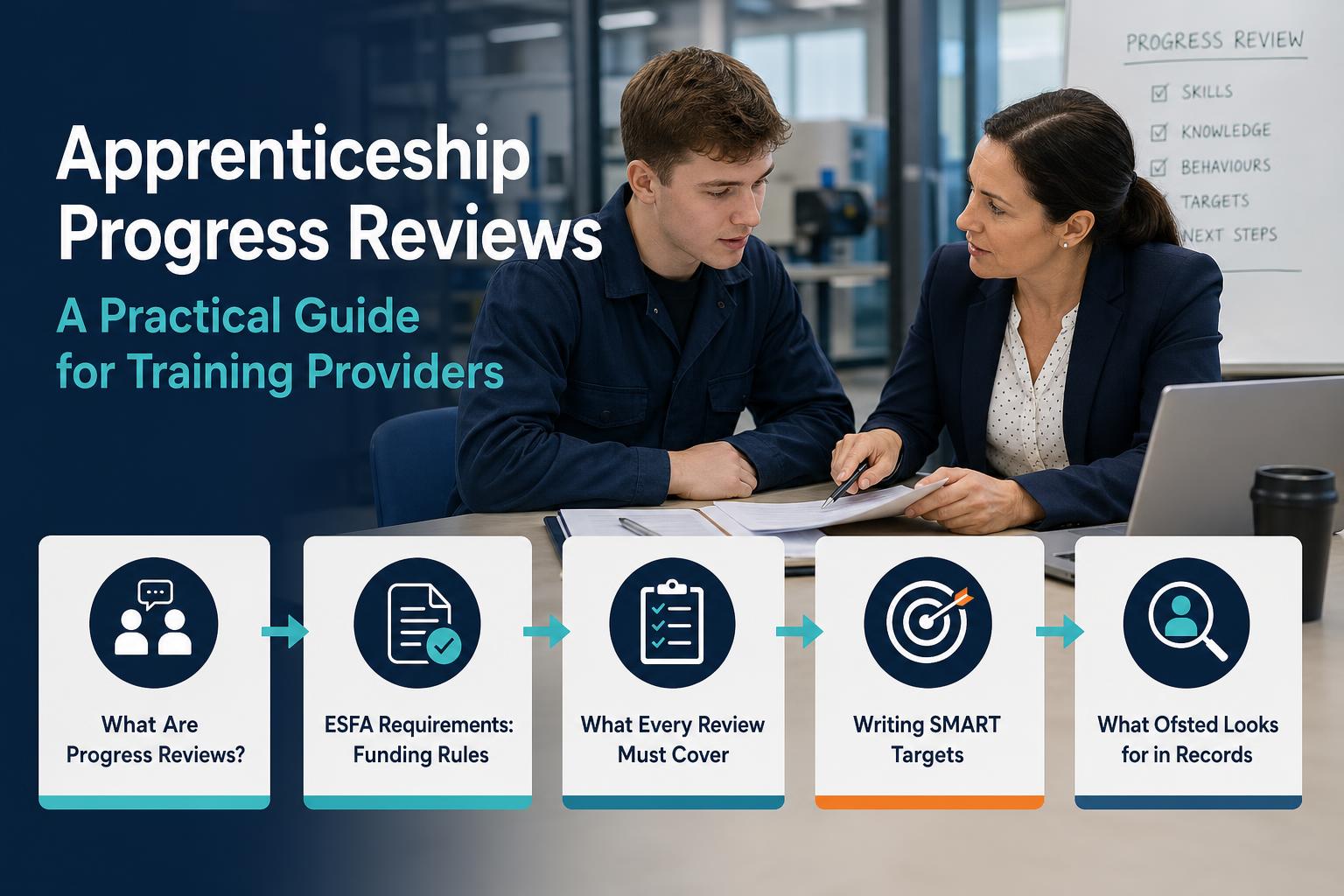
The four-part structure below is a practical recommendation, not an Ofsted template. Ofsted says inspectors do not need information in a particular format and do not expect providers to create documents solely for inspection.
Reviews are evidence, not pastoral notes
If a review could be moved into another apprentice's file without changing its meaning, it is unlikely to show progress against that person's training plan, circumstances and agreed actions.
What Ofsted actually checks
Ofsted's current operating guide does not prescribe a fixed sample of review forms. Inspectors gather first-hand evidence through professional conversations, visits, discussions with apprentices and employers, work sampling and relevant records. They connect those sources to understand typical experiences and outcomes. Review evidence may help answer questions such as:
- Are apprentices gaining and applying KSBs — rather than content simply being marked as covered?
- Are agreed actions followed up, with evidence of what happened since the previous review?
- Is the employer involved — not just signing the form, but contributing to the conversation about progress?
- Does the review reference the standard, or just the apprentice's current work situation?
- Is there evidence of stretch and challenge, or has the bar dropped as the programme has progressed?
Uniformly positive review records can be difficult to reconcile with missed training, low participation, withdrawals or weak achievement. A provider should be able to explain that difference and show how risks were identified and addressed.
The four parts of a credible review
Strip away the template and four elements make a review useful. The funding rules do not prescribe this exact structure, but each element supports the required discussion.
1. KSB progress: what's been demonstrated
Not what's been covered. What's been demonstrated. The distinction matters. "We covered K3 in this period" tells the inspector you had a session on K3. "The learner demonstrated K3 by independently designing the configuration walkthrough for two new starters and writing it up in their portfolio" tells the inspector the learner actually has the knowledge.
For each review, name 2–4 specific KSBs the learner has progressed against in this period. Cite the evidence: which portfolio submissions, which workplace artefacts, which observations. Then make a qualitative judgement — is the demonstration secure, developing, or surface-level?
2. SMART targets: where the learner is heading
The rules require agreed, documented actions; they do not mandate the SMART acronym. If you use SMART targets, make them specific to the apprentice, anchored to the training plan, realistic for the period and clear about the expected outcome and date. "Complete unit 3" describes an activity; an action that explains what capability or evidence completion should demonstrate is easier to follow up.
At the next review, revisit every previous action: met, partially met, slipped or no longer relevant. This directly supports the rule to check progress against actions agreed at the previous review.
The "did the last target happen?" check
Before writing a new review, read the last one. Open every target. Note which were met. If a target slipped, say why. If it was dropped, explain why it became irrelevant. This single habit is what separates a credible review chain from a compliance trail.
3. Employer voice: what the workplace adds
The employer is not a signature collector. Useful reviews record what the employer contributed — about the apprentice's work, gaps the provider may not otherwise see and workplace changes affecting the apprenticeship. A specific attributed comment can form part of a credible record; an employer signature alone does not show the quality of their involvement.
4. Off-the-job training: what was logged and what it produced
The review must check overall progress against the training plan and document any slippage against planned off-the-job training. Use the minimum volume published on the apprentice's current Skills England standard and the hours agreed after recognition of prior learning. There is no universal 20% rule for current starts. An honest note such as "planned hours are on track but workplace application is weak" helps turn volume into a training-quality discussion.
Language that fails — and what to write instead
Specific language makes a review chain easier to use and verify. Formulaic phrases do not show what changed, what evidence informed the discussion or what each party will do next.
The learner is on track and working well. Targets discussed and agreed.
This says nothing specific. It does not identify which apprentice this is, what progress occurred or what was agreed, and it could read identically on any file in the cohort.
Replace with:
- "On track" → on track for what. Name the next training, assessment or completion milestone, the off-the-job plan, or the specific KSBs that need attention.
- "Working well" → describe what, specifically, has changed in the apprentice's work since the last review.
- "Targets discussed and agreed" → write the targets in the review. Don't reference them elsewhere — have them visible in the review itself.
- "Pleased with progress" → whose view is this, and on what basis? The reviewer, the employer, the apprentice? Attribute it.
The tripartite sign-off problem
The 2026 to 2027 funding rules require a three-way discussion involving the apprentice, employer and provider. The review may be face to face, virtual or by email. If the employer cannot attend, they must be offered an opportunity to contribute, but they must attend physically or virtually in the majority of reviews for each apprentice.
The summary must be shared with all parties and signed, at minimum, by the provider and apprentice. That is different from a universal rule requiring three signatures on every review. Providers may still choose to obtain employer sign-off, but a signature alone does not demonstrate the quality of employer involvement.
Inspectors may speak with employers and line managers to understand apprentices' progress. Useful questions for an internal quality check include:
- "Did you discuss this review with the apprentice and their assessor?"
- "What targets were agreed for this period?"
- "What's the apprentice working on in their off-the-job training?"
Two practical fixes are to schedule reviews so the employer can attend most occurrences and to record their substantive contribution. Where they cannot attend, retain evidence that they were invited to contribute and share the final summary with them.
A working review structure
Below is a sector-agnostic structure providers can adapt. It supports the funding-rule discussion and can connect review evidence to wider inspection evidence, but neither DWP nor Ofsted prescribes this template.
- Review period and basic info — date, period covered, attendees (apprentice, assessor, employer representative, names not just roles).
- Last review's targets — revisited — each target listed, met / partially met / slipped, with a sentence of evidence.
- KSB progress this period — 2–4 KSBs the learner has progressed against, with named evidence (portfolio item, workplace artefact, observation).
- Off-the-job training reflection — progress against the standard-specific plan, any slippage, evidence and re-planned activity.
- Employer voice — what the employer specifically said about progress, gaps, or workplace context. Quoted, not paraphrased generically.
- New actions — written into the review with a clear owner, outcome and date; use SMART wording if it helps.
- Welfare, safeguarding, support, English & maths checkpoint — relevant concerns and actions, applying English and maths requirements by age at the start of training, apprenticeship level and the applicable start-date rules.
- Summary and confirmation — shared with all parties and signed at least by the provider and apprentice, with employer attendance or contribution recorded accurately.
What a strong review reads like
It reads like a working professional reflecting on a learner they actually know — specific, sometimes critical, with concrete evidence and clear next steps. It does not read like a form being filled in.
Reviewing your own reviews
At a frequency proportionate to risk, run a short quality exercise on recent reviews from across the team. Ask:
- Could I tell these reviews apart if the apprentice names were redacted?
- Does every target from the prior review have a status update?
- Is the employer present as a voice, not just a signature?
- Are KSBs cited specifically, with named evidence?
- Is anything weak or slipping acknowledged honestly, or is the tone uniformly positive?
If reviews read interchangeably, train the team on specificity and use later reviews to check improvement. Review records are one part of the evidence chain and should match training delivery, apprentices' work, employer experience and outcomes.
At July 2026, Ofsted's November 2025 inspection materials remain in use; updated versions have been published for inspections from September 2026. Check the version in force when preparing, and focus on normal operational evidence rather than creating an inspection-only file.
Sources & further reading
- Further Education and Skills Inspection Toolkit and Operating Guides — Further Education and Skills Inspection Toolkit and Operating Guides
- Apprenticeship Funding Rules, 2026 to 2027 — Apprenticeship Funding Rules, 2026 to 2027
- Education Inspection Framework — Education Inspection Framework