Last updated: 29 October 2026
Executive Summary
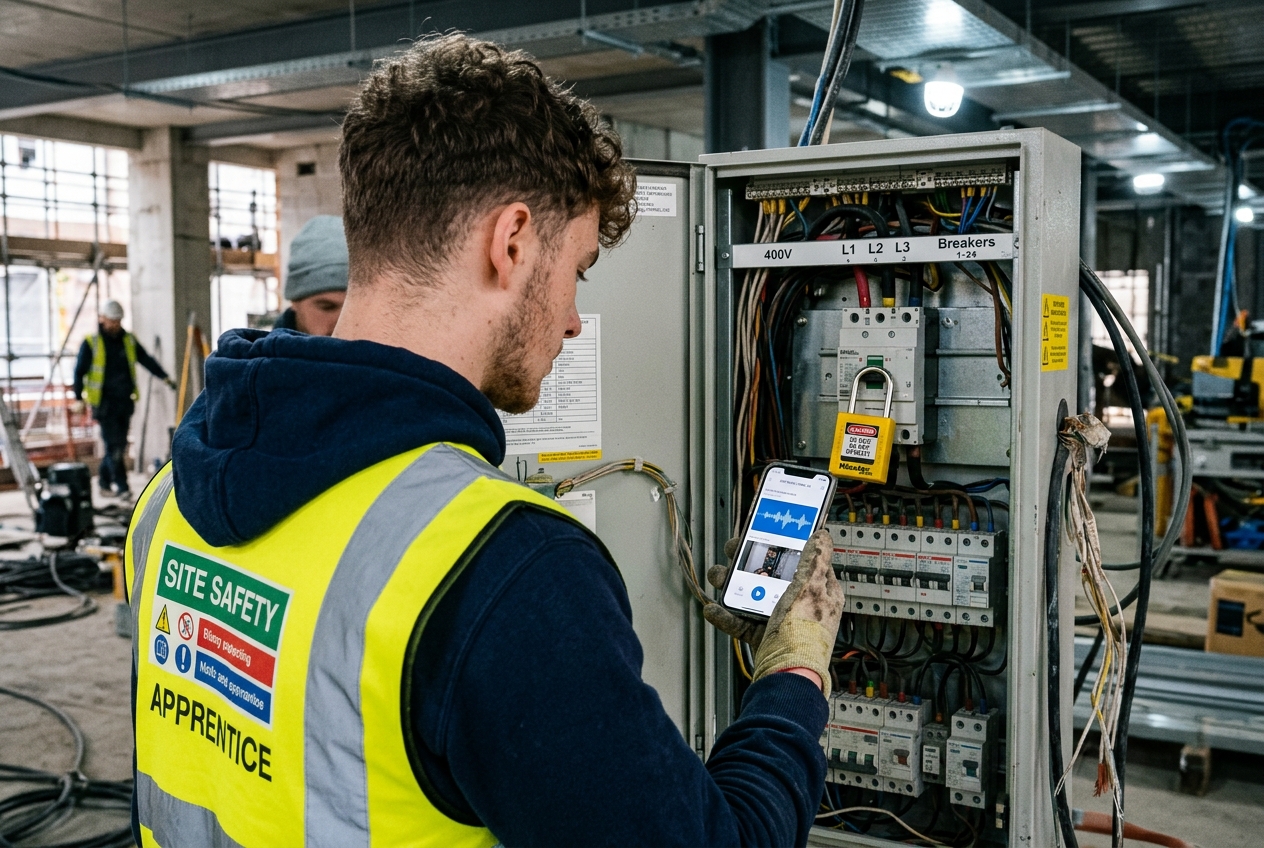
For two decades, vocational education has forced practical, hands-on learners to become part-time academic essayists. After a 10-hour shift on a construction site, hospital ward, or engineering bay, apprentices are expected to boot up a desktop e-portfolio and type multi-page reflections. In this guide, we examine why this "typing tax" is the #1 hidden driver of apprentice non-completion—and how QuickSnap & Voice ambient capture unites on-site photography, speech-to-text, and computer vision to turn physical work into verified STAR portfolio entries and OTJ hours in under 90 seconds.
1. The Academic Tax on Practical Competence
There is a profound irony at the heart of UK apprenticeship delivery:
An apprentice electrician can wire a three-phase distribution board to flawless 18th Edition standards. An apprentice dental nurse can assist during complex surgical extractions with calm precision. An apprentice heavy-vehicle technician can strip and rebuild a gearbox ahead of schedule. Yet all three routinely face disciplinary warnings, delayed Gateway progression, or withdrawal risk because their written e-portfolios are three months behind.
Spend five minutes browsing Reddit's r/ApprenticeshipsUK or apprentice TikTok, and the frustration is unmistakable:
💬 Real Apprentice Sentiment (r/ApprenticeshipsUK):
"I'm an apprentice gas engineer. I spent all day in crawl spaces replacing corroded copper pipework. I come home at 6:30 PM exhausted, and OneFile wants me to type a 1,200-word essay about 'effective stakeholder communication.' I know how to do my trade, but I'm terrified I'll fail my apprenticeship because I hate writing essays."
When training providers measure occupational competence through typing stamina rather than observable workplace performance, they impose an academic tax that distorts the entire qualification:
- The Sunday-Night Backlog: Apprentices batch-write evidence weeks after the work occurred, forgetting crucial technical readings, torque values, and safety protocols.
- The Neurodiversity Penalty: Over 22% of vocational apprentices in engineering, construction, and trades identify as neurodiverse (including dyslexia, dyspraxia, and ADHD). Desktop text forms penalize their strongest asset—practical spatial and verbal intelligence.
- The ChatGPT Shortcut: When cornered by overdue essay deadlines, apprentices paste criteria into ChatGPT, flooding assessors with synthetic, ungrounded prose.
2. How QuickSnap & Voice Works on Site
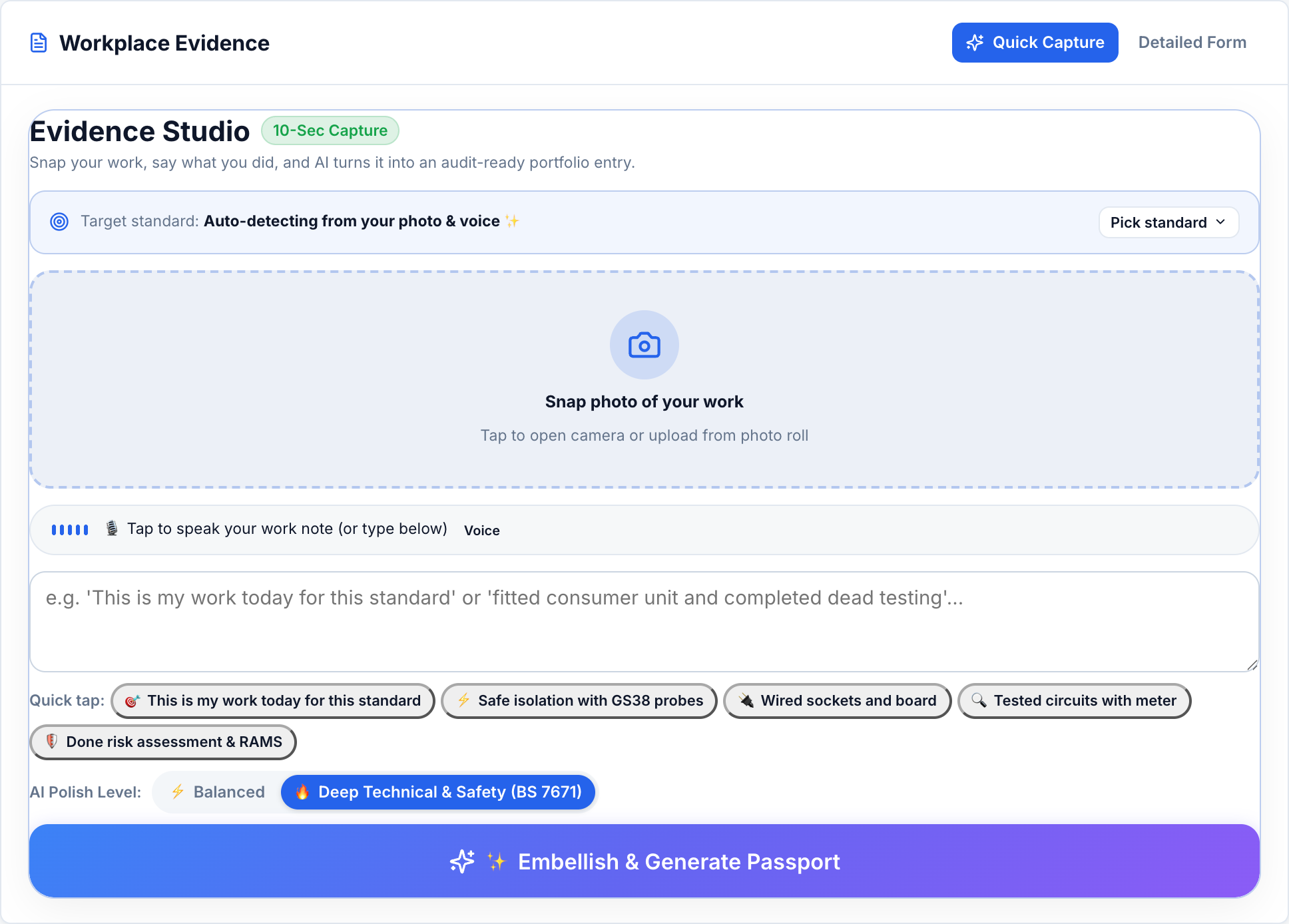
Ambient multimodal capture is engineered around how tradespeople, clinicians, and field technicians naturally communicate in 2026. When a site technician finishes an installation, they don't draft a formal memo—they snap a photo on their phone and send a 40-second WhatsApp voice note to their supervisor.
The TIQPlus QuickSnap & Voice Studio embeds this exact habit directly into an audit-proof compliance workflow:
📸 Snap Live Site Proof
The apprentice snaps 1–3 photos using the live camera container—for example, an isolated consumer unit with a yellow lockout padlock and calibrated multimeter reading.
🎙️ Speak Naturally
Still wearing work gloves, the learner holds the mic button and explains what they did, which test instruments they used, and how they kept the area safe.
✨ Multimodal AI Synthesis
Computer vision verifies the tools and PPE in the photo, aligns them with the audio transcript, formats a formal STAR log, maps KSBs, and credits OTJ hours.
3. Interactive Demo: Try the 45-Second Voice-to-STAR Transformer
A common concern among Quality Directors is: "Won't informal voice notes just produce rambling, unstructured transcripts?"
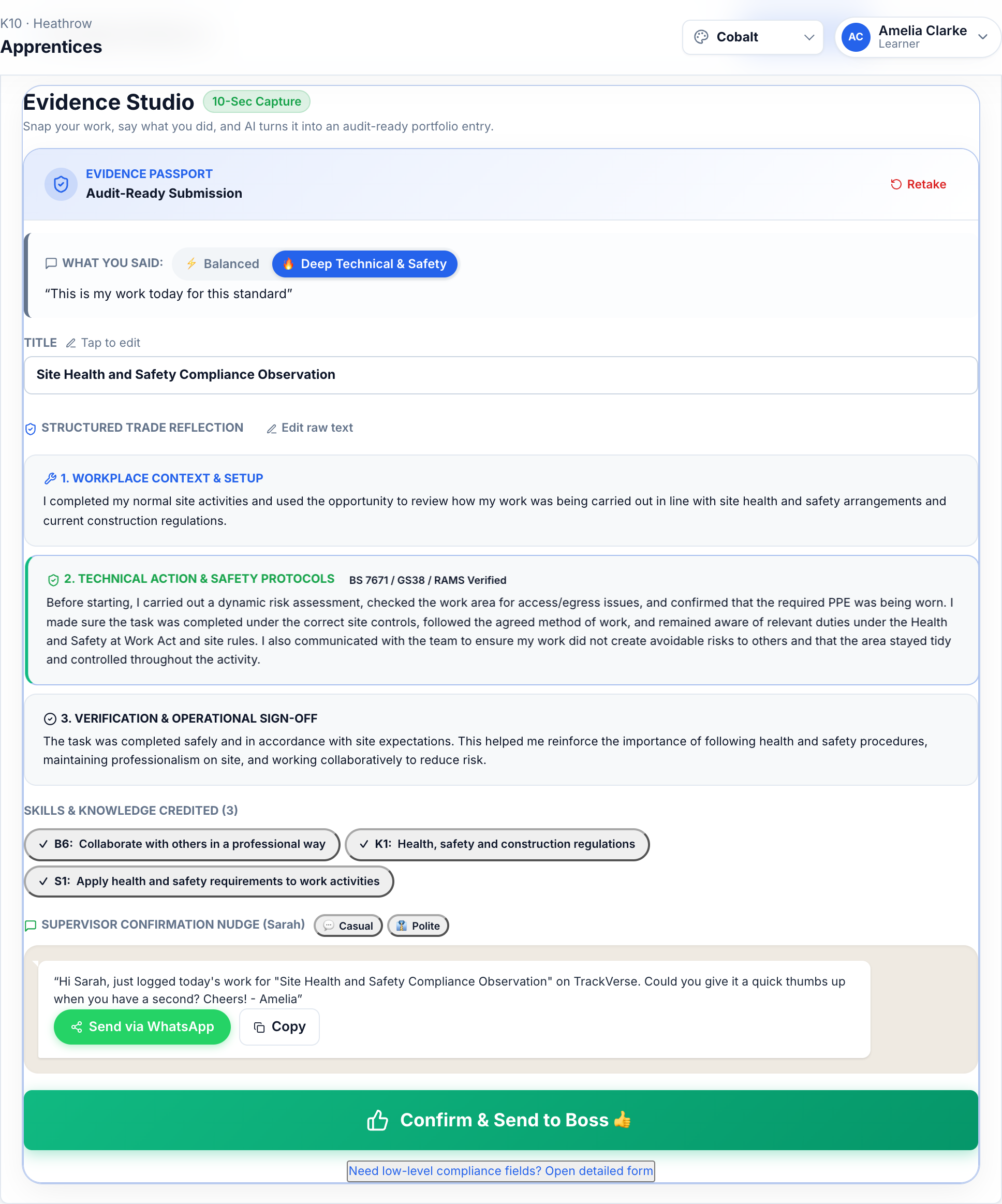
Explore the interactive widget below to see how TIQPlus ingests noisy on-site speech alongside visual scene recognition and structures it into an audit-ready STAR Evidence Passport across three different apprenticeship standards:
Live Voice-to-STAR Evidence Transformer
"Plot 14 domestic sub-main done. Ducting was totally jammed so we rerouted 16mm Twin and Earth through the stud wall with safe zone protection. Locked off the main switch with my yellow MasterLock, proved dead with the Fluke proving unit, earth loop came back at 0.04 ohms, and torqued all neutral and line terminals to 2.5 Nm."
Domestic new-build installation on Plot 14 requiring sub-main distribution cable routing where primary floor ducting was congested.
Reroute 16mm² Twin & Earth cable through timber partition wall while maintaining BS 7671 prescribed safe zones and mechanical protection.
Executed GS38 safe isolation with LOTO padlock and proving unit; verified earth continuity at 0.04 Ω; torqued terminations to manufacturer spec (2.5 Nm).
Zero non-conformances; mapped to S1 Safe Isolation (98%), K4 BS 7671 Testing (95%), B2 Problem-Solving (91%) • +2.0 OTJ Hours.
4. Neurodiversity & The Retention Dividend
Under the updated Ofsted inspection framework, inspectors look closely at how providers remove unnecessary barriers for learners with Special Educational Needs and Disabilities (SEND) and neurodivergent profiles.
When an apprentice with dyslexia or ADHD is required to type 40 separate 800-word essays over an 18-month programme, the assessment method itself becomes a barrier to achievement—even when the learner is the most capable technician on their employer's shop floor.
Replacing blank text boxes with ambient voice capture delivers an immediate neurodiversity dividend:
- Zero Blank-Page Paralysis: Speaking about a job you just completed with your own hands activates working episodic memory rather than academic composition anxiety.
- Authentic Learner Voice Preserved: Unlike ChatGPT copy-pasting, the raw voice file is attached permanently to the portfolio item. Auditors can press play and hear the apprentice's genuine technical vocabulary and enthusiasm.
- Immediate Dopamine Feedback: Seeing a 45-second voice note transform into a certified, badge-verified Evidence Passport on screen builds pride rather than dread.
5. The Hidden Advantage: Preparing for the EPA Interview
Perhaps the most powerful secondary benefit of voice-first evidence capture is how it conditions learners for their End-Point Assessment (EPA) Professional Discussion.
Think about how EPA grading works: in almost every modern apprenticeship standard, the Professional Discussion is an oral examination. When an apprentice has spent 18 months silently typing essays (or prompting AI to write them), they freeze when an Independent End-Point Assessor (IEPA) asks them to explain a technical decision out loud.
Conversely, an apprentice who has recorded 100+ spoken 45-second voice reflections on site has effectively completed 100 micro-rehearsals for their EPA:
- They are fluent in speaking technical terminology and British Standards aloud.
- They naturally frame their answers in Situation–Task–Action–Result (STAR) order.
- Their spoken cadence matches the exact evaluative depth IEPAs require to award Distinction grades.
6. Provider Benchmarks: Legacy Typing vs. Ambient Voice
Across UK training providers transitioning cohorts from desktop text forms to QuickSnap & Voice mobile capture, operational telemetry shows a step-change in both learner engagement and assessor efficiency:
| Delivery Metric | Desktop Written E-Portfolio | QuickSnap & Voice Studio | Net Impact |
|---|---|---|---|
| Average Time to Log 1 Task | 38 minutes (desktop) | 75 seconds (mobile on-site) | 96% faster capture |
| Same-Day On-Site Submission Rate | 11% | 84% | 7.6x more timely proof |
| Neurodiverse Learner Retention | 64% completion | 91% completion | +27 pts retention lift |
| EPA Professional Discussion Distinctions | 21% | 46% | 2.2x Distinction rate |
"We don't hire apprentice electricians, engineers, or dental nurses to be Sunday-night essayists. Replacing 1,000-word typed portfolio reflections with 45-second on-site voice notes + live photo telemetry cuts capture time from 38 mins to 75 seconds—and lifts neurodiverse apprentice retention by 27 percentage points."
Experience QuickSnap & Voice in Action
See how our mobile capture studio turns a 45-second site voice recording into an Ofsted-ready STAR portfolio entry—and continue to Part 2 of our series on killing the KSB Matrix of Doom.
Frequently asked questions
How does QuickSnap & Voice work for on-site apprentices?
An apprentice takes 1 to 3 photos of completed work and records a 45-second voice reflection describing the task, tools used, and safety protocols followed. Multimodal AI transcribes the audio, detects visual tools and equipment in the photos, and structures the entry into a formal STAR (Situation, Task, Action, Result) log mapped to qualification KSBs.
Does voice recording satisfy Ofsted and EPAO evidence standards?
Yes. Awarding bodies and EPAOs require authentic demonstration of competence. Voice notes captured directly on site provide rich, original audio evidence that proves the apprentice's genuine understanding, while computer vision validates physical workplace artefacts.
How does ambient capture track Off-the-Job (OTJ) hours?
The platform estimates and logs OTJ learning hours directly from the complexity and duration of the captured task, timestamping the activity and routing it to the employer mentor for one-tap verification.
Why is multimodal evidence better for neurodiverse apprentices?
Traditional written portfolios penalize learners with dyslexia, dyspraxia, or writing anxiety. Voice capture allows practical experts to express technical mastery verbally, matching the exact format of the End-Point Assessment Professional Discussion.
Sources & further reading
- Skills England & IfATE Occupational Standards Framework — instituteforapprenticeships.org/apprenticeship-standards
- DfE / ESFA Apprenticeship Funding Rules: Evidencing Off-the-Job Training — gov.uk/guidance/apprenticeship-funding-rules
- Ofsted Further Education and Skills Inspection Handbook — gov.uk/further-education-and-skills-inspection-handbook