Last updated: 15 July 2026
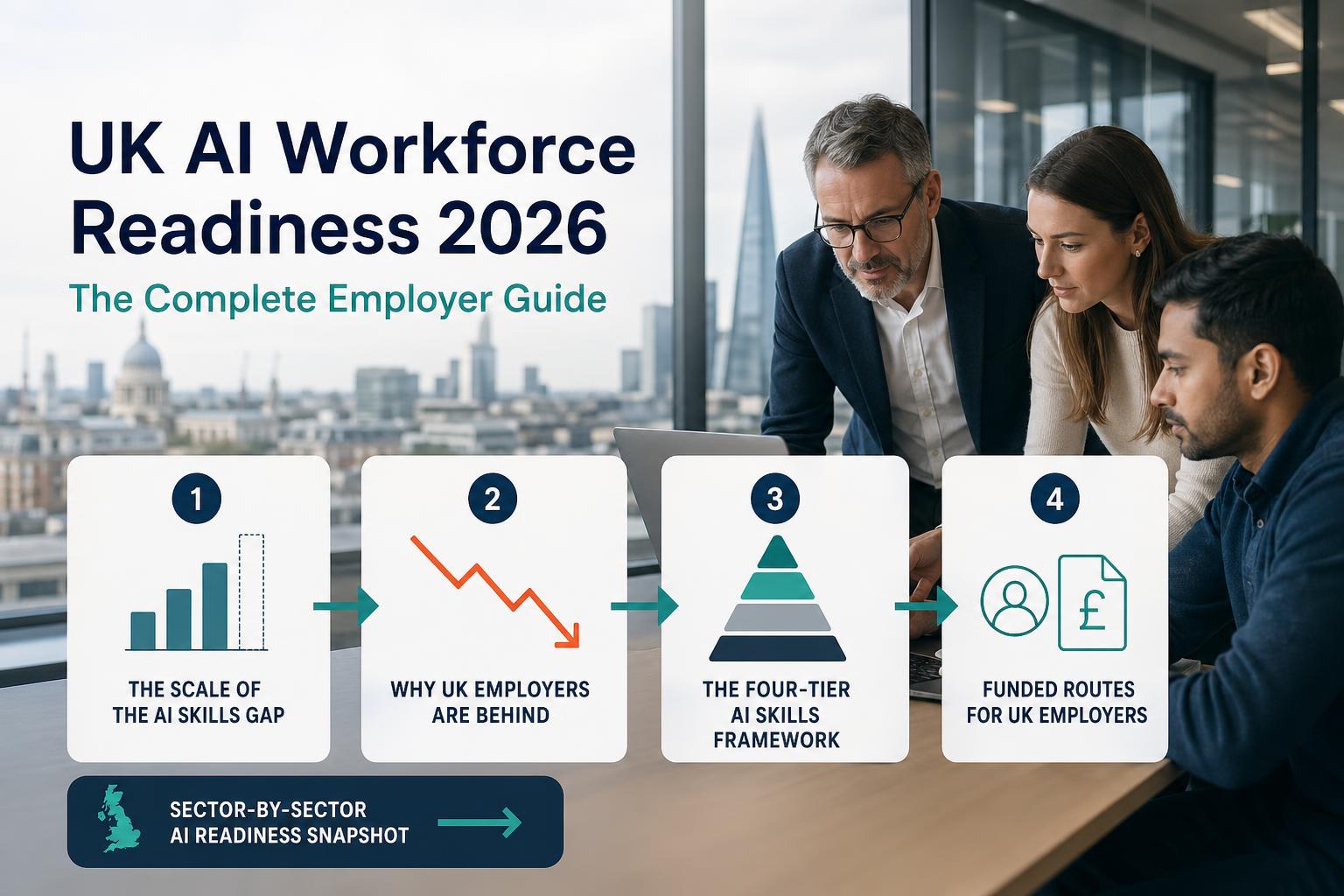
The Scale of the UK AI Skills Gap
There is no defensible single total for the UK “AI skills gap”. Different studies measure vacancies, self-reported confidence, use of particular tools, task exposure or modelled occupational change. Those measures should not be combined into a claim about a fixed number of jobs or workers.
Skills England’s 2026 annual report offers a more useful planning distinction: most workers are likely to need practical AI literacy — using, checking and safely integrating tools — while a smaller group needs specialist technical skills. Its evidence also describes adoption as uneven and often limited in impact. That points employers towards role- and task-level diagnosis rather than a blanket course for everyone.
The World Economic Forum’s 2025 global employer survey estimates that 39% of workers’ existing skill sets may be transformed or become outdated by 2030. It is a global survey-based forecast, not proof that 40% of every UK role changes by 2027.
Government labour-market assessment similarly warns against treating technical exposure as a job-loss forecast. A model may be able to assist with tasks inside a role without being able to perform the whole occupation, and adoption depends on cost, integration, regulation, trust and organisational choices. Workforce planning should map tasks that can be augmented, tasks that require human judgement and genuinely declining work.
Historical ONS automation analysis can provide context, but it predates the current generative-AI market and should not be presented as a 2026 displacement forecast. Use current internal workflow evidence, sector intelligence and employee consultation to identify the cohorts that actually need intervention.
Do not reuse an old economy-wide “digital skills cost” as if it measured today’s AI gap. Baseline cycle time, quality, rework, escalation, adoption and incidents for the selected workflow, then compare them after training.
AI capability is no longer confined to technology teams. Marketing, finance, operations, HR, legal and customer-service roles may all require different combinations of tool use, verification, data handling and escalation. The relevant gap is the difference between the capability a defined workflow needs and the capability the people performing it can evidence today.
Why UK Employers Are Behind
Skills England’s evidence describes persistent barriers to upskilling and uneven adoption. At employer level, the practical blockers commonly include unclear use cases, weak baseline data, uncertain ownership, limited manager time, supplier risk and a failure to connect training with redesigned work. Diagnose those constraints locally instead of assuming a national survey explains your organisation.
What is blocking AI readiness
Uncertainty about scope. Most HR and L&D leaders have not received a structured brief from the board on AI workforce strategy. They are making programme decisions in the absence of a clear organisational position on which roles will be AI-augmented, on what timeline, and to what depth. Without that clarity, programmes are designed too narrowly (serving only the most visibly AI-affected teams), too shallowly (foundation awareness without practical application), or not at all.
Provider identification difficulty. The AI training market has expanded rapidly and is not yet well-structured. Employers struggle to distinguish between high-quality structured programmes with outcomes evidence and low-quality content refreshed with AI terminology. The proliferation of “AI fundamentals” short courses — many of which are 2–4 hours of video content with a badge — has made it harder, not easier, to find provision that will actually change behaviour.
Fear of employee reaction. A significant proportion of employers are delaying explicit AI workforce planning because they are uncertain how to communicate role change to employees without triggering anxiety, resistance, or flight. This is understandable but counterproductive. Employees who are not told the truth about how their role is changing are not reassured — they fill the information vacuum with their own assumptions, which are typically more alarming than the reality.
Budget allocation uncertainty. AI skills development sits at an awkward intersection of IT, L&D, and HR budgets. In organisations without a clear owner, the programme falls between functions. Where budget ownership is clear, L&D teams often face the challenge of making the investment case for a programme whose ROI is diffuse and plays out over 12–24 months.
The productivity cost of operating with an AI-skills-deficient workforce — slower task completion, higher error rates, underuse of AI tools already deployed — typically exceeds the cost of a structured skills programme within 12 months. The question is not whether your organisation can afford AI skills development. It is whether you have calculated the cost of the gap you are currently running.
The Four-Tier AI Skills Framework for UK Organisations
A common failure in AI skills planning is treating the workforce as a single population with a single training need. The employees who need basic AI literacy are not the same population as those who need to build AI-augmented workflows in their function — and neither group is the same as the technical specialists who will configure and govern AI systems at scale. A single-track programme that tries to serve all three will serve none of them adequately.
The four-tier framework below provides a practical structure for mapping your workforce population to the appropriate level of AI skills development, identifying the funding routes applicable at each tier, and sequencing investment sensibly.
Tier 1: AI Literacy (All Employees)
Tier 1 is the foundation that every employee in the organisation needs, regardless of role, function, or seniority. AI literacy at this tier covers three things: understanding what AI is and what it can and cannot do in a workplace context; basic prompt literacy — the ability to interact productively with AI tools to complete common tasks; and responsible and ethical use — understanding the risks of over-reliance, bias, data privacy considerations, and when human judgment must take precedence.
The learning at Tier 1 should be short, accessible, and anchored in workplace scenarios that are recognisable to the learner. Jargon-free content that explains AI in terms of what it does in everyday work contexts is far more effective than technically accurate but abstract explanations of how large language models work. Most employees at Tier 1 need enough AI understanding to use tools safely and productively — not to understand the architecture behind them.
A short self-paced module may establish a baseline, but duration should follow the role, existing knowledge, system context and risk. Article 4 applies only where the organisation is a provider or deployer within the EU AI Act’s territorial scope; effects on an EU customer or employee do not by themselves settle that test. The obligation is proportionate and does not prescribe a course, certificate, number of hours or documentation format.
Tier 2: AI Practitioner (Function-Specific Roles)
Tier 2 is for employees who use AI tools as a meaningful part of their daily work. This is the largest tier by headcount in most organisations — encompassing marketing, finance, customer service, HR, legal, and operational roles where AI tools are now embedded in the workflow. The skills required at this tier are function-specific rather than generic: a finance analyst’s AI practitioner capability is different from a customer service manager’s.
Tier 2 content should cover: confident productive use of the specific AI tools relevant to the role; data interpretation skills — reading AI-generated outputs critically, identifying errors, and knowing when to verify; workflow automation for the common task patterns of the role; and output verification — the discipline of not treating AI outputs as correct without review. The last of these is consistently underweighted in AI training content and is consistently the failure mode that produces the most significant errors in practice.
Typical duration: 8–16 hours of structured learning plus 4–6 weeks of supported practice in the live role. Skills Bootcamps and short accredited programmes are often the right funding vehicle for Tier 2 development at scale.
Tier 3: AI Specialist (Technical and Analytical Roles)
Tier 3 covers roles where employees are expected to build, configure, evaluate, or manage AI-enabled processes rather than simply use them. This includes data analysts, business analysts, operations technology teams, IT functions, and specialist practitioners in sectors like healthcare informatics or financial risk modelling where AI is central to the technical work.
The skills at this tier include: designing and building AI workflows that integrate with existing systems; selecting AI models or tools for specific use cases and evaluating their outputs for accuracy, bias, and fitness for purpose; integration of AI tools with business systems, data pipelines, and reporting; and AI governance at team and function level — defining and enforcing responsible use policies for an AI-augmented team. The Level 4 AI and Automation Practitioner apprenticeship (ST1512) is one funded option where the learner’s employed role aligns with the current standard’s occupational duties.
Typical duration: 20–40 hours of structured learning for existing practitioners using a short-course route, or 18 months for the current ST1512 apprenticeship pathway.
Tier 4: AI Leadership (Senior and Strategic Roles)
Tier 4 is for board members, C-suite, senior managers, and heads of function who are responsible for AI strategy, governance, and accountability at organisational level. The gap at this tier is frequently the most acute: many senior leaders have enthusiastically deployed AI tools or commissioned AI programmes while lacking the conceptual framework to govern them responsibly or hold the organisation accountable for their use.
Tier 4 skills include: AI strategy development — defining an organisational position on AI use, investment, and capability building that is coherent and evidence-based; governance frameworks — designing the policies, accountability structures, and review mechanisms that ensure AI is deployed responsibly; change management at scale — leading an organisation through the human dimensions of AI-driven role change, managing anxiety, building trust, and sustaining momentum through a multi-year transformation; and board accountability — understanding the governance and reporting obligations that come with deploying AI in regulated environments.
The skills gap at Tier 4 has a multiplier effect. Leaders who are AI-literate and strategically capable make better decisions about AI investment, set better expectations for the wider programme, and model the behaviours that accelerate adoption throughout the organisation. Leaders who are not — who treat AI as a purely technical matter delegated entirely to IT — undermine the programme from the top.
The Funded Routes Available to UK Employers
The cost of AI skills development is a barrier for many employers — but the UK has more funded provision available for AI and digital skills than most HR teams are aware of. Understanding the funding landscape properly allows employers to design programmes that maximise public subsidy while meeting genuine workforce needs.
Skills Bootcamps for AI and Digital Skills
Skills Bootcamps can support selected Tier 1 and Tier 2 digital or AI development, but they are commissioned offers rather than one uniform national product. Subject availability, eligibility, timetable, duration, delivery mode and any employer contribution vary by location, commissioner and provider. Check the live offer before treating a particular subject or subsidy as available.
For employees in operationally critical roles, compare the provider’s actual timetable with the release time the employer can protect. Do not plan around a generic weekly-availability figure: entry and attendance requirements are set by the commissioned offer.
Level 4 AI and Automation Practitioner Apprenticeship (ST1512)
The current Skills England record for AI and Automation Practitioner (ST1512) is version 2.1, Level 4, approved and available. It lists a typical duration of 18 months, 420 minimum compliance hours and a maximum funding band of £18,000. A revised assessment plan applies from 22 May 2026, so providers and employers should use the current plan rather than an archived version.
Funding depends on the apprentice’s start date, age and the employer’s levy position. For starts from 1 August 2026, government funds eligible training and assessment up to the band maximum for an eligible non-levy apprentice aged 16–24. For a non-levy apprentice aged 25 or over, the employer pays 5% and government pays 95%. Levy payers normally use account funds; if those funds are insufficient, the employer pays 25% of the eligible shortfall and government pays 75%. Employers pay any amount above the band maximum. Earlier starts normally remain under the rules in force when they began.
For starts from 1 August 2025, plan the exact standard’s published minimum off-the-job training volume rather than a generic weekly number. ST1512 currently lists 420 minimum compliance hours; the learner’s requirement can be adjusted for evidenced recognition of prior learning subject to the funding-rule floor. The practical period must last at least eight months, while this standard’s typical duration is 18 months. Earlier starts retain the training and duration rules that applied at their start.
Growth and Skills Levy
The confirmed Growth and Skills Levy offer is made up of exact approved products, not a general short-course budget. For AI, employers can consider the full ST1512 apprenticeship or the approved Level 5 leadership units AU0009, AU0010 and AU0011 where the role and learner meet the rules. Foundation apprenticeships are another product type for eligible young people, not a general existing-workforce AI route.
The 50% figure in the current unit rules is the levy-transfer allowance to other employers; it is not permission to spend half an account on arbitrary shorter qualifications. Skills Bootcamps remain separately commissioned, and AI Skills Boost partner courses are a separate free-course initiative. Verify the exact product, provider and start-date funding rules.
EU AI Act Article 4: AI Literacy as a Compliance Obligation
Article 4 has applied since 2 February 2025 to providers and deployers within the EU AI Act’s territorial scope. It requires measures, to the best of the organisation’s extent, to ensure a sufficient level of AI literacy among staff and other people dealing with AI systems on its behalf, taking account of knowledge, experience, education, training, context and affected people. It does not say every employee must take one course.
A UK organisation is not brought into scope merely because an AI output affects an EU customer or employee; test Article 2 against the provider, deployer, system and use. Article 4 prescribes no certificate, fixed hours or documentation format. A proportionate record of roles, systems, risk, measures and review decisions can support accountability, but completion data alone does not prove compliance.
DfE Free Digital Entitlement
England’s adult essential digital skills entitlement can fully fund eligible adults aged 19 or over who are assessed below Level 1 to study an approved essential digital skills qualification up to Level 1. It is a baseline digital route, not an AI-training entitlement, and residency, prior attainment, local availability and current Adult Skills Fund rules still apply.
Sector-by-Sector AI Readiness Snapshot
AI readiness is not uniform across UK sectors. The nature of the challenge, the regulatory context, the quality of available provision, and the current state of employer action vary significantly. The following sector snapshots provide orientation for employers and training providers working in each area.
Healthcare and the NHS
The NHS is deploying AI at pace — in diagnostic imaging, clinical decision support, administrative automation, and patient pathway management. The workforce readiness challenge is acute because the deployment is ahead of the training. Clinical staff are interacting with AI-assisted diagnostic tools without structured training in how to evaluate AI outputs, when to override AI recommendations, or how to document AI-assisted clinical decisions for governance purposes.
The key readiness gap in healthcare is not AI literacy at the foundational level — NHS digital literacy programmes have improved substantially since COVID-19 — but clinical AI governance: the discipline of understanding AI system limitations in a clinical context, maintaining appropriate human oversight of AI-assisted decisions, and managing the ethical and safety dimensions of clinical AI use. NHS trusts and integrated care systems are at very different points in addressing this, with some having well-developed programmes and many having none.
Financial Services
Financial services is highly regulated, but firms should not reduce its AI obligations to one supposed FCA training rule. Map each use case to applicable FCA and PRA requirements, Consumer Duty, governance and systems-and-controls expectations, data protection, equality, model risk and accountability. The people approving or monitoring a use case need capability proportionate to their actual responsibilities.
Test readiness at the governance layer as well as among tool users. Risk, compliance and senior managers may need to evaluate limitations, challenge evidence, understand escalation and document decisions; the precise requirement follows the firm, use case and applicable regulatory framework.
Manufacturing and Made Smarter
UK manufacturing’s AI readiness challenge is shaped by the Made Smarter programme, which has provided significant support for AI and digital technology adoption in manufacturing SMEs — particularly in the North and Midlands. The adoption picture is better than it was, but there remains a substantial gap between the minority of manufacturers who have structured AI skills development programmes and the majority who are deploying AI tools in production, quality control, or supply chain management without training the workers operating those systems.
The skills gap in manufacturing is concentrated at the operator and team leader level: workers who are expected to interact with AI-assisted production systems, interpret AI output on quality or efficiency dashboards, and make informed decisions based on AI recommendations. Tier 2 practitioner training for manufacturing contexts is an underserved provision area.
Public Sector
The Government Digital Service and Cabinet Office have published guidance on responsible AI use in central government, and the AI Opportunities Action Plan sets out an ambitious agenda for AI deployment across public services. The readiness gap is significant: the public sector’s AI adoption is accelerating faster than its workforce training, and the accountability expectations around public sector AI use — including Freedom of Information implications, equalities duties, and public sector ethics standards — create specific training requirements that are not well-served by generic AI literacy content.
Local government is at an earlier stage than central government. The combination of tight budgets, limited L&D resource, and high operational pressure means that structured AI workforce readiness programmes are rare outside the largest councils.
Professional Services
Professional services — legal, accountancy, management consulting, architecture, and related sectors — face a specific readiness challenge: generative AI is transforming the economic model of professional knowledge work at pace, and the firms that build AI-augmented working practices ahead of the market will gain a structural competitive advantage. The skills gap is less about basic AI literacy (professional services workforces tend to be digitally capable) and more about the governance, professional ethics, and output quality management dimensions of AI use in professional contexts.
For legal and accountancy practices in particular, the regulatory and professional body dimensions of AI governance are still developing. Firms need to build internal policies and training around AI use in professional advice before external standards arrive — not after.
The 12-Month AI Workforce Readiness Roadmap
Acknowledging the gap is not the same as closing it. The organisations that are making meaningful progress on AI workforce readiness share a common characteristic: they have a plan that goes beyond intention. The 12-month roadmap below provides a structured implementation sequence for employers starting from a low baseline.
Months 1–3: Audit and Baseline
The first three months are about understanding the shape of the gap before designing the programme. This phase should produce: a skills assessment across the workforce population — current AI capability baseline by role group; a role mapping exercise that defines the AI-augmented capability requirement for each major role type; and a priority identification that distinguishes the high-exposure, low-readiness cohorts who need urgent structured intervention from the lower-priority groups who can be served by self-directed foundation content.
The skills assessment should use a combination of self-assessment surveys and line manager input, with role-specific question tracks rather than a generic survey. A generic AI skills survey administered across the whole organisation produces data that is too aggregated to drive useful programme decisions. Segment by role group from the start.
Alongside the skills assessment, map the legal, regulatory, policy and contractual requirements that actually apply to each AI use case. Test Article 4 territorial scope rather than assuming it, distinguish regulator guidance from binding rules, and record which controls are legal duties, contractual commitments or voluntary governance choices.
By the end of the audit phase, you should have: a documented skills baseline by role group; an AI-augmented capability requirement specification for each major role type; a prioritised cohort list; and a confirmed inventory of compliance training obligations. Without these, the programme design in Months 4–6 will be guesswork.
Months 4–6: Foundation Layer
Months 4–6 deliver the foundation layer: Tier 1 AI literacy training for all staff, responsible use policy, and any compliance training obligations identified in the audit phase. The foundation layer should be deployed broadly and completed by the end of Month 6. The temptation is to delay broad deployment until the full programme design is complete — this is a mistake. Every month of delay is a month where employees are using AI tools without foundation training, and a month where compliance risk accumulates.
The foundation layer content should be short, accessible, and designed for completion in a 2–3 week self-paced window. It is not the place for deep content — that is what Months 7–9 are for. The goal of the foundation layer is to establish a shared baseline of AI understanding, responsible use, and prompt literacy across the full employee population. This also serves the change management function: making visible the organisation’s commitment to preparing people rather than simply deploying technology.
The AI use policy should be developed and communicated during this phase. The policy does not need to be comprehensive or final — policies in this space are iterative — but the basic framework (what AI tools are approved, what data should not be fed to AI systems, what human review is required for AI outputs used in external communications or decisions) should be in place before Tier 2 practitioner development begins.
Months 7–9: Practitioner Development
Months 7–9 deliver Tier 2 practitioner capability for the priority cohorts identified in the audit. This is the highest-impact phase of the programme — it is where the productivity gains from AI tool adoption are realised — and the phase that requires the most resource investment and the most careful programme design.
Role-specific AI tool training should be developed for each of the priority role groups. This content cannot be bought off the shelf — it needs to be co-developed with subject matter experts from each function, covering the specific AI tools in use for that role and the specific task contexts where they are applied. Buy the foundation content; build the practitioner content.
Validate funding routes in this phase for each cohort. Skills Bootcamps are separately commissioned and depend on the live local offer. The apprenticeship service can fund exact approved products, including ST1512 and, for eligible leaders, AU0009, AU0010 or AU0011; it is not a general AI-course budget. AI Skills Boost lists free partner courses but is not a provider-accreditation or automatic employer-funding scheme. Record the product code, provider permission, learner eligibility, employer contribution and start-date rules before budgeting.
Manager readiness is critical at this stage. Managers must be at Tier 2 level in their own AI skills before their teams enter practitioner development — a manager who is behind their team cannot coach AI tool adoption in the role. If managers were not prioritised in the foundation phase, this is the point at which they should receive fast-tracked development.
Months 10–12: Specialist Tracks and Leadership Development
The final quarter of the first year delivers Tier 3 and Tier 4 development for the specialist and leadership populations, and begins the embedding phase for the broader programme.
For Tier 3 specialist roles, Level 4 AI apprenticeship enrolments initiated in Month 8–9 will be under way by this point. Supplementary structured learning — advanced AI workflow design, model evaluation, integration projects — should be running in parallel. The specialist population should also be recruited as internal AI champions: the people other teams go to for support, who can disseminate practitioner learning from the inside and identify emerging AI use cases in their function.
For Tier 4 leadership, this phase should deliver a structured AI strategy and governance programme — not generic AI awareness content repurposed for a senior audience, but substantive content on AI governance frameworks, accountability structures, strategic investment decisions, and the change management requirements of sustained AI-driven transformation. Board-level AI readiness is frequently the missing link between well-designed programmes and programmes that translate into lasting organisational capability.
How TIQPlus Supports AI Workforce Readiness Delivery
For training providers delivering AI workforce readiness programmes to employer clients, the operational challenge is as significant as the content challenge. TIQPlus is built to handle the delivery complexity that AI skills programmes at scale require.
The platform supports all eight training types relevant to an AI workforce readiness programme: apprenticeship delivery (including KSB mapping for Level 4 AI and Automation Practitioner ST1512), compliance training for EU AI Act and sector-specific obligations, Skills Bootcamp provision, professional development programmes, onboarding, soft skills, and blended learning. Employers and training providers can manage all delivery types through a single platform rather than maintaining separate systems for different funded routes.
For apprenticeship delivery, TIQPlus can support KSB mapping, evidence, standard-specific off-the-job hours and completion-readiness workflows. For other workforce learning, completion and activity records can support internal governance, but no TIQPlus report or certificate proves Article 4 compliance. Skills Bootcamp reporting requirements depend on the live commissioned contract and should be configured against that specification.
The reporting layer is particularly important for AI workforce readiness programmes, where stakeholders need to see evidence of behaviour change rather than just completion rates. TIQPlus generates the learner progress, cohort completion, and outcomes evidence that allows training providers to demonstrate programme impact to employer clients — and that allows employer L&D teams to make the internal investment case for continued AI skills development.
AI Workforce Readiness Programme Checklist
Before initiating your AI workforce readiness programme, work through this checklist to confirm you have the foundations in place:
- Organisational AI strategy confirmed — the board or senior leadership team has agreed a position on AI deployment and workforce readiness investment
- Skills audit planned — role-segmented assessment of current AI capability baseline and AI-augmented role requirements
- Regulatory and compliance obligations inventoried — EU AI Act Article 4, sector-specific obligations, contractual requirements
- Funding routes verified separately — live Skills Bootcamp contract, exact Growth and Skills Levy product, AI Skills Boost partner course, digital entitlement or commercial training; eligibility and employer contribution recorded
- Four tiers mapped to your workforce — Tier 1 (all employees), Tier 2 (role-specific), Tier 3 (specialist/analytical), Tier 4 (senior/strategic) populations sized
- Tier 2 content development planned — role-specific practitioner content requires co-development with subject matter experts; allow 6–8 weeks for development
- Manager readiness sequenced ahead of team deployment — managers should complete foundation and early practitioner development before their teams enter the programme
- AI use policy drafted — approved tools, data handling rules, output verification requirements in place before practitioner development begins
- Measurement framework designed — leading indicators (confidence surveys, tool usage) and lagging indicators (productivity change, quality change) defined before launch
- Communication plan complete — employee messaging on what the programme is, why it exists, what will and will not change in their role, and where they can get support
Frequently asked questions
How big is the UK AI skills gap?
There is no single reliable number for “workers who need retraining”. Skills England's 2026 annual skills report says most workers will need practical AI literacy while a smaller share need specialist technical skills, and it highlights uneven adoption and persistent barriers to upskilling. Job-exposure estimates measure tasks that AI could affect, not people certain to lose jobs. Employers should therefore measure the gap by role, task and actual tool deployment rather than applying a national displacement percentage to their workforce.
What are the four tiers of AI skills for a UK organisation?
A practical four-tier framework for AI skills in UK organisations distinguishes between: Tier 1 (AI Literacy, for all employees) — understanding what AI is, what it can do, basic prompt literacy, and responsible and ethical use; Tier 2 (AI Practitioner, for function-specific roles) — confident daily use of AI tools relevant to the role, data interpretation, workflow automation, and output verification; Tier 3 (AI Specialist, for technical and analytical roles) — building AI workflows, selecting and evaluating AI models, integration into business systems, and AI governance at team level; and Tier 4 (AI Leadership, for senior and strategic roles) — AI strategy development, board-level governance frameworks, change management at organisational scale, and accountability for AI deployment outcomes. Most UK organisations need to build all four tiers simultaneously rather than sequentially, starting with the foundation (Tier 1) while developing Tier 4 leadership capability in parallel.
What funded routes are available in the UK for AI workforce training?
UK employers can combine Skills Bootcamps, apprenticeships and eligible digital-skills provision, but the terms differ. Skills Bootcamp subjects, entry criteria, timetables and employer contributions vary by commissioned offer. The current AI and Automation Practitioner apprenticeship (ST1512) is version 2.1 at Level 4, with a typical duration of 18 months, 420 minimum compliance hours and a maximum funding band of £18,000. For apprenticeship starts from 1 August 2026, government funds eligible non-levy apprentices aged 16–24 up to the band maximum; non-levy apprentices aged 25 or over use 5% employer and 95% government co-investment. Levy employers with insufficient account funds pay 25% of the eligible shortfall, with government paying 75%. Employers pay above the band maximum, and earlier starts normally retain their start-date rules. Check each live offer and the learner's eligibility before budgeting.
How long does it take to achieve AI workforce readiness?
There is no statutory or universal readiness timeline. This guide uses a 12-month implementation roadmap: audit and prioritisation, foundation literacy and policy, role-specific practice, then specialist and leadership development. A small team can move faster; a regulated or multi-site employer may need longer. Set review triggers around new tools, incidents, material role changes and regulatory updates instead of treating completion at month 12 as permanent readiness.
Sources & further reading
- Skills England: — Annual Skills Report 2026
- DSIT: — Assessment of AI capabilities and labour-market impact
- World Economic Forum: Future of Jobs Report 2025 — weforum.org/publications/the-future-of-jobs-report-2025
- GOV.UK AI Opportunities Action Plan — gov.uk/government/publications/ai-opportunities-action-plan
- ONS: Automation and the UK Labour Market — ons.gov.uk/employmentandlabourmarket/peopleinwork
- Skills England: AI and Automation Practitioner (ST1512), version 2.1 — skillsengland.education.gov.uk/apprenticeships/st1512