Last updated: 30 March 2026
What “AI-ready” actually means for a mid-market company
AI readiness is not a state you achieve once. It is a continuous capability — the organisational ability to identify where AI creates value, deploy AI tools effectively, build consistent usage habits across the workforce, and adapt as the technology changes faster than any static training programme can keep up with.
For a mid-market company with 200–2,000 employees, AI readiness has a practical definition: the percentage of your workforce that uses AI tools consistently enough to produce measurable productivity gains, and the speed at which that percentage grows as new tools and use cases become available. An organisation where 80% of managers use AI workflows daily is materially more AI-ready than an organisation where 20% of enthusiasts use them inconsistently — regardless of which organisation has the more sophisticated technology stack.
The distinction between “AI access” and “AI readiness” is important. Most mid-market organisations now have access to AI tools through Microsoft 365 Copilot, Google Workspace AI, or standalone tools like ChatGPT Enterprise. The bottleneck is not access — it is the capability, habit, and accountability structures that turn access into consistent, productive use.
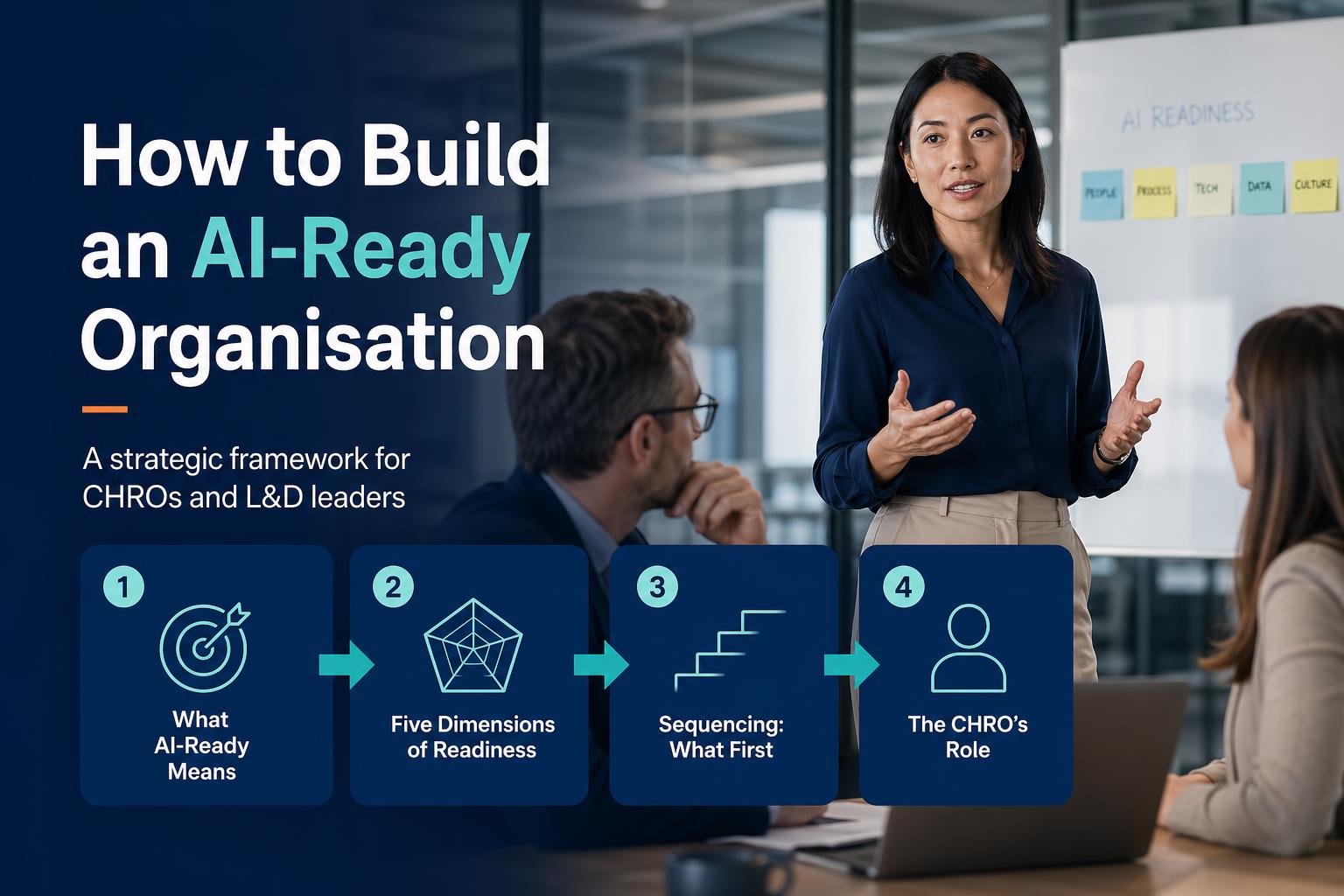
The five dimensions of organisational AI readiness
1. Leadership readiness
AI transformation stalls at the level of leadership commitment. This does not mean the CEO needs to be an AI enthusiast — it means leaders need to understand the business case for AI investment, model the behaviour they want to see (using AI tools in their own work), and create the accountability structures that sustain adoption below them.
The most reliable indicator of leadership AI readiness is not what leaders say about AI in all-hands meetings — it is whether they have changed any of their own workflows in the past 90 days as a result of AI tools. Leaders who use AI to prepare board presentations, analyse data, or draft communications create visible permission for their teams to invest time in adoption. Leaders who only talk about AI create cynicism.
Leadership readiness interventions: executive AI literacy sessions that focus on use cases relevant to their specific functions, facilitated AI workflow pilot with the leadership team before rolling out to the workforce, and a leadership communication plan that provides specific examples of how leaders are using AI personally — not just endorsements of the programme.
2. Workforce skills foundation
AI tools amplify existing skills — they do not compensate for skill deficits. A workforce that cannot write clearly will not produce better writing by using an AI writing assistant; it will produce more poorly-structured output faster. A manager who cannot give useful feedback will not give better feedback by using an AI feedback preparation tool; it will surface their feedback gaps more visibly.
The skills that AI augments most effectively — writing, analysis, communication, critical thinking, structured problem-solving — are the same skills that matter most for human performance without AI. Organisations that invest in these foundational skills alongside AI tools get compound returns. Organisations that deploy AI tools on top of underdeveloped foundational skills get inconsistent results and attribute the problem to the technology.
The practical implication: before or alongside AI tool deployment, assess the workforce’s foundational skills and address the highest-priority gaps. This is not a gatekeeping argument — it is a sequencing argument for getting maximum value from the AI investment.
3. AI literacy at the right level
AI literacy means different things at different levels of the organisation. At the individual contributor level, it means knowing which tools exist, what they are useful for, how to prompt them effectively, and how to evaluate the quality of their outputs. At the manager level, it means all of the above plus the ability to identify workflow automation opportunities in their team’s operations and to set expectations for how AI is used in team deliverables. At the leadership level, it means understanding AI’s strategic implications for the business, the competitive landscape, and the workforce.
Most AI training programs deliver the same content to all levels and wonder why impact is low. Level-specific AI literacy training, calibrated to the decisions and workflows relevant to each population, produces materially higher adoption and business impact than blanket training.
4. Culture and psychological safety
The cultural dimension of AI readiness is the least discussed and the most important for sustained adoption. Employees who fear that demonstrating AI proficiency will accelerate their redundancy will not adopt AI tools voluntarily. Employees who see colleagues being replaced by automation will not share AI productivity wins. Employees in cultures where admitting you don’t know how to use a tool is seen as weakness will not ask for help when they are struggling.
Building AI-positive culture requires explicit leadership communication about the organisation’s approach to AI and workforce change: what will change, what will not, how roles will evolve, and what investment the organisation is making in its people’s AI capabilities. The organisations that get this communication right create psychological safety for adoption. The organisations that stay vague create anxiety that suppresses it.
5. Systems and measurement infrastructure
Sustainable AI adoption requires measurement infrastructure — the ability to track who is using AI tools, how consistently, with what quality of output, and with what business impact. Without measurement, adoption is invisible: you cannot identify who needs support, you cannot celebrate wins, you cannot build the business case for continued investment, and you cannot detect regression after the initial rollout energy fades.
Minimum viable measurement infrastructure: a baseline capability assessment before deployment, usage tracking at the individual level (not just aggregate), a quality check mechanism for output review, and a before/after productivity measurement protocol for the specific KPIs the AI investment is targeting. This infrastructure is buildable in a spreadsheet for the first cohort. It should be systemised by the second.
Sequencing: what to build first
The temptation is to build all five dimensions simultaneously. This produces an unfocused programme that spreads resource too thin and delivers marginal progress on everything rather than decisive progress on what matters most.
The recommended sequence for mid-market organisations
Phase 1 (months 1–3): Leadership readiness and baseline assessment. Brief and align the leadership team. Run a baseline AI capability and readiness assessment across the workforce. Identify the highest-value AI use cases for the business. Launch a small pilot (one function, one cohort) that produces ROI data before any broad rollout.
Phase 2 (months 3–6): Manager population first. Managers are the highest-leverage AI adoption investment because they are also the accountability layer for their teams. A manager who uses AI daily, values it, and can speak credibly to its impact will pull their team’s adoption. A manager who is not using AI has no ability to support or expect it in their team. The manager population is the correct first broad rollout target — not the entire workforce.
Phase 3 (months 6–12): Function-by-function workforce rollout. Using the manager layer as the accountability structure, expand AI adoption function by function, starting with the functions where ROI is most clearly measurable. Build culture and measurement infrastructure during this phase. Address psychological safety explicitly through communication and by making wins visible.
Phase 4 (ongoing): Continuous capability building. AI tools are changing too fast for a one-time training programme to remain current. Build the infrastructure for continuous capability updating: a prompt library that is refreshed regularly, a quarterly new-workflow introduction process, and a mechanism for employees to share use cases with the L&D team for scaling. The organisations that stay ahead of AI adoption build this continuous learning habit rather than running periodic one-off programmes.
The CHRO’s role in AI transformation
The CHRO is the most strategically positioned executive for AI transformation — with responsibility for workforce planning, talent acquisition, culture, and capability development, the CHRO’s mandate spans every dimension of AI readiness. The problem is that most CHROs are positioned as programme support rather than programme leadership in AI transformation initiatives, which are often owned by the CTO or CIO with HR brought in to “handle the people side.”
The CHRO’s AI transformation responsibilities should include: workforce impact assessment (which roles will change and how, and what is the reskilling and restructuring timeline), AI readiness programme design and governance, leadership AI enablement (the CHRO often has better access and credibility with the leadership team on culture and behaviour change than the CTO does), and the measurement framework that connects AI investment to workforce productivity outcomes.
The workforce planning dimension
AI transformation will change the skill requirements of almost every role over a 3–5 year horizon. The CHRO who is proactively modelling which skills are at risk of automation, which new skills are being created, and what the reskilling and redeployment strategy is for the affected workforce is a strategic partner to the CEO. The CHRO who waits for the technology team to determine the workforce impact and then manages the fallout is a reactive cost centre.
The practical work: a role-by-role AI impact assessment (which tasks in each role will be automated, augmented, or unaffected within 24–36 months), a skills transition map for the most affected populations, and a build/reskill/redeploy/release decision framework for the talent management process.
The L&D leader’s role
The L&D leader’s role in AI transformation is to design and operate the capability building infrastructure — but the ambition needs to be larger than running training. The L&D team that approaches AI transformation as a training delivery problem will produce good training with modest business impact. The L&D team that approaches it as a behaviour change and productivity problem will produce measurable workforce capability improvement.
Shifting from training delivery to performance consulting
The most valuable contribution an L&D leader can make to AI transformation is to connect capability gaps to business outcomes and design interventions that produce measurable performance improvement — not just training completion. This requires a different set of stakeholder relationships (with operations and finance as well as HR), a different set of measures (productivity metrics rather than completion rates), and a different programme design approach (30-day behaviour change sprints rather than one-day training events).
The L&D team as an AI adoption model
The L&D team is also one of the highest-potential AI beneficiaries in the organisation. AI tools can dramatically accelerate content creation, skills assessment, needs analysis, and reporting — reducing the ratio of L&D administrative overhead to strategic work. L&D teams that use AI extensively in their own operations have better credibility when leading AI adoption programmes and generate the internal case studies that make adoption more tangible for the workforce.
The four failure modes of AI readiness programmes
1. Technology-first, people-second sequencing
Deploying tools before building the capability and habit infrastructure is the most common failure mode. Organisations that announce a Microsoft Copilot or ChatGPT Enterprise rollout and assume employees will adopt through self-discovery consistently produce the same outcome: 15–20% enthusiastic adoption, 60% passive non-use, 20% active resistance. The tool is in place; the behaviour change programme is not.
2. One-and-done training events
A half-day AI training event produces knowledge but not habit. Behaviour change requires repeated practice, accountability structures, and feedback loops over time. Organisations that define “AI training” as a completion event on the LMS and declare the programme complete are creating a false sense of progress. The measure of programme success is not whether employees attended training — it is whether they are using AI tools productively three months later.
3. No accountability for managers
Manager AI adoption is both a value in its own right and the single most important enabler of team-level adoption. Organisations that deploy AI training to the full workforce without specifically addressing manager adoption and accountability produce highly uneven adoption rates across teams. The variance is almost entirely explained by manager behaviour — teams with adopting managers adopt; teams with non-adopting managers don’t, regardless of what individual contributors learn in training.
4. No measurement of business impact
AI readiness programmes without business impact measurement cannot sustain investment or demonstrate value to finance. The budget is approved; the programme runs; completion rates are reported; and at the next budget cycle, L&D cannot demonstrate what the investment returned. Building measurement infrastructure — before/after productivity assessment, manager time savings data, KPI movement connected to specific training cohorts — is the difference between a programme that grows and one that gets cut.
Measuring AI readiness progress
Organisational AI readiness score
Measure AI readiness across the five dimensions (leadership readiness, workforce skills, AI literacy, culture, measurement infrastructure) on a 1–5 scale at programme launch and at 90-day intervals. This gives you a baseline, a directional trajectory, and the ability to identify which dimension is lagging and needs intervention. The score is not a KPI you optimise for — it is a diagnostic tool that guides resource allocation.
Adoption depth vs. adoption breadth
Track two adoption metrics separately: breadth (what percentage of the target population is using AI tools at all) and depth (how frequently — daily users vs. weekly vs. monthly). Breadth without depth is superficial adoption that produces no lasting productivity gain. Depth without breadth means your AI investment is concentrated in a small enthusiast population. The target is both: 70%+ of the target population using AI tools 3+ times per week on relevant workflows.
Productivity impact
For each AI workflow deployed, measure the before/after time cost of the specific task the workflow addresses. A manager who previously spent 45 minutes preparing a weekly status report and now spends 12 minutes represents a 33-minute saving per week. Aggregated across a manager cohort of 50 people, that is 27.5 hours of recovered management capacity per week — a number that is credible in a CFO conversation in a way that completion rates are not.
Leading indicators for culture and confidence
Run a short quarterly pulse on: AI confidence (do employees feel capable of using AI tools effectively), AI safety (do employees feel safe to experiment and fail), and AI value (do employees believe AI is making their work better). Culture takes longer to move than behaviour — these leading indicators let you see whether the cultural preconditions for sustained adoption are improving.
Sources and further reading
- McKinsey Global Institute, The Economic Potential of Generative AI (2023) — analysis of AI impact on workforce productivity, role transformation, and the reskilling requirement by sector and occupation
- World Economic Forum, Future of Jobs Report 2025 — global data on AI-driven job transformation, skill requirement shifts, and employer investment in reskilling
- MIT Sloan Management Review, Building the AI-Powered Organisation — research on the organisational and cultural factors that predict successful AI deployment at scale