Last updated: 30 March 2026
Reskilling vs. upskilling: the distinction that shapes programme design
Upskilling means deepening or extending skills within a current role. A customer service manager who learns to use AI to analyse customer sentiment data is upskilling — their role remains fundamentally the same but they are now more capable in it.
Reskilling means developing a materially different skill set, often in preparation for a different role. A data entry specialist whose role is being automated and is being prepared for a customer success role is reskilling — the new role requires different capabilities from the old one, and the development investment required is larger.
Most what is called “reskilling for AI” in 2026 is actually upskilling: adding AI tool proficiency to existing roles rather than transforming people for fundamentally different work. That distinction matters for programme scope and investment. True reskilling — transforming employees whose roles will be substantially automated into employees who can do genuinely different work — requires a longer programme, higher investment, and more careful candidate selection than upskilling.
How to assess which roles AI will impact most
The AI job impact analyser gives you a role-by-role exposure view to start from, rather than assessing every job in the organization by hand.
Not all roles face the same AI impact timeline or magnitude. Before designing a reskilling programme, organisations need a role-level AI impact assessment — an honest analysis of which specific tasks in each role are likely to be automated, augmented, or unaffected within the relevant planning horizon.
The task-level analysis
Job titles are not useful units of analysis for AI impact. A “marketing manager” role that is 60% content creation and data analysis faces a different AI exposure than a “marketing manager” role that is 60% stakeholder management and strategic planning. The analysis requires going below the title level to the actual task composition of each role in your specific organisation.
For each major role, map the primary recurring tasks and categorise each as: automatable (AI can perform this task without human input), augmentable (AI can significantly accelerate this task but human judgement remains important), or human-dependent (the task requires human relationship, judgement, or creativity that AI cannot substitute in the planning horizon).
The distribution of tasks across these categories gives you the AI exposure profile for each role. A role with 60%+ automatable tasks faces a significant reorientation requirement. A role with 80%+ human-dependent tasks faces a different kind of AI opportunity — using AI tools to handle the automatable minority so human capacity can be freed for what humans uniquely do well.
Timeline calibration
AI impact is not binary — it unfolds over time, and the timeline varies by task type and by how quickly specific AI tools mature. Data processing and structured analysis tasks are already substantially automatable. Complex creative, ethical judgement, and relationship-intensive tasks will remain human-dependent considerably longer.
Build your reskilling timeline around realistic impact horizons: 0–18 months (already happening), 18–36 months (likely with current technology trajectory), and 36–60 months (plausible but uncertain). Prioritise reskilling investment for the 0–36 month window where the timeline is predictable enough to act on.
Involve the affected workforce
The best source of data on which tasks in a role are ready for AI augmentation is the people doing the role. A structured input process — a workshop or structured survey asking employees to identify which of their recurring tasks are time-consuming but repetitive, which require real judgement, and which they find least engaging — surfaces reskilling opportunities faster than any analyst assessment and builds buy-in for the changes that follow.
Building the reskilling business case
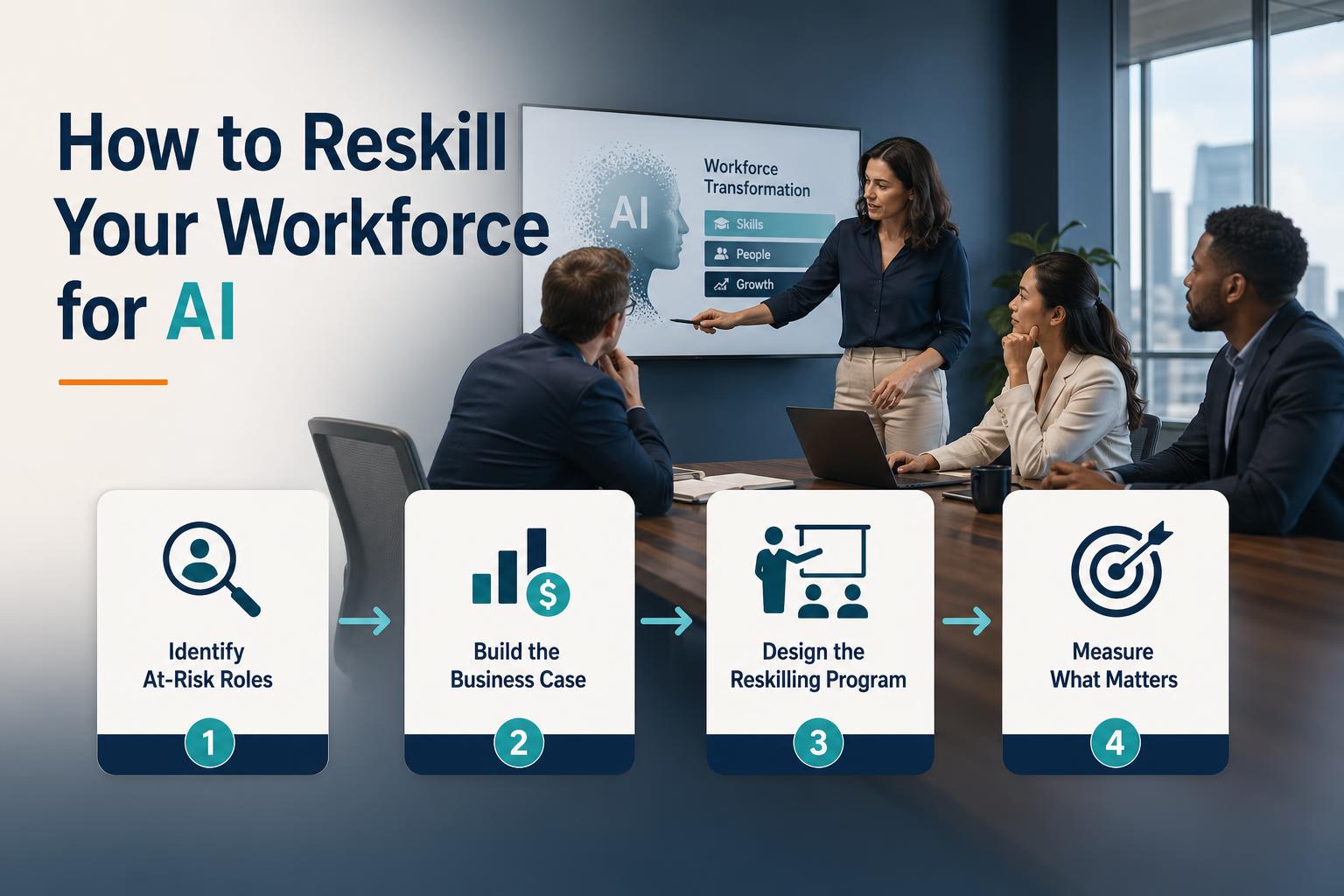
Reskilling investment requires a business case because it is expensive: typically 3–6 months of programme time per significant reskilling target, plus development costs, plus productivity displacement during the transition. Finance will not approve it on the basis of vague arguments about “future-proofing the workforce.”
The cost-of-inaction argument
The strongest reskilling business case is built on the cost of inaction. What happens if the organisation does not reskill the affected population? The options are: replace them when their roles are automated (recruiting cost: 50–200% of annual salary per replacement, plus time-to-productivity lag), make them redundant (severance cost, legal risk, organisational disruption, reputational damage in the talent market), or retain them in roles with declining productive output (ongoing salary cost with declining value creation).
Reskilling cost is typically lower than any of these alternatives when the affected population has high average tenure and strong organisational knowledge — the type of contextual knowledge that new hires take 6–12 months to acquire. For populations where this is true, the reskilling ROI case is strong and relatively straightforward to model.
The productivity gain argument
For upskilling (adding AI proficiency to existing roles), the business case is simpler: what is the productivity gain from the AI augmentation, and what does that represent in business value? A manager population of 100 that recovers an average of 4 hours per week through AI workflow automation represents 400 hours of recovered management capacity per week. At an average fully-loaded manager cost of $75 per hour, that is $30,000 per week in recovered capacity — or $1.5M per year. The reskilling investment to produce that outcome is typically a fraction of the annual return.
Identifying the right skill targets
AI reskilling programmes that target only AI tool proficiency — “how to use ChatGPT” — produce thin, fast-decaying capability. The tools will change. The underlying skills that make AI tool use effective are more durable.
The AI-amplified skill set
The skills that AI augments most powerfully — and that reskilling programmes should therefore build alongside AI tool proficiency — include:
- Critical evaluation of AI output: The ability to assess whether AI-generated content, analysis, or recommendations are accurate, appropriate, and complete — and to identify the specific failure modes of each tool. This becomes more important as AI is used for higher-stakes tasks.
- Structured problem framing: AI is most effective when the problem it is solving is precisely defined. Employees who can structure problems clearly, decompose complex questions into tractable sub-questions, and specify desired outputs precisely get dramatically better AI outputs than those who cannot.
- Synthesis and judgement: AI produces outputs; humans decide what to do with them. The skill of integrating AI-generated analysis with organisational context, stakeholder knowledge, and strategic judgement is a uniquely human capability that becomes more valuable as AI handles more of the analytical groundwork.
- Communication and translation: Explaining AI-driven decisions to stakeholders who do not understand the underlying tools, translating AI outputs into actionable recommendations, and communicating about AI’s limitations honestly are skills that will grow in demand as AI is used in more decision-making contexts.
Programme design principles for AI reskilling
Use cases first, tools second
The most effective AI reskilling programmes start with the specific workflows and tasks employees need to do — then identify which AI tools address those workflows — rather than starting with an AI tool and asking employees to find applications for it. “Here is how to use Copilot in your weekly reporting workflow” is more effective than “here is everything Copilot can do” because it connects the learning to an immediate, tangible use case the employee cares about.
Short, practice-heavy modules over long events
AI skills are developed through practice, not through instruction. A 30-minute session where every employee tries a specific workflow and produces an output is worth more than a 3-hour presentation on AI capabilities. Design the programme around doing, not watching. Use the instruction time to provide frameworks and context; use the majority of programme time for practice with feedback.
Build habit loops, not training events
Lasting AI skill adoption requires habit formation — which requires repetition in context over time, not a one-off training event. Design the programme around a recurring practice cadence: a new workflow each week, a review of what worked and what did not, and a mechanism for employees to share effective variations with the group. This creates a peer learning dynamic that sustains skill development beyond the formal programme.
Measure behaviour, not attendance
The measure of AI reskilling programme success is not completion rates — it is whether employees are using AI tools in their actual work, with what frequency, and with what quality of output. Build measurement into the programme design from the start: baseline the target workflows before the programme, re-measure at 30 and 90 days, and report the change in behaviour rather than the change in knowledge assessment scores.
Designing for different workforce segments
Early adopters (typically 15–20% of the workforce)
These employees are already experimenting with AI tools informally. Your job is to channel their enthusiasm productively: give them structured frameworks, connect them to the formal programme, and turn them into internal champions and peer coaches for the rest of the workforce. They are your best reskilling asset — if you ignore them, they will develop idiosyncratic habits that are harder to standardise later.
Willing but uncertain (typically 50–60%)
The majority of the workforce wants to use AI effectively but is uncertain about where to start, what is safe to use AI for, and whether their early outputs are good enough. This population needs structured starting points (specific workflows with clear instructions), psychological safety (explicit permission to experiment and fail), and visible social proof (colleagues demonstrating that AI is making their work better). They will adopt if the programme makes adoption easy and low-risk.
Resistant (typically 20–30%)
Resistance to AI is almost never irrational — it is usually a rational response to a perceived threat (job security, status change, skill obsolescence) or a past experience of technology change that did not deliver its promises. Address the specific concerns rather than dismissing them. The most effective interventions for resistant employees are: honest communication about the workforce planning implications, early wins that make the value tangible and personal, and peer influence from trusted colleagues rather than management pressure.
Measuring reskilling impact
- Skill capability change (Level 2): Pre/post assessment of the specific AI skills the programme targeted. Measure immediately after the programme and again at 90 days — the 90-day score is the more meaningful indicator of lasting capability gain.
- Behaviour change (Level 3): Are employees using AI tools in their actual workflows at 30 and 90 days post-programme? Track by tool, by workflow, and by frequency. The gap between employees who completed training and employees who are using AI regularly is your behaviour transfer gap — the number that tells you whether the programme produced habits or just knowledge.
- Productivity impact (Level 4): Before/after measurement of the specific task efficiency the AI reskilling was targeting. Time savings per workflow, error rate reduction, output volume, or whatever the relevant metric is for each specific use case. This is the number that matters for the CFO conversation.
- Workforce composition indicator: For true reskilling programmes targeting role transitions, track the percentage of the target population that has successfully moved to the target role and is performing at or above the required level 6 months post-programme. This is the ultimate reskilling ROI metric.
What reskilling programmes get wrong
Confusing tool training with reskilling
A one-day Copilot training session is not a reskilling programme. It is tool orientation. Reskilling requires sustained behaviour change over a long enough timeline that new habits form and the workforce’s productive capability genuinely shifts. Labelling tool training as reskilling produces misleading programme outcome claims and sets false expectations with finance and leadership.
Targeting the wrong population first
Reskilling programmes that start with the most resistant population — often because they are the most at-risk — start with the hardest problem and the lowest probability of visible early success. Starting with the willing-but-uncertain population (the 50–60% majority) produces faster early wins, creates the social proof that makes subsequent rollout to other populations easier, and generates the data that builds the case for sustained investment.
No accountability structure post-programme
Reskilling programmes that end cleanly — training complete, attendees return to their roles, no follow-up — produce knowledge gain that decays within 90 days without reinforcement. The accountability structure for sustaining reskilling is manager reinforcement: managers who know what skills were developed, ask about how they are being applied, and connect skill application to performance conversations. Without this layer, reskilling is an event, not a transformation.
Sources and further reading
- McKinsey Global Institute, Skill Shift: Automation and the Future of the Workforce — research on which skills will grow and decline in demand as AI automation progresses, with US-specific sector data
- World Economic Forum, Future of Jobs Report 2025 — employer survey data on AI impact timelines, reskilling investment plans, and the skills most in demand by 2027
- SHRM, Reskilling and Upskilling for the Future of Work — practitioner guide for US HR leaders on programme design, ROI measurement, and workforce transition planning