Last updated: 15 July 2026
Use the rules for the apprentice's start date
This guide summarises the apprenticeship funding rules for starts from 1 August 2026. Earlier starts remain governed by the rules that applied when they began. Apprenticeship units have separate funding rules; the April-to-July 2026 unit rules prohibit subcontracting, so do not apply the full-apprenticeship model to a unit.
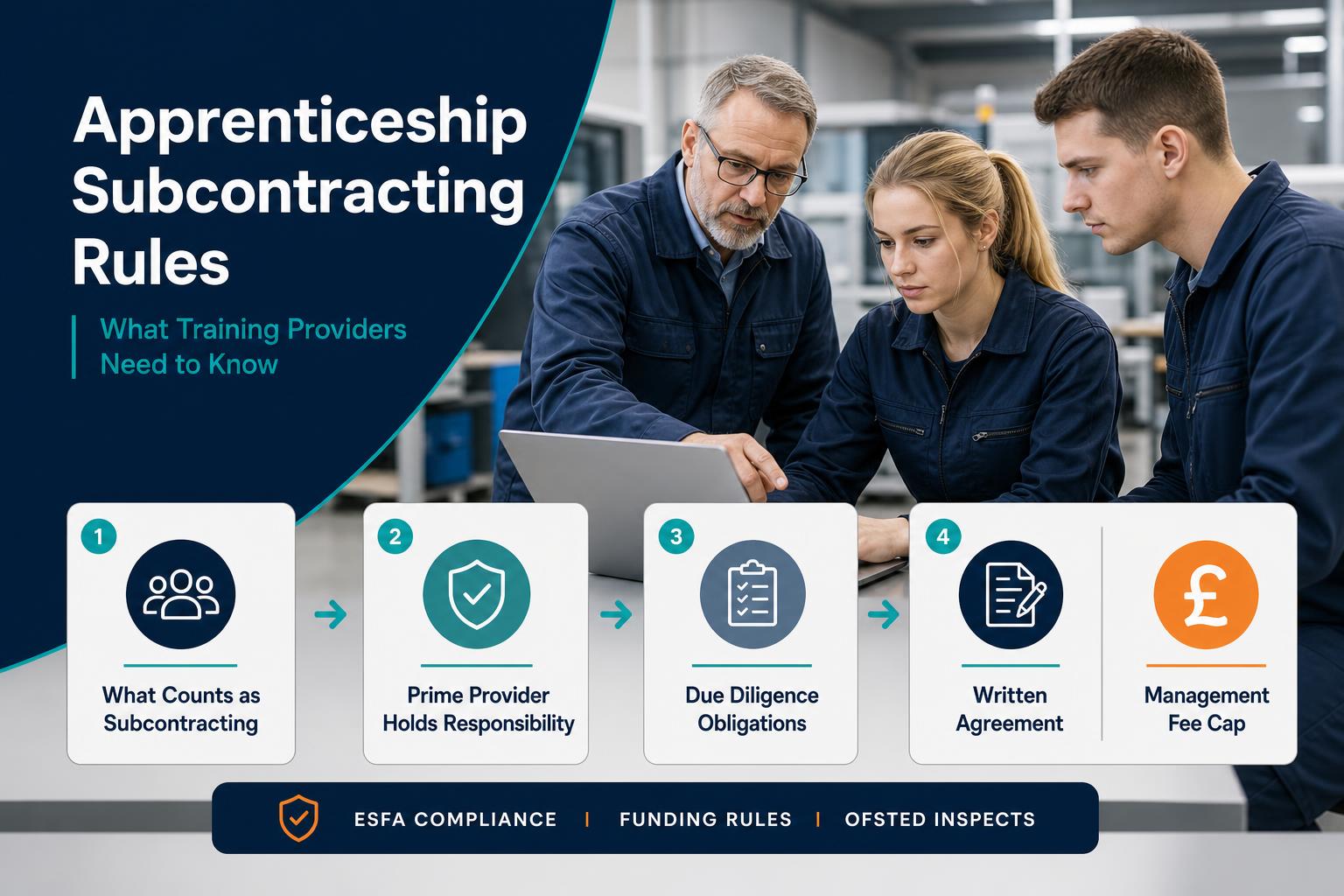
What Counts as Subcontracting in Apprenticeship Delivery
Subcontracting occurs when a separate legal entity or an individual who is not the provider's employee delivers funded apprenticeship training under an agreement with the provider. The label on the invoice does not decide the issue. Calling the arrangement consultancy, facilitation or specialist support will not take it outside the rules if the third party is actually delivering apprenticeship training.
A genuine worker who is directly managed and controlled by the provider may fall outside the subcontractor definition. That is a fact-specific employment and IR35 question: contracts, substitution rights, financial risk, control and working arrangements all matter. Providers should document their classification and take professional advice where the position is uncertain.
The 2026/27 definition relates subcontracting to delivery of training. Assessment arrangements and ordinary purchases of goods or services should be classified against the definitions in the current rules rather than automatically entered as training subcontracting.
The Main Provider Keeps Responsibility
The main provider receives apprenticeship funding and retains overall responsibility for training delivered by itself and its subcontractors. It must maintain the employer relationship, ensure apprentices understand each party's role, submit accurate data, protect public funds, oversee safeguarding and act when quality or continuity is at risk.
The provider must directly deliver some substantive apprenticeship training within each employer's apprenticeship programme. A token induction, generic safeguarding input, English or maths alone, or delivery to only a few apprentices in a large employer cohort does not satisfy this requirement. A subcontractor may complement the provider's programme and can deliver full or partial training for particular apprentices where the rules permit, but the provider cannot outsource its whole relationship and contribution.
The employer must request or agree the use of a subcontractor at the start. The provider must be able to explain how the arrangement improves the learner offer. Permitted educational rationales include extending opportunities, filling a niche or facilities gap, improving geographical access, supporting disadvantaged groups and considering the impact on people with shared protected characteristics. Financial gain is not a sound rationale.
No brokerage and no second tier
A provider must not pay a broker to source subcontractors. Every delivery subcontractor must contract directly with the provider; a subcontractor cannot pass funded apprenticeship training to another delivery layer. The provider may use more than one directly contracted subcontractor.
Eligibility and Due Diligence Before Delivery
For starts from 1 August 2026, a subcontractor normally needs the appropriate status on the Apprenticeship Provider and Assessment Register (APAR). The rules also provide limited routes for an apprentice's employer or connected organisation, a department-approved exception, and a de-minimis arrangement.
Under the de-minimis route, an organisation that is not on APAR may deliver less than £100,000 of apprenticeship training under contract across all main and employer-providers in the funding year. It must have a current UKPRN, must not have triggered the higher-risk organisations policy, and cannot deliver full apprenticeship standards. The £100,000 test is aggregate, not £100,000 for each contract.
Register status is only one check. Before appointment, the provider should evidence ownership and control, financial health, capacity, insurance, safeguarding and Prevent arrangements, conflicts and connected-party interests, delivery competence, data security, quality history and any funding restrictions. The rules prohibit using a subcontractor the provider assesses as unsuitable or demonstrably inadequate. Monitoring should remain live throughout the contract, with action triggered by ownership changes, financial distress, staffing loss, complaints, inspection findings or removal from APAR.
Procurement must follow the legal regime that applies to the provider and the procurement. New procurements by contracting authorities may fall under the Procurement Act 2023, while some earlier arrangements continue under the Public Contracts Regulations 2015. This guide is not procurement-law advice.
What the Written Agreements Need to Do
The provider must make its educational rationale, services and associated costs clear before the employer agrees to subcontracting. Its written employer agreement should identify the subcontractor, the reason for using it, the training it will deliver, the price and the provider's retained services and charges. The training plan should also make delivery roles and escalation routes clear to the apprentice and employer.
A separate written contract between the provider and each subcontractor should translate those commitments into enforceable controls. The current rules specify matters including:
- the apprenticeship training and funding covered by the arrangement;
- the exact fees, quality-monitoring costs and support charges retained by the provider, with an explanation of why they are reasonable and proportionate;
- access for the department and its nominated representatives to premises, people and relevant records;
- timely, accurate ILR and supporting data;
- quality, safeguarding, Prevent, health and safety, data-protection and audit obligations;
- notification of material events, complaints, inspection outcomes and delivery risks;
- continuity, termination, data return and learner-protection arrangements; and
- the complaints and dispute route available to employers and apprentices.
The provider remains responsible for resolving issues between an employer and a subcontractor. If a subcontractor can no longer deliver, alternative arrangements must be agreed with the employer and recorded; apprentices should not be left without training while commercial disputes are resolved.
Management Fees: What the 20% Figure Actually Means
The 2026/27 apprenticeship rules do not say that 20% is an automatic management-fee cap or that exactly 80% must always be passed on. They require the provider to publish its full range of retained fees and charges and explain how each cost is reasonable, proportionate and connected to high-quality learning. Retained charges must relate to eligible activity.
The department reserves the right to seek an explanation where a management fee exceeds 20% of the overall contract value but offers little value. That is a scrutiny trigger, not permission to retain 20% without evidence and not a blanket prohibition above it. A 10% fee with no real service can be difficult to justify; a higher figure needs especially clear cost and value evidence.
Create a schedule that maps each retained charge to an actual service, owner, frequency, cost basis and evidence record. Examples may include data assurance, curriculum oversight, observations, safeguarding assurance, contract management and learner-support infrastructure. Do not hide unrelated margin in vague administration headings or include employer incentives automatically in a fee calculation.
The Three Thresholds Providers Commonly Confuse
Three separate tests appear in the 2026/27 rules:
- Under £100,000 de-minimis eligibility: an off-register subcontractor may use the limited route only when its apprenticeship training across all contracting providers remains below the threshold and the other conditions are met. It cannot deliver a full standard.
- More than 25% subcontracted: if a provider plans to pay subcontractors more than 25% of the apprenticeship funding it receives and cannot reduce the proportion, it must obtain departmental agreement through an exemption case before the provision starts. Existing above-threshold arrangements also need the required approval.
- £100,000 aggregate assurance threshold: where total subcontracted delivery across the relevant DfE-funded provision and DWP apprenticeship provision exceeds or is expected to exceed £100,000 in a funding year, the provider must meet the DfE subcontracting standard and external-assurance requirements.
Do not use one calculation as a substitute for the others. Keep a live register that shows every subcontractor, register route, cumulative delivery value, employer, apprentice, programme, directly delivered activity, fees and monitoring evidence.
Declarations and annual governance
A provider returning ILR data must submit a fully completed subcontractor declaration twice in the 2026/27 funding year: by 31 October and by 30 June. A nil return is required where there is no subcontracting, and the declaration must be updated if arrangements change. All subcontractors must be included, including de-minimis and approved-exception cases.
The subcontracting policy and rationale must be reviewed before each funding year, approved by the person with overall governance responsibility and, for main providers, published with the services and charges by 31 October. Where the £100,000 assurance threshold applies, the 2026/27 rules require the self-assessment and external auditor's final report, action plan and assurance declaration through Document Exchange by 31 August of the relevant year. Check current operational instructions before submission.
Quality and Inspection Evidence
Funding compliance and inspection are related but not interchangeable. The DfE subcontracting standard focuses on oversight, control and public funds; Ofsted evaluates the quality and impact of education across the provider's provision. A signed contract cannot compensate for weak teaching or poor apprentice experiences.
Useful evidence includes curriculum alignment, observations and professional-development actions, apprentice and employer feedback, safeguarding referrals and themes, progress and attendance, standard-specific off-the-job delivery, withdrawals and completion, achievement and progression. Providers should segment outcomes by delivery partner and compare them with directly delivered provision, while considering cohort size and learner context.
Monitoring must lead to decisions. Record the issue, evidence, risk owner, action, deadline, follow-up and outcome. Where quality or viability fails, the provider must protect continuity rather than wait for an inspection or funding audit.
Common Compliance Failures
- Whole-programme outsourcing: the provider contributes only a token induction and lets the subcontractor own the employer relationship.
- Incorrect threshold calculations: values are tested per contract instead of across the relevant aggregate, or the 25% and £100,000 tests are confused.
- Unverified eligibility: an APAR snapshot is missing, the de-minimis limit is not monitored across providers, or a non-APAR party delivers a full standard.
- Unsupported fees: a percentage is copied into contracts without a cost schedule or evidence of delivered services.
- Late or incomplete declarations: small, employer-linked or off-register arrangements are omitted.
- Paper-only oversight: meetings and observations occur, but risks, actions and follow-up are not evidenced.
- Second-tier delivery: an approved subcontractor quietly commissions another legal entity to train apprentices.
- Applying full-apprenticeship rules to units: current apprenticeship-unit rules are separate and must be checked directly.
2026/27 Subcontracting Compliance Checklist
- Apply the funding rules that match each apprentice's start date
- Document the educational rationale and employer agreement before subcontracting
- Evidence substantive direct delivery for every employer's apprenticeship programme
- Confirm APAR status or the precise de-minimis or approved-exception route
- Track an off-register subcontractor's aggregate delivery across all providers
- Complete risk-based due diligence and refresh it when circumstances change
- Contract directly with every subcontractor; prohibit second-tier delivery and brokerage
- Publish the approved subcontracting policy, services and fee schedule by 31 October
- Map every retained charge to eligible, reasonable and evidenced activity
- Test the 25% exemption threshold and £100,000 assurance threshold separately
- Submit declarations by 31 October and 30 June, including nil or changed returns
- Complete external assurance by the applicable deadline where the threshold is met
- Monitor curriculum quality, safeguarding, data, outcomes and financial continuity
- Keep an evidence trail showing that monitoring actions were closed
- Check the separate apprenticeship-unit rules before using any delivery partner
Frequently asked questions
What is the management fee cap for apprenticeship subcontracting?
The 2026/27 apprenticeship rules do not state an automatic 20% legal cap. They say the department may require an explanation where a management fee exceeds 20% of the overall contract value but offers little value. Every retained fee and charge must still be eligible, reasonable, proportionate, transparent and connected to services that support high-quality learning.
Can a subcontractor further subcontract apprenticeship delivery?
No. The provider must contract directly with every subcontractor and must not create a second subcontracting level. A provider can use more than one subcontractor, but each must be directly contracted, declared and managed by the provider.
What happens if a subcontractor receives a poor Ofsted inspection outcome?
The provider remains responsible for quality and must monitor changes that affect a subcontractor's ability to deliver. Its agreement must require notification of relevant Ofsted outcomes, complaints and other material events. If delivery cannot continue, the provider must agree alternative arrangements with the employer and protect each apprentice; the correct action depends on the facts and current funding agreement.
Sources & further reading
- Apprenticeship funding rules 2026 to 2027 — Apprenticeship funding rules 2026 to 2027
- DfE subcontracting standard — DfE subcontracting standard
- Apprenticeship Provider and Assessment Register (APAR) — Apprenticeship Provider and Assessment Register (APAR)
- Further Education and Skills Inspection Handbook — Further Education and Skills Inspection Handbook