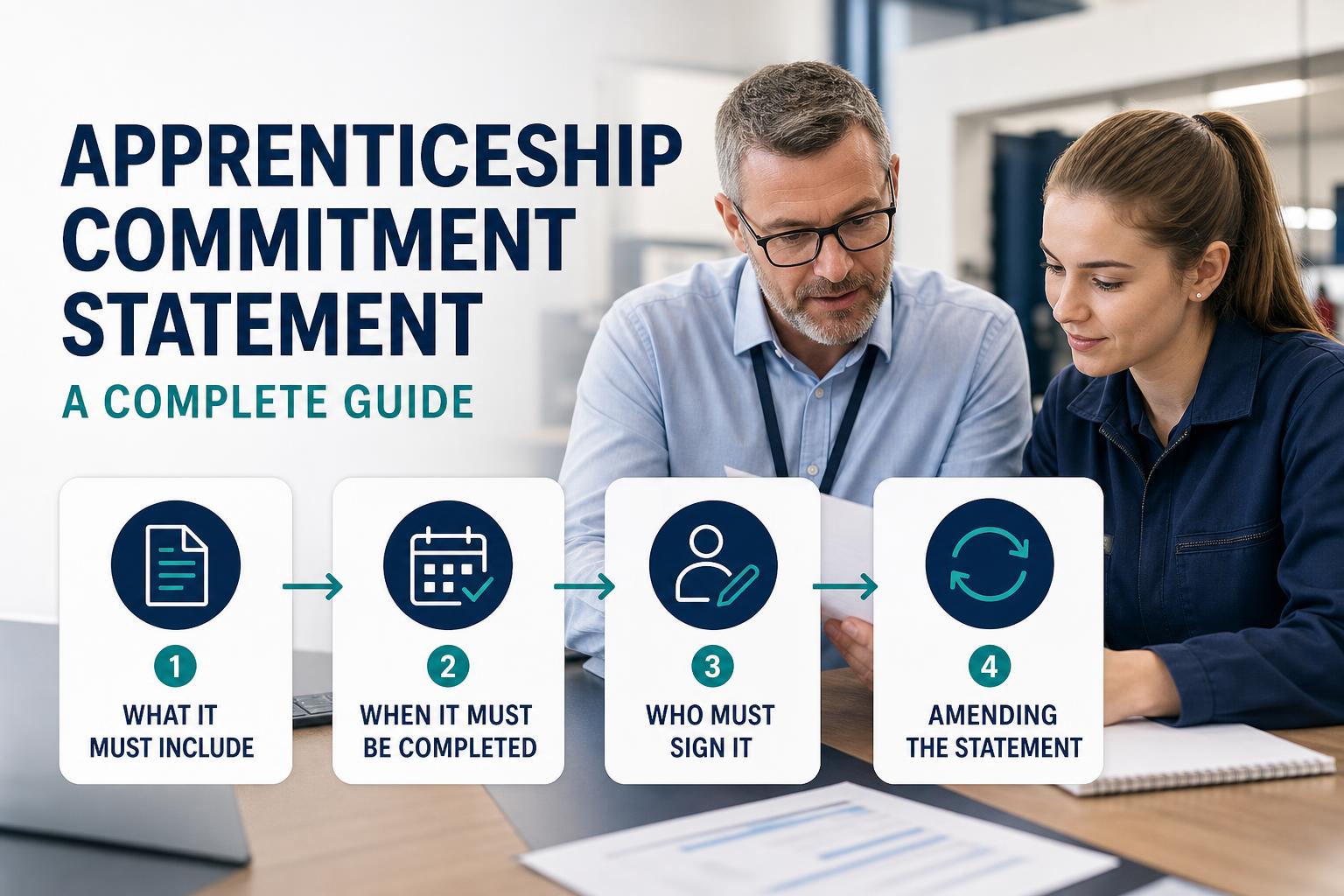
The training plan is the operational agreement for an apprentice's learning. The provider develops it with the apprentice and employer, and both must have an opportunity to contribute. It is not the same as the apprenticeship agreement: the agreement is between employer and apprentice, while the provider also signs the training plan.
Funding rules differ by start year. This guide focuses on apprenticeships starting between 1 August 2026 and 31 July 2027. Keep earlier cohorts on the rules that applied when they started.
Agreement and signature timing
The broad content must be agreed before training is delivered. Aim to obtain the fully signed plan before the learning start date. If agreement is reached virtually or by email and a signature cannot be obtained immediately, retain that evidence and complete the signed plan by the end of the 42-day qualifying period.
For a long apprenticeship, every later module does not have to be fully specified on day one. The signed plan must still show the total planned off-the-job hours for the whole apprenticeship, with content added as it becomes known. Funding can only be claimed from the date that documented, apprenticeship-related learning begins and can be evidenced.
Mandatory content checklist for 2026/27
The provider may use the government template or its own system. An alternative is acceptable only if it captures the required information. Include:
- the apprentice's name, job role and normal paid weekly hours excluding overtime;
- the provider, employer, subcontractors and assessment organisation;
- a summary of the initial assessment, unless it is recorded separately;
- the standard name, level, apprenticeship dates and practical-period dates;
- the total planned off-the-job training hours;
- the delivery model, such as day release, block release or front-loaded delivery;
- the occupational content and whether each activity is included in off-the-job hours;
- any standalone English or maths qualification, clearly excluded from planned OTJ hours;
- when content will be delivered and who is responsible for each component;
- the employer's written confirmation that release will occur in normal working hours;
- the frequency and format of progress reviews; and
- the provider's internal complaints route and escalation to Apprenticeship Service Support.
If the assessment organisation is unknown at the start, update the plan when selected and no later than six months before the planned learning end date.
Off-the-job hours and prior learning
Do not put a universal “20%” figure into every new plan. For starts from 1 August 2025, use the minimum hours published for the exact standard and version on Skills England. The provider can plan more, but not less, unless a permitted adjustment for evidenced relevant prior learning applies.
Complete the initial assessment before finalising the plan. Content the apprentice already has must not be delivered or charged again. Show omitted content as hours, adjust the plan and compliance minimum under the applicable RPL method, and align the price. For starts from 1 August 2026, at least eight months and 187 hours of content must remain, and a standard or assessment plan may require longer.
The planned hours and dates in the training plan, ILR and apprenticeship agreement should agree. A correct figure in one system does not cure a conflicting signed document.
Progress reviews and material changes
Under the 2026/27 rules, conduct a progress review at least every three calendar months. A different timetable can be agreed in advance for an evidenced delivery reason, but reviews must be no more than six months apart; separate learning-support review requirements still apply.
The review is a three-way discussion. If the employer cannot attend, give it an opportunity to contribute and do not let absence become the default. The employer should attend the majority of reviews. Share the summary with all parties and obtain the signatures required by the applicable rules.
Use reviews to compare delivered learning against the plan, collect evidence controlled by other parties, record slippage, agree actions and update the plan. Obtain a fresh employer signature when:
- content is added or removed;
- the planned learning end date changes; or
- replanned missed training materially changes the future release hours required.
Keep every signed version. Do not overwrite the evidence trail.
End-of-programme confirmation
For starts from 1 August 2026, the employer, provider and learner must agree that the training-plan content has been delivered. Record that agreement in the plan or the gateway-to-completion review process.
If actual off-the-job hours are below the original planned total but still meet the adjusted standard minimum, the rules require a statement showing planned hours, actual hours, why fewer were delivered and confirmation that the minimum was met. Arrange signatures from the employer and apprentice and retain the statement in the evidence pack within the required timeframe.
Provider audit checklist
- The exact standard code and version match Skills England.
- The correct start-year funding rules are recorded.
- Initial assessment and RPL decisions map to content, hours and price.
- Broad content was agreed before learning began.
- All parties signed within the permitted timing.
- Planned hours meet the standard-specific minimum.
- English and maths standalone learning is not counted as OTJ.
- Employer release in normal working hours is explicit.
- Plan, ILR and apprenticeship agreement dates and hours align.
- Material changes are versioned and re-signed where required.
- Progress reviews meet the agreed cadence and involve all parties.
- End-of-programme delivery agreement is retained.
The training plan should describe the apprenticeship actually being delivered, not the programme that existed when a template was first created. Treat it as a controlled, living record and use the official rules—not this article alone—when making a funding decision.
Frequently asked questions
Is the apprenticeship commitment statement still required?
The current funding rules use the term training plan. Providers should not rely on an old commitment-statement template without checking it against the rules for the apprentice's start year. The training plan is a separate document from the apprenticeship agreement and is signed by the provider, employer and apprentice.
When must the apprenticeship training plan be signed?
For starts from 1 August 2026, the broad content must be agreed before training begins. Where the provider cannot obtain a signed version before delivery, it must retain evidence of that initial agreement and have the fully signed plan in place by the end of the 42-day qualifying period.
Does the training plan use a 20% off-the-job calculation?
Not for starts from 1 August 2025. Record the provider's planned hours, which must be at least the minimum published for the exact standard and version on Skills England, after any valid prior-learning adjustment. English and maths standalone qualifications do not count in those planned off-the-job hours.
How often must a training plan be updated?
Keep the plan current when material circumstances change. Progress reviews provide an opportunity to update it. Under the 2026/27 rules, a new employer signature is expected when content is added or removed, the planned learning end date changes, or replanned off-the-job training materially changes future release hours.
Sources & further reading
- Apprenticeship funding rules and assessment-plan guidance 2026 to 2027 — GOV.UK — Apprenticeship funding rules and assessment-plan guidance 2026 to 2027 — GOV.UK
- Apprenticeship funding rules by start year — GOV.UK — Apprenticeship funding rules by start year — GOV.UK
- Apprenticeship standards and versions — Skills England — Apprenticeship standards and versions — Skills England