Last updated: 1 November 2026
Executive Summary
One of the most consequential clauses in Skills England's apprenticeship assessment reform is the decision to remove independent assessment of workplace Behaviours and transfer that verification duty directly to the employer. Pedagogically, it makes total sense: nobody knows an apprentice's work ethic, teamwork, and safety habits better than their daily supervisor. Operationally, however, it creates a ticking time bomb for providers still relying on desktop portals that line managers never log into. Here is how to turn employer-verified Behaviours into a 10-second mobile advantage.
1. Why Independent Behaviour Testing Was Scrapped
Under the old 2017 EPA rules, an external assessor who had never met the apprentice had to judge whether the learner possessed occupational Behaviours like "takes ownership of work," "adapts positively to changing priorities," or "works inclusively with colleagues" based solely on a 45-minute video Q&A.
That rewarded learners who were good at rehearsing interview stories and penalized quiet, conscientious craftspeople who demonstrated exemplary workplace habits every day on site. Shifting Behaviour verification to the employer fixes that distortion.
2. The New Operational Risk: When Busy Line Managers Hold the Keys to Completion
Wait until you look at what this reform means for your completion cashflow:
Previously, an employer only had to sign a single high-level Gateway Readiness declaration. Under the reformed Apprenticeship Assessment Plans (AAPs), **employer verification IS the formal assessment mechanism for Behaviours**.
If your e-portfolio requires a busy construction site manager, retail store manager, or NHS ward matron to log into a desktop web portal and write paragraph justifications against six Behavioural criteria (`B1` to `B6`), your completions will grind to a halt.
3. Interactive Demo: 10-Second WhatsApp Behaviour Verification
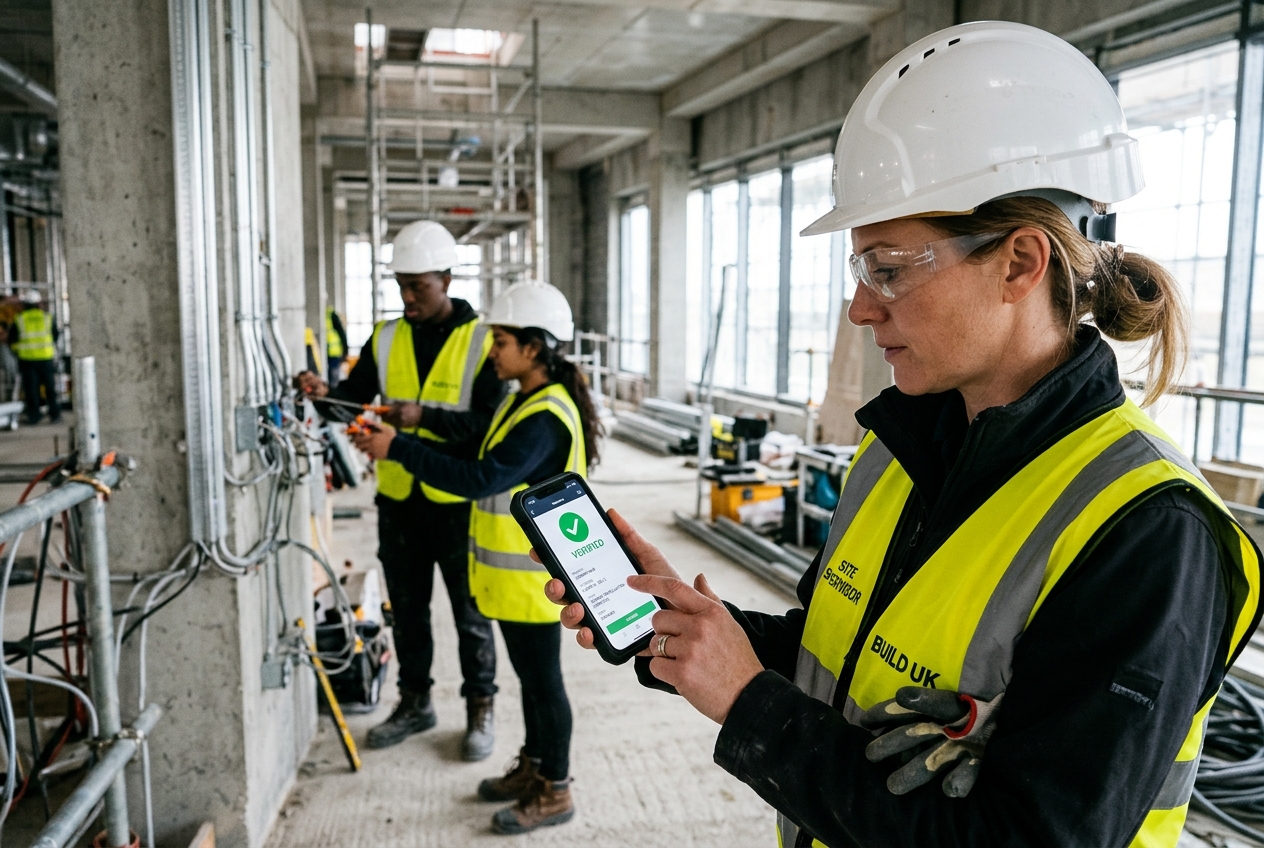
Instead of dumping a 6-page Behavioural sign-off form on a line manager at the end of the apprenticeship, TIQPlus captures **micro-verified Behavioural proof throughout the programme**. Click the verification buttons in the interactive simulator below to see how a supervisor signs off `B1`, `B2`, and `B4` in 10 seconds on their phone:
Live Employer Behaviour Verification Matrix
4. Preventing "Tick-Box Rubber-Stamping" at External Quality Assurance
Ofqual and Awarding Organisations have already flagged a key quality risk with employer-verified Behaviours: **what stops an employer from blindly ticking "Pass" on all Behaviours on the final day without any underlying proof?**
Under External Quality Assurance (EQA) scrutiny, a bare signature with zero attached workplace examples will be challenged. TIQPlus solves both problems at once: the line manager never has to type an essay, yet every 1-tap WhatsApp vouch is cryptographically bound to a specific geotagged photo and apprentice voice reflection from a real shift.
5. Provider Implementation Playbook for Employer-Verified Behaviours
- Map Behaviours to Socratic Voice Prompts: Ensure learners articulate how they behaved (safety, teamwork, communication) during their 45-second on-site voice reflections.
- Require 3 Micro-Vouches Per Behaviour Across the Programme: Rather than one high-stakes sign-off at Month 15, collect three 10-second WhatsApp micro-vouches per Behaviour across Months 3, 8, and 12.
- Auto-Compile the Employer Behaviour Statement: At the final assessment point, TIQPlus automatically compiles the employer's timestamped micro-vouches into a single, EQA-compliant Behavioural Verification Certificate.
"Skills England's assessment reforms hand workplace Behaviour verification directly to the employer. Great in theory—until you realize 70% of busy site supervisors and line managers never log into desktop e-portfolios. If employer sign-off is required for certification, 10-second WhatsApp micro-vouching is essential."
Frequently asked questions
Who assesses workplace Behaviours under the reformed Apprenticeship Assessment Plans?
Under Skills England's apprenticeship assessment reforms, independent End-Point Assessment Organisations (EPAOs) no longer assess workplace Behaviours separately at the end of the programme. Instead, the apprentice's employer is responsible for verifying that occupational Behaviours (such as safety culture, resilience, teamwork, and adaptability) have been consistently demonstrated in the workplace.
Why did the government move Behaviour verification to employers?
Evaluating whether an apprentice is reliable, collaborative, and safety-conscious over 18 months is something their daily line manager observes firsthand—whereas an external assessor in a 45-minute video interview could only test whether the learner had memorized a scripted story about teamwork.
What is the operational risk for training providers?
If an apprenticeship cannot be certificated until the employer formally verifies every Behavioural statement, any friction in getting busy site supervisors or ward managers to log into an e-portfolio will directly block completion and the provider's 20% final payment.
How does TIQPlus capture audit-ready employer Behaviour verification?
Whenever an apprentice logs workplace evidence demonstrating a Behaviour, TIQPlus sends a 1-tap WhatsApp micro-vouch card to the line manager's phone. By Gateway, the employer has already verified specific behavioural examples across the entire programme.
Sources & further reading
- Skills England: Apprenticeship Assessment Reform — Employer Verification of Behaviours — gov.uk/government/organisations/skills-england
- Ofqual Consultation on Regulating Reformed Apprenticeship Assessments — gov.uk/government/organisations/ofqual
- DfE Apprenticeship Funding Rules: Employer Declarations — gov.uk/guidance/apprenticeship-funding-rules