Last updated: 1 November 2026
Executive Summary
When the Richard Review reforms introduced standalone End-Point Assessment (EPA) in 2017, the goal was independent rigour. The unintended consequence was a bureaucratic logjam: apprentices waiting months past their planned end date for assessor availability, duplicate testing of skills already passed in mandatory qualifications, and high-stress "all-or-nothing" final exams. Now, Skills England and the DfE are dismantling standalone EPA in favor of streamlined Apprenticeship Assessment Plans (AAPs) featuring any-stage assessment, proportionate sampling, and employer-verified behaviours.
1. Why the 2017 Standalone EPA Model Broke
Across 700+ occupational standards, the post-2017 EPA architecture created three systemic failures that damaged both Qualification Achievement Rates (QAR) and employer trust:
- The Month-18 Logjam: Concentrating 100% of independent assessment after Gateway created severe seasonal bottlenecks, delaying final certification and withholding the provider's 20% completion payment for months.
- Duplicative Assessment Theatre: In standards containing a mandatory regulated qualification (e.g., engineering, healthcare, or accounting), learners were forced to pass an exam with an awarding body and then sit a nearly identical test weeks later with an EPAO.
- Episodic Memory Decay: Asking an apprentice at Month 24 to defend a basic safety procedure they mastered in Month 3 tested long-term exam recall rather than practical competence.
2. Interactive Simulator: Legacy 2017 EPA vs. 2026 Any-Stage AAP
Toggle between the two architectures below to see how **Any-Stage Apprenticeship Assessment Plans (AAPs)** distribute assessment milestones across the learner journey and eliminate the Gateway bottleneck:
Assessment Timeline & Cashflow Comparator
Core safety & foundational skills assessed and signed off as soon as mastered on site.
Mandatory qualification units credited directly (zero duplication); employer verifies Behaviours via mobile.
Proportionate sampling assessment with zero 12-week EPAO scheduling backlog. Instant 20% completion claim.
3. The 4 Pillars of Skills England's Reformed Assessment Plans
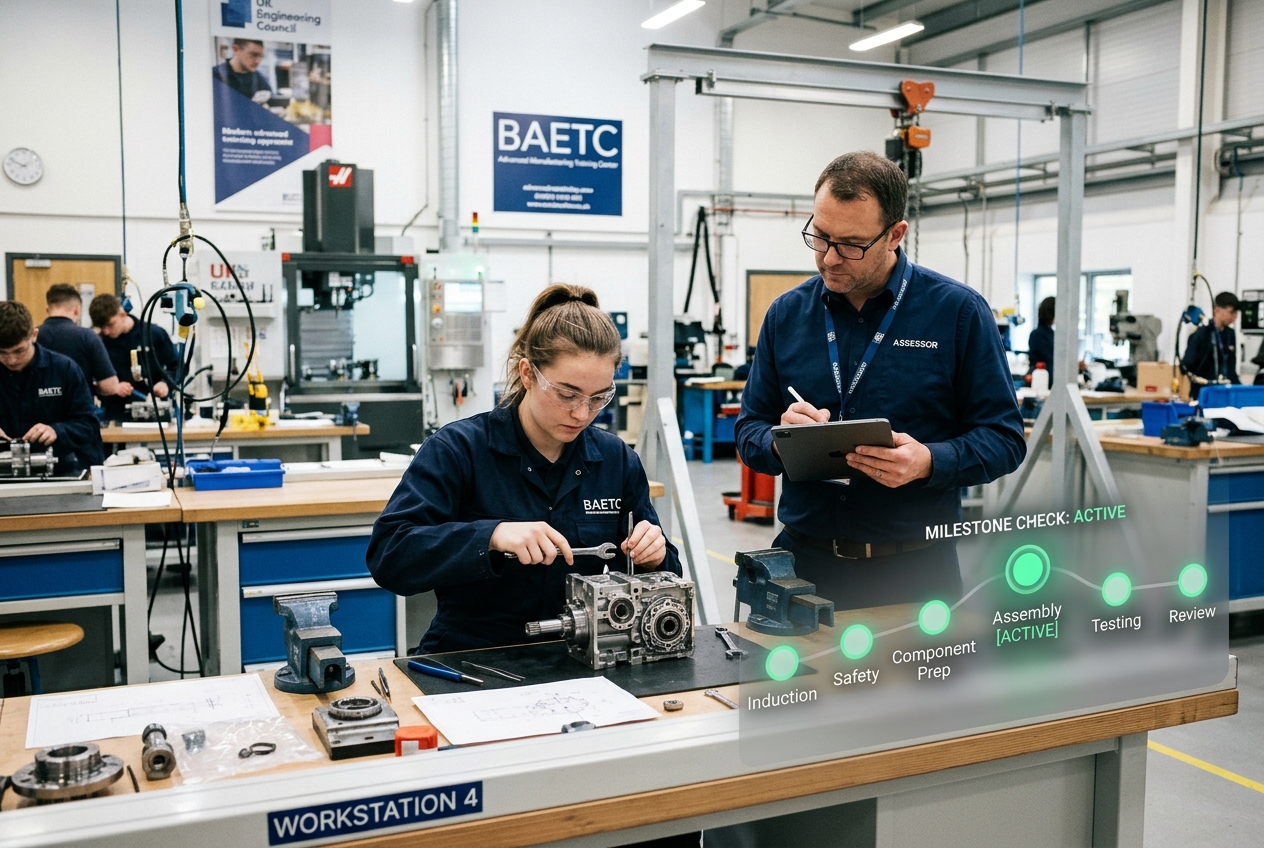
- Assessment at Any Stage: Practical skills and knowledge blocks can be assessed during the programme immediately after teaching and workplace practice, rather than hoarded until Month 18.
- Proportionate Assessment Sampling: Instead of testing every single KSB in multiple assessment methods, AAPs allow valid sampling across criteria clusters.
- No Duplication of Mandatory Qualifications: Where an apprenticeship includes an Ofqual-regulated qualification, passing those modules counts directly toward the apprenticeship assessment without re-examination.
- Employer-Verified Behaviours: Independent EPAOs no longer artificially grade workplace Behaviours in a 45-minute interview; instead, the employer verifies that the learner has consistently demonstrated required Behaviours on the job.
4. What This Means for ITPs and Assessment Organisations
While the pace of publishing reformed AAPs across all 700+ standards is phased through 2026 and 2027, the operational direction of travel is unmistakable: **on-programme evidence quality is now the main event**.
When training providers are trusted to deliver and mark staged assessments under awarding body quality assurance, their digital audit trail must be watertight. A provider cannot sign off an on-programme stage assessment using an unverified Word document—they need timestamped, geotagged, computer-vision-grounded proof.
5. Building Continuous Evidence Passports in TIQPlus
TIQPlus was built from the ground up for continuous, staged verification. Every **Evidence Passport** combines live on-site photo telemetry, voice reflection, semantic KSB confidence scoring, and 1-tap employer sign-off—allowing providers to package and bank on-programme AAP milestones effortlessly.
"The 2017 standalone End-Point Assessment (EPA) bottleneck is finally being dismantled. Under Skills England's reformed Apprenticeship Assessment Plans (AAPs), assessments can happen at any stage on programme, mandatory qualifications aren't tested twice, and workplace Behaviours are verified by the employer."
Frequently asked questions
What is replacing traditional End-Point Assessment (EPA) in England?
Skills England and the Department for Education are replacing rigid, standalone End-Point Assessment plans with streamlined Apprenticeship Assessment Plans (AAPs). Under the reformed framework, assessments can take place at appropriate stages throughout the apprenticeship rather than exclusively after Gateway at the very end.
What is assessment 'sampling' in the new Apprenticeship Assessment Plans?
Instead of testing every single KSB exhaustively across multiple duplicative end-point exams, reformed AAPs use proportionate sampling of Knowledge and Skills alongside mandatory qualifications where they exist, while shifting Behaviour verification to employers.
Can training providers deliver and mark on-programme assessments under the new rules?
Where permitted by the specific reformed Apprenticeship Assessment Plan, training providers can conduct and mark designated on-programme assessment elements, subject to external quality assurance and Ofqual-regulated awarding organisation oversight.
How does Any-Stage Assessment reduce Gateway delays?
By allowing practical observations and knowledge modules to be assessed and banked as soon as the learner masters them (e.g., at Month 4 and Month 8), learners no longer face a single high-stakes multi-exam logjam at Month 18.
Sources & further reading
- Skills England & DfE: Apprenticeship Assessment Reform Principles — gov.uk/government/organisations/skills-england
- Ofqual Regulatory Framework for Reformed Apprenticeship Assessments — gov.uk/government/organisations/ofqual
- FE Week Special Report: Inside the Overhaul of End-Point Assessment — feweek.co.uk