Last updated: 15 November 2026
Executive Summary
For UK employers with a pay bill over £3 million—and the independent training providers (ITPs) who advise them—the 2026/27 Growth and Skills Levy introduced the sharpest financial restructuring since 2017. While headlines focused on the introduction of flexible modular Apprenticeship Units, three simultaneous fiscal tightenings caught many Finance and L&D teams off guard: the removal of the 10% government top-up, the halving of fund expiry from 24 months to 12 months, and the shift to 25% co-investment for over-25s once levy pots are exhausted. Here is the complete mathematical model to protect your budget.
1. The 2026/27 Triple Funding Shock for UK Levy Payers
If your L&D team is still running cohort spreadsheets built in 2024 or 2025, your forecast is mathematically broken in two opposite directions at once:
- If you under-spend your levy: The new 12-month sunset window claws back unspent monthly declarations twice as fast as before. An employer who only recruits a single September intake each year will now forfeit up to 40% of their early-year monthly contributions before the cohort's monthly instalments can draw them down.
- If you fully spend your levy: Removing the 10% government top-up shrinks your annual digital account inflow by 9.09%, pushing high-utilisation employers into co-investment earlier—where learners aged 25+ now trigger a 25% employer cash contribution instead of the legacy 5%.
2. Financial Impact of Losing the 10% Government Top-Up
Under the old Apprenticeship Levy rules, every £1.00 of levy declared via PAYE (0.5% of pay bill above £3m, adjusted for English fraction) received a 10p top-up from HM Treasury, giving the employer £1.10 in purchasing power.
With the 10% top-up removed on new declarations, look at how a mid-sized and large UK employer's annual purchasing power shifts—assuming a 100% English fraction:
| UK Employer Pay Bill | Base Annual Levy (0.5% > £3m) | Legacy Pot (With 10% Top-Up) | 2026/27 Pot (0% Top-Up) | Lost Training Purchasing Power |
|---|---|---|---|---|
| £15 Million | £60,000 | £66,000 | £60,000 | -£6,000 / yr |
| £35 Million | £160,000 | £176,000 | £160,000 | -£16,000 / yr |
| £80 Million | £385,000 | £423,500 | £385,000 | -£38,500 / yr |
| £150 Million | £735,000 | £808,500 | £735,000 | -£73,500 / yr |
3. Why the 12-Month Expiry Window Breaks Annual Cohort Planning
Remember how the Apprenticeship Service draws down funds: 80% of the negotiated price is paid in equal monthly instalments over the planned duration of the programme, with the remaining 20% held back until End-Point Assessment (EPA) completion.
Under the old 24-month rule, an employer could let funds accumulate for 14 months and then launch a large autumn cohort. Under the 12-month expiry rule, funds work on a strict First-In, First-Out (FIFO) basis over 12 rolling months:
The FIFO Monthly Burn Rule: To prevent Month 1's levy declaration from expiring in Month 13, your cumulative monthly drawdowns across active learners during Months 1–12 must equal or exceed Month 1's inflow. Relying on a single annual intake guarantees expiry leakage.
4. Navigating the 25% Co-Investment Rate (25+) vs. 100% Youth Funding
When modelling cohorts that exceed your monthly levy balance—or if you are a non-levy SME—the 2026/27 age-banding rules create a massive financial divergence between younger hires and existing-staff upskilling:
- Aged 16–21 (and 22–24 with EHCP / Care Leaver status) at SMEs: 100% government-funded with 0% employer co-investment, plus eligible Foundation Apprenticeship and Youth Guarantee incentives.
- Aged 25+ Overspend / Non-Levy Co-Investment: When a levy-payer's digital pot hits £0 in a given month, the employer co-investment rate on that month's instalment for learners aged 25+ jumps from the historic 5% to 25% (with the government paying 75% up to the funding band cap).
- Defunded Level 7 Restrictions: With public funding restricted on most Level 7 senior leader routes for older workers, employers must redirect leadership development budgets toward funded AI Leadership Apprenticeship Units (AU0002–AU0011) and Level 4–5 operational standards.
5. The "Barbell Levy Strategy": Pairing Full Standards with Short AI Units
How do UK Finance and L&D Directors achieve 98%+ levy utilisation without accidentally triggering 25% co-investment charges? By replacing static annual cohorts with a Quarterly Barbell Levy Strategy:
The 3-Part Barbell Allocation Model
- 65% Core Baseload (8-to-18-Month Full Apprenticeships): Run continuous or bi-annual intakes across core operational standards (including 8-month RPL-accelerated apprenticeships for experienced staff) to absorb a steady baseline of monthly levy declarations.
- 25% Quarterly Absorber (30-to-140-Hour Modular Apprenticeship Units): Every quarter, review your 90-day expiry horizon in the Growth & Skills Levy Planner. Deploy short, high-impact AI Leadership & Digital Apprenticeship Units to burn down expiring FIFO balances in 8 to 12 weeks.
- 10% Buffer & RPL Price Optimization: Use rigorous Recognition of Prior Learning (RPL) skills scans to trim 15%–25% off funding band prices for experienced staff—preventing your monthly drawdowns from breaching your reduced 0%-top-up ceiling.
Test your exact pay bill, English fraction, and cohort mix right now in our interactive Growth and Skills Levy Planner, or book a 15-minute live walkthrough to see how TIQPlus automates RPL price reductions and modular unit tracking.
Frequently asked questions
Did the UK government remove the 10% Apprenticeship Levy top-up?
Yes. Under the 2026/27 Growth and Skills Levy reforms, the automatic 10% government top-up previously applied to monthly employer levy declarations entering the Apprenticeship Service account was removed—reducing an employer's effective purchasing power by 9.09% per pound contributed.
How long do Growth and Skills Levy funds last before expiring in 2026/27?
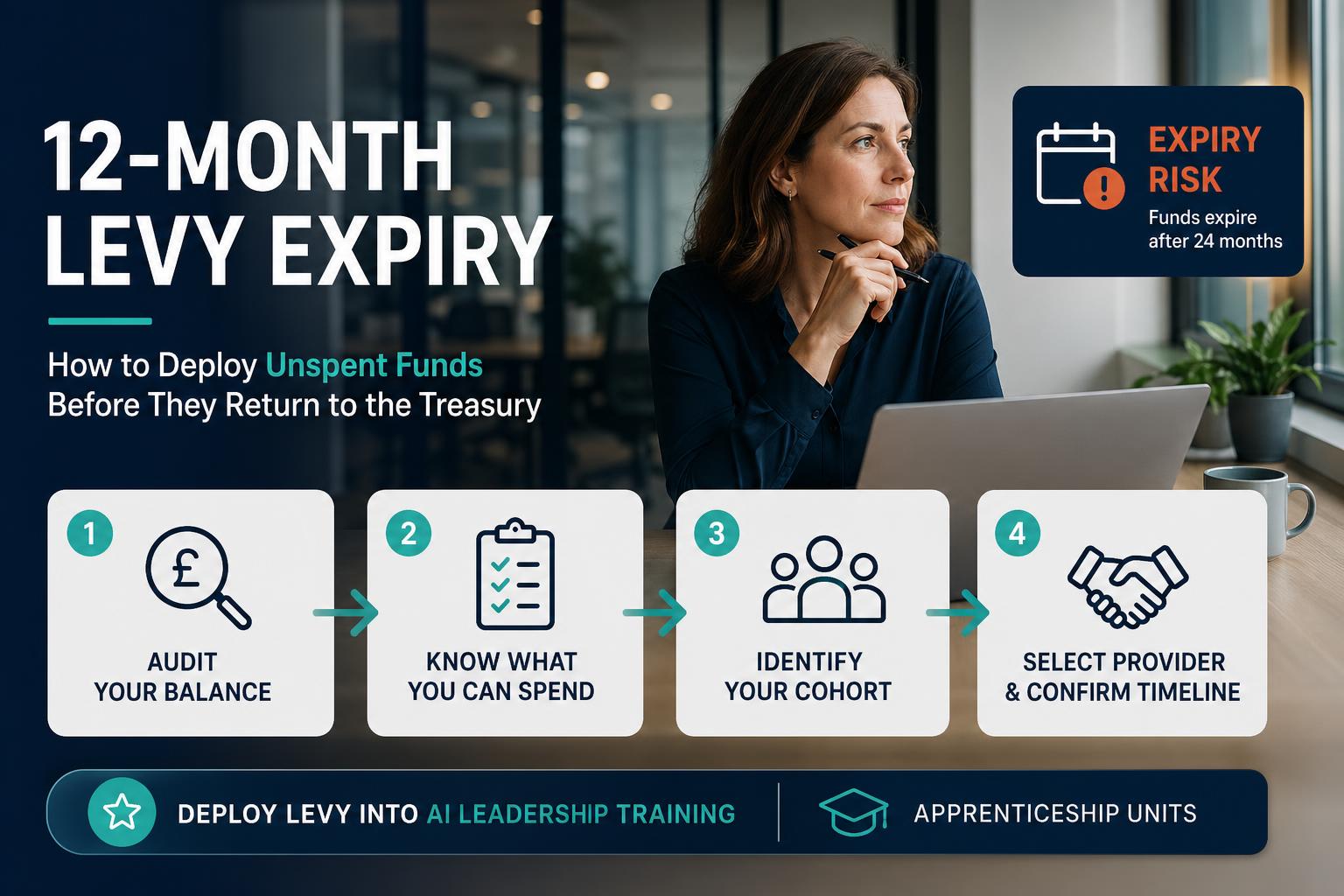
Newly accrued Growth and Skills Levy funds now expire after 12 months instead of the legacy 24-month window. Any monthly declaration not committed to active learner drawdowns (including monthly on-programme instalments or modular Apprenticeship Units) within 12 months returns to HM Treasury on a first-in, first-out basis.
What is the co-investment rate when an employer exhausts their levy pot?
Under the reformed age-differentiated funding rules, eligible training for young people aged 16 to 24 (including Foundation Apprenticeships) is 100% funded for SMEs, whereas levy-paying employers who exhaust their digital account balance face an increased 25% employer co-investment rate (up from the historic 5%) for learners aged 25 and over.
How can employers prevent levy funds expiring under the 12-month rule?
Employers are adopting a 'Barbell Levy Strategy': anchoring base monthly drawdowns with 8-to-18-month core apprenticeships while deploying 30-to-140-hour modular Apprenticeship Units (such as AI Leadership AU0002–AU0011) each quarter to absorb surplus monthly declarations before the 12-month cliff.
Sources & further reading
- DfE / Skills England: Growth and Skills Levy Funding Rules 2026 to 2027 — gov.uk/guidance/apprenticeship-funding-rules
- Skills England: Priority Growth Sectors & Modular Apprenticeship Units — gov.uk/government/organisations/skills-england
- HM Treasury & DfE: Employer Levy Account Reform Impact Assessment — gov.uk/department-for-education