Last updated: 15 July 2026
What Changed in 2026
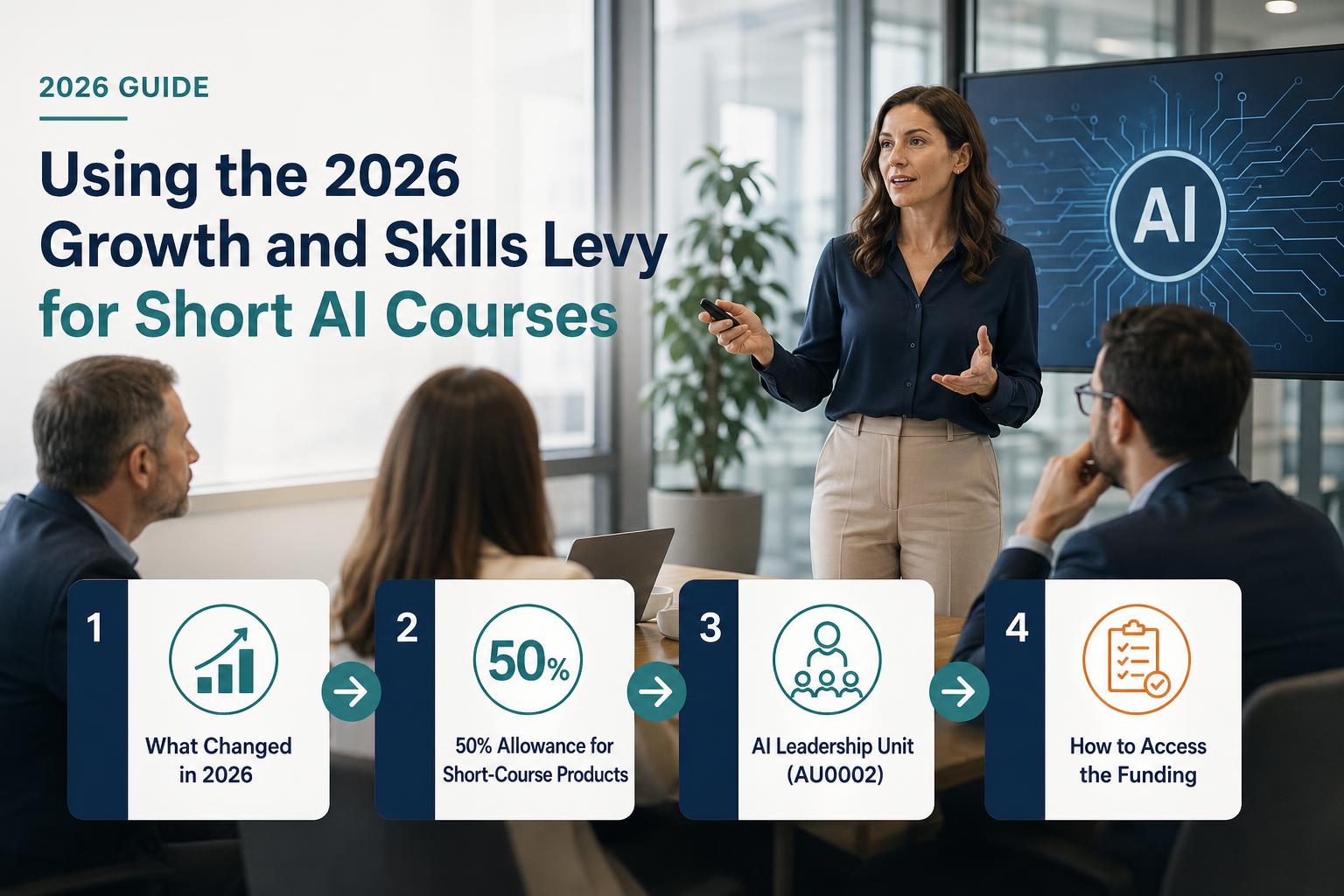
If your mental model of the Apprenticeship Levy is limited to full apprenticeships with a practical period, standard-specific off-the-job training and end-point assessment, that model no longer describes every product that may be funded. The Growth and Skills Levy, introduced as part of the Skills England agenda, significantly expands what UK employers can spend their levy funds on.
The most important change for L&D and HR teams is the introduction of apprenticeship units: approved, standalone programmes with 30–140 published delivery hours under the unit rules. The first AI leadership units opened for starts from 28 April 2026. An apprenticeship unit is a defined government product, not a funding label that can be attached to any short course.
The practical implication: if you are a levy-paying employer with unspent funds in your Digital Apprenticeship Service (DAS) account, you now have a compliant, government-approved route to fund focused AI upskilling for your existing workforce without the administrative and time burden of a traditional apprenticeship.
What the 50% Figure Means — and What It Does Not
There is no general rule allowing an employer to spend 50% of its levy account on arbitrary short courses. In the current apprenticeship-unit rules, 50% is the annual levy-transfer allowance: a levy-paying employer can transfer up to that allowance to fund eligible apprenticeships and units for other employers. It is not a ring-fenced short-course budget.
For an employer's own workforce, eligibility follows the approved-product list and the unit funding rules. In July 2026 the live short AI leadership products are AU0009, AU0010 and AU0011. A generic prompt-engineering workshop, vendor course or conference does not become levy-funded merely because it covers AI or lasts fewer than sixteen weeks.
This is particularly significant for employers who have struggled to spend their levy on full apprenticeships. The most common barrier to enrolment is not willingness to invest — it is programme length and protected learning time. For full-apprenticeship starts from 1 August 2025, employers must plan the exact standard’s published minimum off-the-job training volume, adjusted for evidenced recognition of prior learning subject to the funding-rule floor, and a practical period of at least eight months; the standard may require longer. Earlier starts retain the rules that applied when they began. Apprenticeship units are separate short products with their own published delivery hours, designed for concentrated learning over a shorter period.
Confirm the unit code and version on Skills England, confirm that the provider is authorised for that unit, and use the funding rules in force on the learner's start date. Do not rely on a proposal that describes a commercial course only as “levy eligible”.
The Three Approved AI Leadership Units
Skills England split AI leadership into three separate Level 5 products. AU0009 covers AI strategy and opportunity; AU0010 covers adoption, procurement and governance; and AU0011 covers delivery and organisational transformation. AU0002 is withdrawn and is not available for enrolment.
Across the portfolio, the published outcomes cover:
- AI fundamentals and the current landscape of AI tools in the workplace
- AI governance, ethics, and responsible use frameworks
- Managing AI risk — data security, bias, intellectual property, and regulatory compliance
- AI procurement and vendor evaluation
- Building an AI strategy and communicating it to stakeholders
- Leading AI-enabled teams and managing cultural change
Each unit requires at least 30 eligible delivery hours and carries a maximum government contribution of £750. Unit delivery normally sits within the one-to-sixteen-week framework, but the provider must agree a realistic schedule. Completion requires a provider-delivered skills test and employer validation; a workplace project or professional discussion is not automatically the prescribed test.
Who Should Enrol
The units are intended for employed learners aged 19 or over in leadership positions with autonomy to deliver technological change and inform investment decisions. Select the unit by actual responsibility and skills gap, not job title alone. Potential profiles include:
HR Directors and People Leaders. AI is already reshaping hiring, performance management, workforce planning, and learning and development. HR leaders who cannot evaluate AI tools critically are already making consequential decisions without adequate information. The unit gives HR Directors the vocabulary and frameworks to assess AI tools in their domain — and to set the appropriate governance guardrails.
L&D Leads. AI-generated content, adaptive learning, AI coaching tools, and automated progress tracking are all entering the L&D technology stack. Understanding what these tools can and cannot do — and where the risk lies — is increasingly a core competency for L&D professionals managing a training budget.
Senior managers and team leads. Any manager whose team is using or considering AI tools has a governance responsibility. The unit provides the frameworks to set appropriate policies, monitor usage, and handle the inevitable edge cases — without requiring a computer science background.
Finance and legal professionals. AI tools are entering finance, legal, and compliance workflows faster than governance policies are following. The unit is directly applicable to professionals in these roles who need to understand AI risk from a regulatory and liability perspective.
How to Access the Funding: Step by Step
Accessing levy funds for an apprenticeship unit follows a simplified version of the standard apprenticeship enrolment process.
Step 1: Check your apprenticeship service balance. Confirm available funds and their expiry dates. Funds entering an account before 1 August 2026 retain the previous 24-month expiry treatment. New funds entering from 1 August 2026 expire after 12 months and no longer receive the 10% government top-up. Plan from the oldest balance shown in the service rather than assuming every pound follows the same clock.
Step 2: Confirm the exact approved unit. Use the current Skills England product page and apprenticeship service for AU0009, AU0010 or AU0011. All three have earliest starts from 28 April 2026, but each requires a separate eligibility and prior-learning decision. Do not use the withdrawn AU0002 reference in an enrolment or proposal.
Step 3: Select an authorised unit provider. Being listed on the Apprenticeship Provider and Assessment Register (APAR) is not enough by itself. Confirm that the provider is authorised to deliver the selected unit. Unit delivery cannot be subcontracted to another party under the current rules.
Step 4: Complete eligibility and agree the training plan. The provider must evidence employment, age, residency, working in England, job-related skills need and prior learning. A learner whose existing knowledge overlaps with 50% or more of the planned unit hours is not eligible. There is no apprenticeship agreement, but the three parties must agree a compliant training plan before delivery and sign it before the first milestone is claimed.
Step 5: Approve the record and understand payment. The employer approves learner details in the apprenticeship service. Funding is paid to the provider in two milestones: 30% after successful onboarding and completion of 30% of planned delivery hours, then 70% after all hours, the skills test and three-way outcome validation. An employer may still owe 5% where a levy payer has insufficient funds, plus any agreed price above the £750 funding rate.
Making the Internal Business Case
For a levy payer with sufficient account funds and a negotiated price no higher than the unit rate, an eligible unit can avoid an additional training contribution. That does not make the decision cost-free: the employer must release the learner during normal working hours, provide a genuine line manager, validate the outcome and cover any price above the funding rate. Insufficient levy funds can also trigger co-investment.
The stronger business case starts with a named decision or change programme. AU0009 fits leaders defining AI opportunity and strategy; AU0010 fits adoption, procurement and governance; AU0011 fits delivery and organisational transformation. Set an operational measure before enrolment — for example, approved use cases, a completed vendor-risk process, adoption of a governance control or delivery of a change milestone — then compare it with the training and skills-test evidence.
Frequently asked questions
Can I use the Growth and Skills Levy for short AI courses?
Yes, where the product and learner meet the current apprenticeship unit funding rules. The approved AI leadership products are AU0009 for strategy and opportunity, AU0010 for adoption, procurement and governance, and AU0011 for delivery and organisational transformation. Each is a separate Level 5 unit with a 30-hour delivery minimum and maximum funding of £750.
Can employers spend 50% of their levy funds on short courses?
The current unit rules do not create a general right to spend 50% of a levy account on any short course. The 50% figure in those rules is the annual allowance for transferring levy funds to other employers. Employers can fund only products approved for the apprenticeship service; for short AI leadership training, the confirmed products are AU0009, AU0010 and AU0011. Ordinary commercial AI courses are not made levy-eligible by their length or subject alone.
How long are the AI Leadership apprenticeship units?
AU0009, AU0010 and AU0011 each require at least 30 delivery hours. Unit rules generally allow delivery over one to sixteen weeks, with a realistic schedule agreed in writing. Delivery hours are not the same as apprenticeship off-the-job hours: for a unit, the tutor and learner must be in the same physical or virtual space during eligible delivery.
Sources & further reading
- Apprenticeship service: — Growth and Skills Levy employer guidance
- GOV.UK: — apprenticeship unit funding rules
- Skills England: — AU0009 AI strategy and opportunity
- Skills England: — AU0010 AI adoption, procurement and governance
- Skills England: — AU0011 AI delivery and organisational transformation
- GOV.UK: UK AI Opportunities Action Plan — gov.uk/government/publications/ai-opportunities-action-plan