Last updated: 15 July 2026
The Expiry Problem: Why This Happens
Levy funds enter the apprenticeship service account monthly, after the service applies the employer's English percentage. The oldest expiring balance is used first. From 1 August 2026, the treatment changes for new inflows: the 10% top-up ends and those funds expire after 12 months. Funds that entered through 31 July retain their 24-month treatment, so one account can carry both rules at once.
The approved Growth and Skills Levy products are apprenticeships, foundation apprenticeships and the exact apprenticeship units listed by Skills England. A wider label does not make arbitrary training eligible. Expiry planning must start with a real occupational or skills need, not an attempt to manufacture starts before a balance disappears.
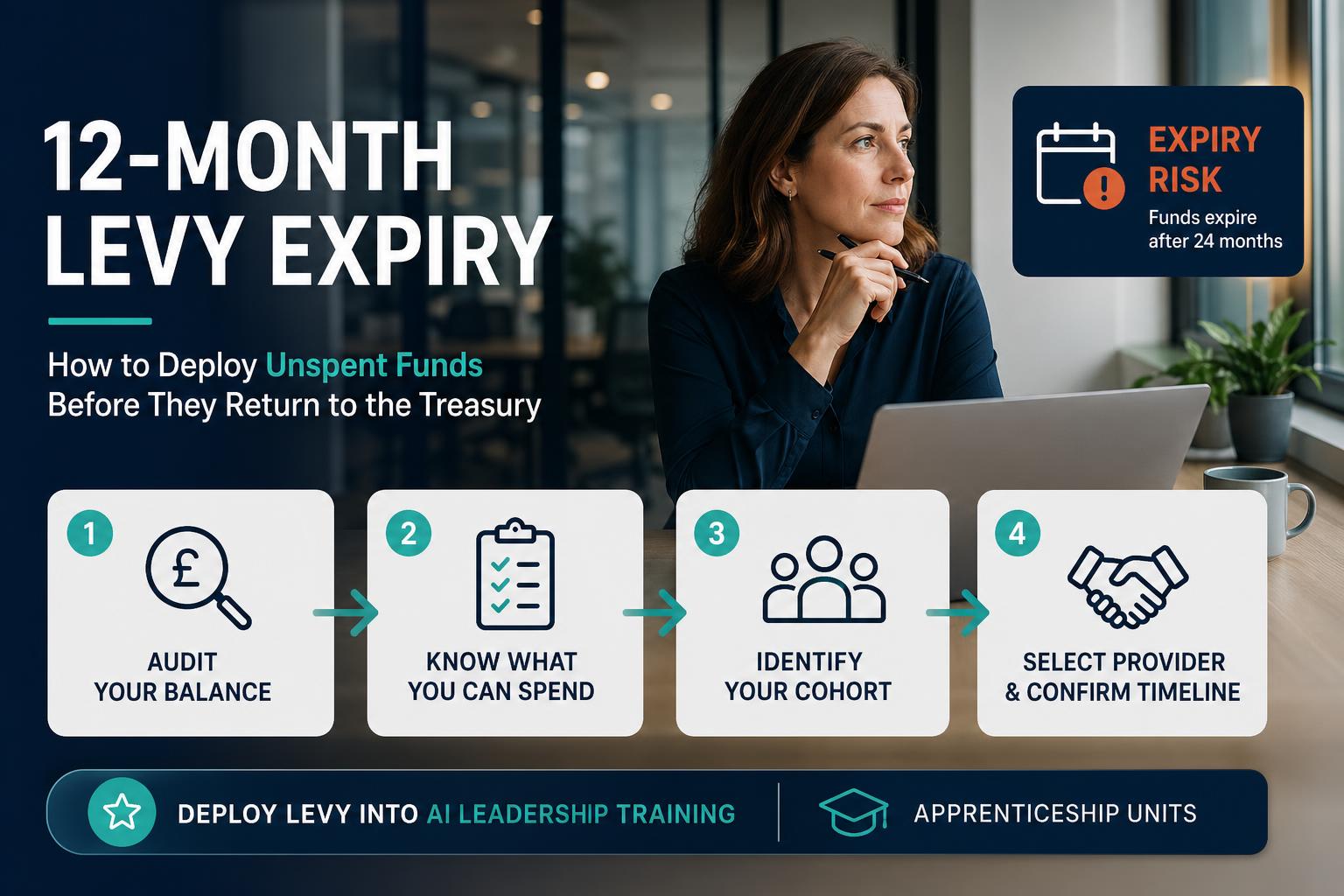
Step 1: Audit Your Current Balance and Expiry Schedule
Log into your Digital Apprenticeship Service (DAS) account at manage-apprenticeships.service.gov.uk. Under the Finance section, you will see your current available balance alongside a breakdown of funds by expiry date. This is the most important number in the exercise — not your total balance, but how much is expiring in the next 1–3 months.
For a fund entry through 31 July 2026, use the 24-month date shown in the service. For a new entry from 1 August, plan around 12 months. Because balances enter monthly, use the account's own expiry forecast and export rather than modelling the whole balance from one date.
When auditing, look for:
- Total balance available today
- Amount expiring in the next 30 days
- Amount expiring in the next 90 days
- Amount expiring in the next 12 months (your planning horizon)
For most large employers who have not been actively spending their levy, the 90-day figure is the crisis number. If it is substantial, you need to move quickly.
Step 2: Know What You Can Spend It On Right Now
Use an exact approved product and its current rules:
Full apprenticeships. These include the Level 4 AI and Automation Practitioner standard (ST1512) where the employee has a genuine occupational training need and suitable job. Level 7 funding has separate age and status restrictions for new starts. Complete eligibility, initial assessment and programme matching before approving a start.
Apprenticeship units (from April 2026). Units are shorter than full standards, but they still require proper selection and evidence. The approved AI leadership products are AU0009, AU0010 and AU0011. Each is Level 5, requires at least 30 delivery hours, carries maximum funding of £750 and uses a provider skills test with employer validation. The employee must be aged 19 or over and work in a leadership position with autonomy to deliver technological change and inform investment decisions.
Levy transfers. An employer can transfer up to 50% of the relevant previous tax year's levy funds under the current rules. A receiving employer uses the transfer for an approved apprenticeship or unit. It requires agreement and administration, so plan before an imminent expiry month.
Unit funding is paid in two milestones: after successful onboarding and completion of 30% of planned delivery hours, then after 100% of delivery hours and a successful validated outcome. A provider should not promise that signing up alone protects funds from expiry. Confirm the current apprenticeship service position and milestone timing against your actual expiry schedule.
Step 3: Identify Your Cohort
The approved AI leadership units are appropriate only where the employee's role and gap match the published outcomes. AU0009 covers strategy and opportunity, AU0010 adoption, procurement and governance, and AU0011 delivery and organisational transformation. Do not assemble a cohort from whoever is available: every learner needs an eligible leadership role and a separate prior-learning assessment.
The fastest cohorts to assemble are managers and senior professionals who already know they need AI skills and have been asking for development in this area. If your last employee survey or 360 review cycle surfaced AI literacy as a development need, those employees are your first cohort. You are not creating demand — you are directing existing demand toward a funded programme.
For each potential participant, confirm:
- They are an existing employee (not a new hire entering an apprenticeship from scratch)
- They are not already enrolled on another levy-funded programme
- Their manager can release them for at least 30 eligible live delivery hours per selected unit during normal working hours
- They hold a leadership position with autonomy to deliver technological change and inform investment decisions
Step 4: Select a Provider and Confirm the Timeline
Once you know your expiry deadline and your cohort, the provider selection conversation is about one thing above all others: timeline. Ask explicitly: how quickly can you get my employees enrolled and drawing levy funds? What is the enrolment process and who handles the DAS administration?
Ask the provider for a realistic schedule covering initial assessment, employer approvals, account actions, training-plan signatures, learning start and the first funding milestone. A rushed enrolment does not itself preserve funds, and no provider should guarantee a drawdown date without checking service processing and product rules.
Also confirm that the provider is listed on the main-provider route of the Apprenticeship Provider and Assessment Register and has been verified to deliver the specific unit. General apprenticeship or AI-training experience does not by itself authorise funded unit delivery.
The Financial Argument in Plain Terms
The levy is a tax and the account is a notional training balance, not cash the employer can reclaim. The useful decision is whether a valid programme creates enough occupational value to justify the time, release and any employer-paid costs before the relevant balance expires.
At the published maximum government contribution of £750 per unit, eight separately eligible employees completing one approved AI leadership unit represent up to £6,000 of funded provision. The provider and employer must agree the actual price, the employer pays any amount above the funding rate, and payment depends on the milestones being achieved. Start with the skills need and delivery feasibility, then assess whether the timetable also helps use funds before expiry.
Frequently asked questions
When do apprenticeship levy funds expire?
The account can contain mixed dates. Funds entering through 31 July 2026 retain their 24-month expiry treatment. New funds entering from 1 August 2026 expire after 12 months and no longer receive the 10% government top-up. Expiry is rolling, so use the apprenticeship service forecast rather than one annual deadline.
What happens to unspent levy funds?
Account funds that reach their applicable 12- or 24-month expiry are removed from the employer's available balance. The service uses the funds with the shortest time remaining first. Employers cannot withdraw the balance as cash, so forecast approved apprenticeship, foundation-apprenticeship, unit or transfer activity before expiry.
Can I spend levy funds quickly on a short programme?
Apprenticeship units can be shorter than full standards, but employers should not use them as an emergency spending device. The approved AI leadership units are AU0009, AU0010 and AU0011; each requires a genuine skills need, eligible learner, initial assessment, training plan, at least 30 delivery hours and a skills test. Funding is paid at milestones rather than simply at enrolment.
Sources & further reading
- GOV.UK: Manage your apprenticeship service account — gov.uk/guidance/manage-apprenticeship-funds
- GOV.UK: Apprenticeship funding rules 2025-26 — gov.uk/guidance/apprenticeship-funding-rules
- GOV.UK: Apprenticeship unit funding rules — gov.uk/government/publications/apprenticeship-unit-funding-rules-2026-to-2027
- Skills England: — AU0009