Last updated: 15 July 2026
The ROI Problem with Leadership Training
Leadership training has a long-standing ROI measurement problem. The value is real but diffuse: better decisions, more capable teams, fewer costly mistakes, stronger stakeholder relationships. These outcomes are difficult to attribute precisely to a single training intervention, which makes it hard to build the kind of clear-cut ROI case that a CFO finds compelling.
AI leadership training has some of this same challenge, but it also has measurable outputs that other leadership training typically lacks. An AI leader, equipped with governance and strategy frameworks, can immediately apply those frameworks to specific, quantifiable business problems: a vendor contract that has poor data handling provisions, a workflow that could save 10 hours per week, an AI tool that employees are using unsafely. These are concrete before-and-after improvements that can be documented and costed.
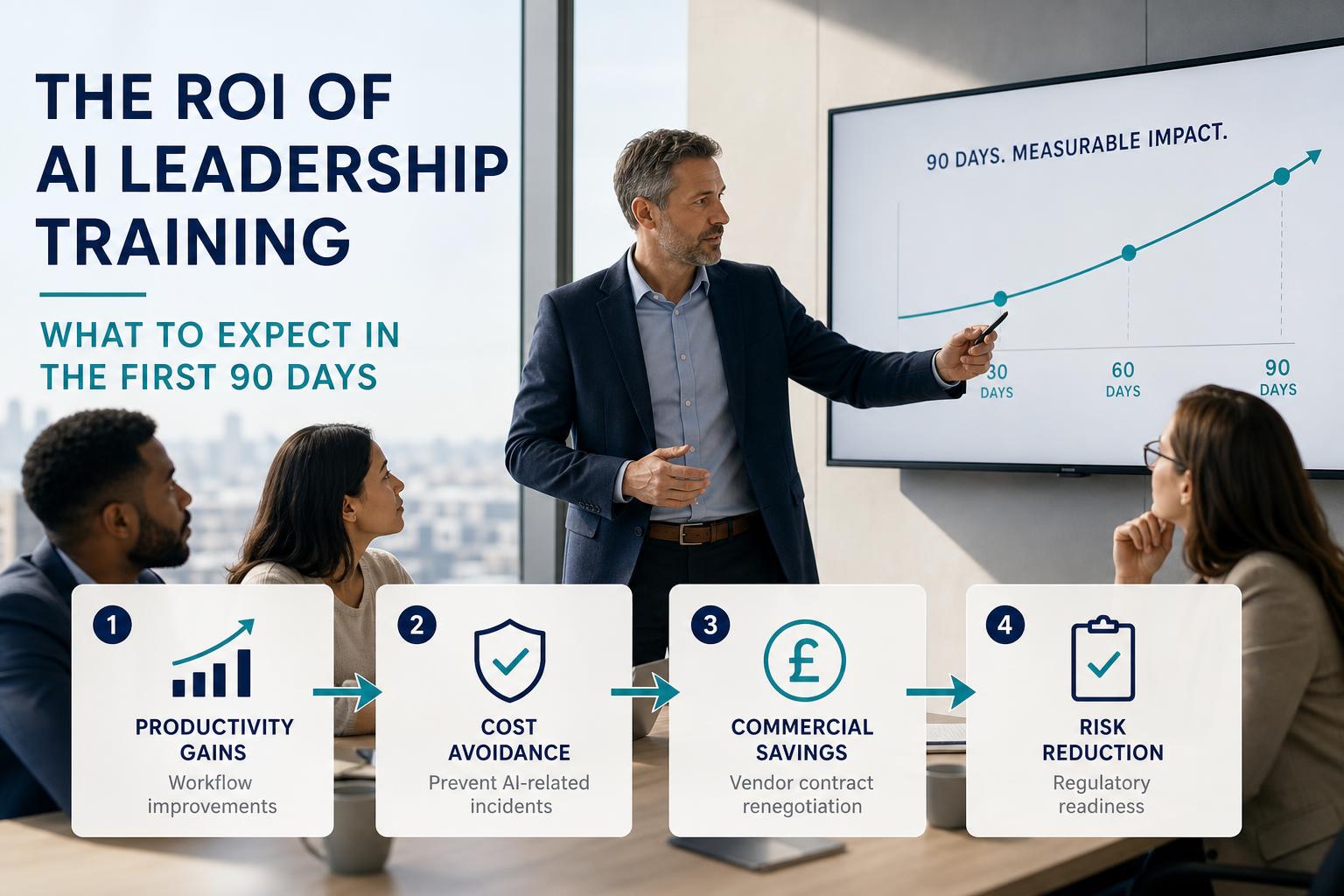
This article organises the ROI case into four categories: productivity gains, cost avoidance, commercial savings, and risk reduction. For each, it provides concrete examples of what an AI-trained manager delivers — specific enough to use in an internal business case presentation.
1. Productivity Gains: Workflow Improvements
An AI leader's first and most visible impact is typically in workflow improvement — identifying where AI tools can eliminate repetitive, low-value work and implementing those changes within their team. This is different from general AI tools training because it is strategic: the AI leader is not just using AI themselves, but systematically identifying where AI creates the highest leverage across their team's work.
Concrete examples from AI leadership programme participants:
- An HR Director who implemented AI-assisted job description drafting reduced the average time to publish a role from 3 days to 4 hours across a team of 6 HR advisors — saving approximately 24 hours of advisor time per role posted.
- An L&D manager who implemented AI content generation for standard compliance training modules reduced external content production costs by 40% in the first quarter after the programme.
- A legal team lead who introduced AI-assisted contract review as a first-pass tool reduced solicitor review time per standard contract by 35%, allowing the same team to process significantly higher volume without additional headcount.
These are not speculative outcomes — they are the direct application of AI leadership skills to specific workflow problems. The key is that an AI leader has the knowledge to identify the right use cases, evaluate the tools, manage the implementation, and monitor for quality issues. An AI user might adopt a tool for their own work; an AI leader systematically implements it across a function.
Realistic 90-day expectation: 1–2 workflow improvements implemented, with documented time or cost savings attributable to AI tool adoption within the manager's team.
2. Cost Avoidance: Preventing AI-Related Incidents
The most significant ROI from AI leadership training is often the cost of incidents that do not happen. AI-related data breaches, regulatory enforcement actions, client data incidents, and reputational harms all have significant and measurable costs — but they are difficult to include in an ROI model because they are counterfactual (we cannot know with certainty what would have happened without the training).
The most credible approach is to benchmark against the known cost of comparable incidents:
- An ICO fine for a significant data breach under GDPR can range from a warning to 4% of global annual turnover — for a £50M turnover business, that ceiling is £2M.
- The average cost of a data breach in the UK (including detection, notification, legal, and remediation) is estimated at over £3M for mid-large enterprises.
- Client data incidents that reach the press carry significant reputational cost — harder to quantify but material for any organisation with a significant B2B client base.
An AI leader who identifies and addresses a specific shadow AI risk — employees pasting client data into consumer AI tools, for example — has potentially avoided a multi-million pound incident. The training cost, even at full unsubsidised market rates, is orders of magnitude smaller than the incident cost.
Realistic 90-day expectation: Completion of an AI tool usage audit identifying 2–3 specific risk areas, with remediation actions in place. At least one policy gap identified and addressed.
3. Commercial Savings: AI Vendor Contract Renegotiation
One of the most directly quantifiable ROI outcomes from AI leadership training is improved AI vendor negotiation. AI procurement is a specialist skill that most managers and executives currently lack — they are negotiating AI contracts without understanding the key terms that determine data handling, liability, pricing, and exit provisions.
An AI leader equipped with vendor evaluation and negotiation skills can make a material difference to existing contracts:
- Identifying data processing clauses that expose the organisation to GDPR liability, and renegotiating them or switching to a GDPR-compliant alternative.
- Reviewing existing AI tool subscriptions against actual usage, identifying underused tools that can be cancelled or downgraded.
- Entering upcoming AI vendor renewals with a clear evaluation framework and credible alternatives, creating negotiating leverage that drives better commercial terms.
- Identifying AI capability that the organisation is paying for separately but could consolidate into an existing platform.
For an organisation spending £200,000–£500,000 per year on AI tools and services (a realistic figure for a mid-size UK employer in 2026), a 10–15% improvement in procurement outcomes through better-informed negotiation represents £20,000–£75,000 in annual savings — many times the cost of the training.
Realistic 90-day expectation: Audit of current AI tool spend completed; at least one vendor conversation initiated using an informed evaluation framework; data handling terms reviewed across top-3 AI subscriptions.
4. Risk Reduction: Regulatory Readiness
The EU AI Act came into force in August 2024 and is being implemented in phases through 2025–26. Article 4 requires organisations to ensure that employees working with AI have adequate AI literacy. The UK's developing AI regulatory framework is moving in a similar direction. For organisations in regulated industries — financial services, healthcare, legal, education — AI regulation is not a future concern but a present one.
An AI leader contributes to regulatory readiness in several specific ways:
- Conducting an AI use case inventory — cataloguing how AI is used in the organisation and classifying each use case by risk level. This is the foundational document required for EU AI Act compliance and is also the starting point for any AI governance framework.
- Identifying high-risk AI applications — AI systems that affect employment decisions, credit decisions, or other significant individual outcomes — and ensuring appropriate human oversight is in place.
- Building the internal AI literacy that regulators are beginning to require as evidence of organisational competence — an audit trail of structured AI training for relevant staff.
- Establishing the documentation and record-keeping practices that compliance with AI regulation will require — decision logs, model cards, data processing records for AI systems.
Realistic 90-day expectation: AI use case inventory completed for the manager's function; risk classification applied; high-risk use cases identified and reviewed with legal or compliance; gap analysis against current AI regulation requirements documented.
When presenting the ROI case for AI leadership training internally, structure it around three numbers: (1) the funded cost — for levy-paying employers, this is £0 from the existing levy account; (2) one concrete productivity saving — the hours per week your team would save from the most obvious workflow improvement; (3) the cost of one comparable incident — a data breach, a regulatory fine, or a failed AI vendor contract. These three numbers make the case without requiring a complex attribution model.
How to Measure Success
The most effective measurement approach for AI leadership training ROI is to agree specific output targets before the programme starts — not generic "improved AI capability" targets, but specific deliverables that the manager will complete during or shortly after the programme.
A well-designed AI leadership programme builds in a workplace project element: a specific AI governance challenge, workflow improvement, or strategy document that the participant develops during the programme. This project is both the learning vehicle and the ROI evidence — at the end of the programme, the organisation has a concrete output that it can point to as the return on its investment.
For the approved AI leadership units, the provider must deliver a valid skills test and the employer must validate successful completion. Workplace outputs can add useful ROI evidence when they are safe and genuinely role-relevant: AU0009 may inform an AI strategy or use-case portfolio, AU0010 a vendor evaluation or governance framework, and AU0011 a transformation or monitoring plan. Those outputs complement the formal skills test; they are not a prescribed assessment format.
The Levy-Funded ROI: Why the Business Case Is Unusually Strong
For levy-paying employers, the ROI case for AI leadership training is unusually compelling because the training cost is effectively £0 — it is funded from levy contributions that would otherwise expire. The ROI is therefore not "value of training vs. cost of training" but "value of training vs. cost of leaving the levy unspent."
Unspent levy funds return to the Treasury and generate zero return. Using those funds for AI leadership training generates the workflow savings, cost avoidance, commercial improvements, and regulatory readiness described in this article. The comparison is not training vs. the status quo — it is training vs. nothing, at zero additional cost to the business. Framed this way, the ROI case is not a comparison; it is a default.
Frequently asked questions
How do you measure the ROI of AI leadership training?
ROI from AI leadership training comes from four primary sources: productivity gains from workflow improvements identified and implemented by trained managers; cost avoidance from avoided AI compliance incidents or data breaches; commercial savings from better-negotiated AI vendor contracts; and risk reduction from improved AI governance. The challenge is that some of these — particularly risk reduction — are difficult to quantify precisely. The most credible ROI measurement approach combines hard cost savings (vendor contract renegotiation, workflow efficiency) with a conservative estimate of risk reduction value based on the cost of a comparable incident.
What can an AI leader realistically do in 90 days?
In the first 90 days after AI leadership training, a manager can realistically: complete an audit of current AI tool usage across their team; identify and address 2–3 specific AI data governance gaps; implement a working AI acceptable use policy; identify 1–2 workflow improvements using existing or new AI tools; and contribute informed input to an upcoming AI procurement decision. These are concrete, measurable outputs that most organisations can point to within a quarter of the training completing.
Is AI leadership training worth it if we already have an AI policy?
An AI policy document and the capability to implement it are different things. Most organisations that have AI policies lack the managerial depth to enforce them consistently, update them as the AI landscape evolves, or handle novel AI-related incidents confidently. AI leadership training builds the human capability that makes a policy operational rather than decorative — which is where the real risk reduction comes from.
Sources & further reading
- EU AI Act, Article 4: AI Literacy requirements — eur-lex.europa.eu
- ICO: Data breach fines and enforcement — ico.org.uk/action-weve-taken/enforcement/
- GOV.UK: UK AI Opportunities Action Plan — gov.uk/government/publications/ai-opportunities-action-plan