Last updated: 15 July 2026
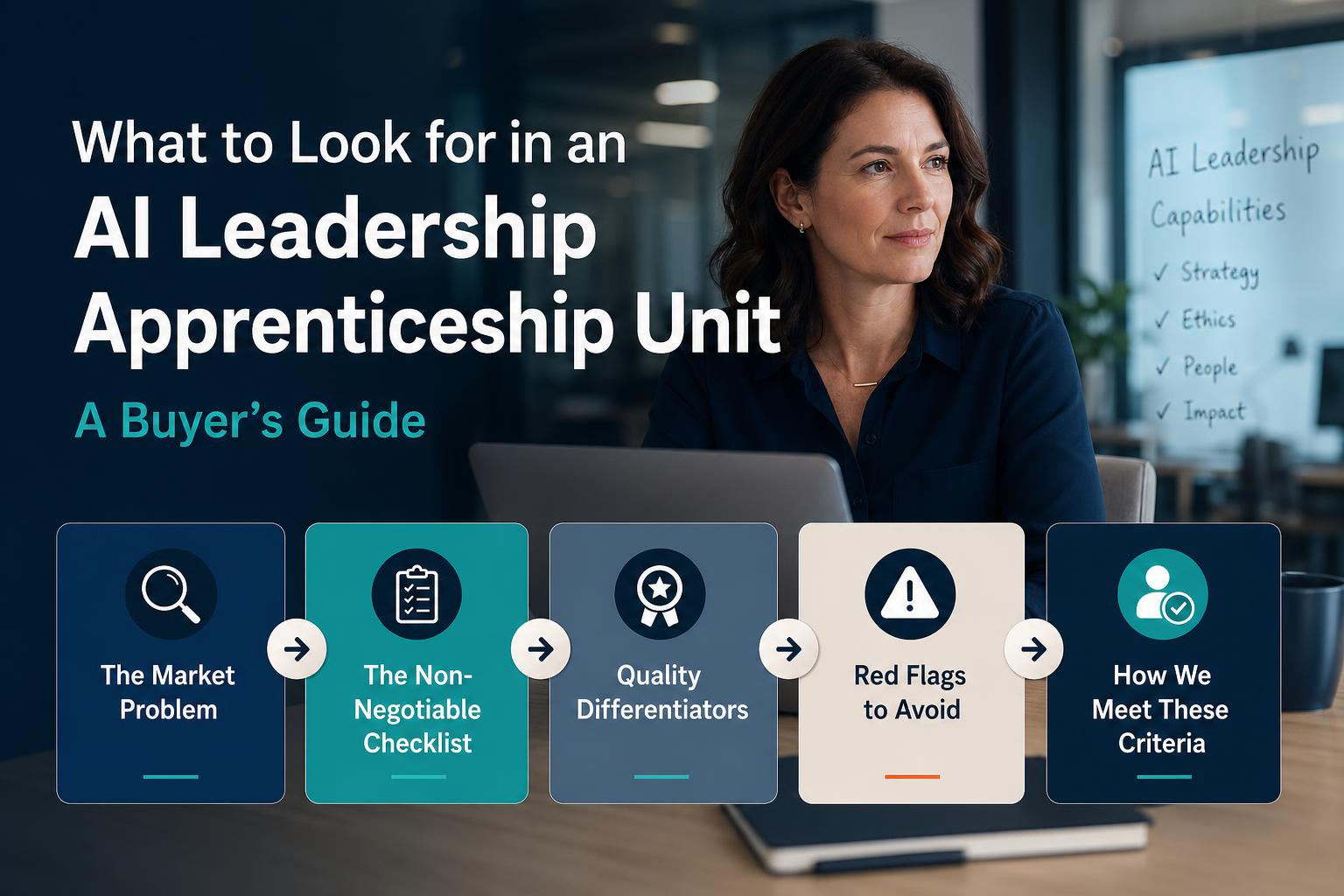
The Market Problem: Quality Varies Enormously
The Growth and Skills Levy has created a specific funding route for approved AI leadership units, and providers are moving quickly to enter the market. The key risks are generic tools training rebadged as a published unit, an APAR-listed provider that is not authorised for the selected code, curricula that blend three distinct units together, weak delivery-hour evidence, or assessment that does not meet the unit rules.
For HR and L&D buyers, the challenge is evaluation. The AI leadership training market is new enough that there are no established league tables, limited published Ofsted inspection reports for this specific unit type, and few established comparison frameworks. This guide provides the evaluation criteria that matter.
The Non-Negotiable Checklist
These are the baseline criteria. Any provider that does not meet all of them should be removed from your shortlist immediately.
✓ APAR listing and approval for the exact unit
Check the provider on the current Apprenticeship Provider and Assessment Register (APAR), including its status and whether it can deliver apprenticeship units. Then request evidence that it is authorised for AU0009, AU0010 or AU0011. Initial unit delivery is limited to eligible providers confirmed for the relevant products; a general APAR entry is not enough.
Red flag: a provider describes any short AI course as levy-funded, cannot name the unit code, or proposes to subcontract delivery. The current unit rules route all delivery through the chosen authorised provider and prohibit subcontracting.
✓ A curriculum that covers governance and ethics — not just AI tools
Ask for the full curriculum outline. A genuine AI leadership programme covers: AI governance frameworks, AI ethics and responsible use, AI risk management, AI procurement and vendor evaluation, AI policy design, and leading teams through AI adoption. A programme that is primarily about using AI tools — ChatGPT, Copilot, specific AI products — is tools training, not leadership training. It may be valuable, but it is not the same thing.
Red flag: a curriculum that is primarily structured around specific AI tools (e.g., "Module 1: Using ChatGPT, Module 2: Microsoft Copilot...") rather than leadership competencies (e.g., "AI Governance Frameworks, AI Risk Management, AI Strategy..."). Tools change rapidly; leadership competencies endure.
✓ A robust skills test and workplace application
The rules require a provider-controlled skills test and three-way confirmation that the training plan was delivered and the learner acquired the knowledge and skills. The provider chooses a proportionate format, which might include a practical demonstration, varied tasks or a secure question bank. A workplace project can add value, but it is not a universal mandated assessment method for these units.
Ask how the assessment samples every published outcome, prevents predictability, handles resits and lets the employer validate new capability in the job. Red flag: attendance alone earns completion, or a predictable quiz is presented as sufficient without mapping to the selected unit.
✓ Clear apprenticeship-service responsibilities
The provider should lead eligibility checks, initial assessment, training-plan creation, evidence and ILR reporting. The employer still has non-delegable responsibilities: approving learner details, confirming employment and PAYE, releasing the learner during normal working hours, contributing to the training plan and validating the outcome. A third party must not authorise payments through the employer's account.
Ask for a responsibility matrix before contracting. Red flag: the provider asks for unrestricted access to the employer account or says the employer has nothing to approve or evidence.
✓ Qualified, expert facilitators — not AI-generated content
The facilitators delivering the programme should have demonstrable expertise in AI strategy, governance, and organisational transformation — not just experience using AI tools. Ask for facilitator biographies. Look for backgrounds that combine AI knowledge with business leadership experience: former CTOs, AI ethics researchers, technology executives, organisational development practitioners who have worked on AI adoption at scale.
Red flag: a provider who cannot clearly describe who delivers the programme, or whose facilitators' credentials are primarily in AI tools training (prompt engineering, Copilot certification) rather than AI strategy and governance.
Quality Differentiators: What Separates Good from Excellent
Once you have established that a provider meets the non-negotiable criteria, these differentiators help you identify the best option from a shortlist of compliant providers.
Cohort delivery vs. individual delivery
The best AI leadership programmes deliver learning in cohorts — groups of participants from the same or different organisations who progress through the programme together, discuss shared challenges, and build a peer network. Individual (self-paced, asynchronous) delivery can work for content acquisition, but the peer learning and network value of cohort delivery is significant — particularly for managers who are navigating novel AI leadership challenges without established precedents in their organisations.
Ask: is the programme delivered in cohorts? What is the typical cohort size and composition? Is there structured peer discussion, or is the cohort element incidental?
Sector-relevant case studies and examples
AI governance challenges in financial services are different from AI governance challenges in healthcare or in professional services. A programme that only uses generic or US-centric case studies will feel less relevant to your managers than one that uses UK-specific examples from comparable industries. Ask about the case study library and whether the programme can be contextualised for your sector.
Post-programme support
The AI landscape changes fast. A programme that is excellent today may be covering outdated content in 18 months. The best providers commit to updating their curriculum regularly and offer some form of post-programme community or resource access — so that graduates can continue to learn and stay current as the field evolves. Ask whether graduates have access to curriculum updates, alumni networks, or ongoing resources after the programme ends.
Minimal disruption to the working week
Each current AI leadership unit has at least 30 eligible delivery hours and must normally be planned over one to sixteen weeks. Those are live tutor-and-learner hours during normal working time, not a nominal self-study estimate. The right cadence depends on the role, planned activities and working pattern; it should be agreed in writing rather than inferred from a standard weekly figure.
Ask: what is the weekly time commitment? Are learning sessions fixed in advance or flexible? What is the maximum consecutive time away from work that the programme requires?
- Are you on APAR and authorised for this exact unit code?
- Can I see the full curriculum outline?
- How does the skills test cover every published outcome?
- Who are the facilitators and what are their credentials?
- What do you handle, and what must our employer team approve?
- What is the weekly time commitment for participants?
- What is the realistic timeline from first conversation to first cohort enrolled?
Red Flags to Avoid
Beyond the non-negotiables above, these patterns in provider conversations should prompt additional scrutiny:
Unclear levy claims. "We can access your levy" or "this is levy-fundable" without clear explanation of how — specifically, which product type (unit, full standard, Bootcamp), at what funding band, and through which route — is a red flag. A provider who genuinely knows the levy framework can answer these questions precisely.
Vague curriculum. A provider who describes their programme as "comprehensive AI leadership training" without being willing to share a detailed curriculum outline in the first or second conversation is hiding something — either the curriculum is thin, or it does not match the AI leadership description.
Very fast enrolment promises. A provider who promises enrolment in 24–48 hours with no apparent eligibility check, prior-learning discussion or training-plan process may be skipping controls and creating recovery risk.
Attendance treated as achievement. Completion requires the planned delivery hours, a passed skills test and provider, learner and employer validation. A certificate issued merely for showing up does not meet the funded-unit outcome rules.
How TIQPlus Supports These Criteria
We believe this checklist is a genuinely useful evaluation framework regardless of which provider you choose. We also want to be transparent about how TIQPlus supports high-quality AI leadership provision.
TIQPlus supports approved providers with structured delivery, evidence tracking, employer reporting and learner progress visibility. Buyers should expect curriculum and facilitation that match the exact selected unit: AU0009 for strategy and opportunity, AU0010 for adoption, procurement and governance, or AU0011 for delivery and organisational transformation. A provider should not blend the three into an old AU0002 syllabus or present generic AI tools training as the published Level 5 outcomes.
Strong provision can use workplace projects and professional discussion as learning and evidence activities, but its formal skills test and completion records must follow the unit rules. TIQPlus supports authorised providers with delivery-hour evidence, training-plan records, employer validation, reporting and learner visibility.
Use this checklist with every provider you evaluate. Confirm authorisation and the product directly through official services before relying on a sales proposal.
Frequently asked questions
How do I know if an AI leadership apprenticeship unit provider is legitimate?
Check the current Apprenticeship Provider and Assessment Register (APAR), then ask the provider to evidence that it is authorised for the specific unit; APAR listing alone is not proof of unit approval. Verify the code on Skills England, check the curriculum against its published outcomes, review facilitator competence, ask to see the training-plan and skills-test approach, and confirm who completes each apprenticeship-service action. Unit delivery cannot be subcontracted under the current rules.
What questions should I ask an AI leadership training provider?
Ask: (1) Are you on APAR and authorised for this exact unit? (2) Which code and published outcomes will you deliver? (3) Who delivers it, and is any delivery outsourced? (4) How will you evidence at least 30 eligible live delivery hours? (5) How do you test the learner's skills and obtain employer validation? (6) How do you assess the job-related skills need and prior learning? (7) What must our team approve in the apprenticeship service? (8) What happens if the learner misses hours or does not pass the test?
What are the approved AI Leadership apprenticeship units?
The approved portfolio is AU0009 for AI strategy and opportunity, AU0010 for adoption, procurement and governance, and AU0011 for delivery and organisational transformation. Each is a separate Level 5 unit with a 30-hour delivery minimum, maximum funding of £750 and earliest starts from 28 April 2026. AU0002 is withdrawn.
Sources & further reading
- Official register: — Apprenticeship Provider and Assessment Register (APAR)
- GOV.UK: — apprenticeship unit funding rules
- Skills England: — approved apprenticeship units