Last updated: 15 July 2026
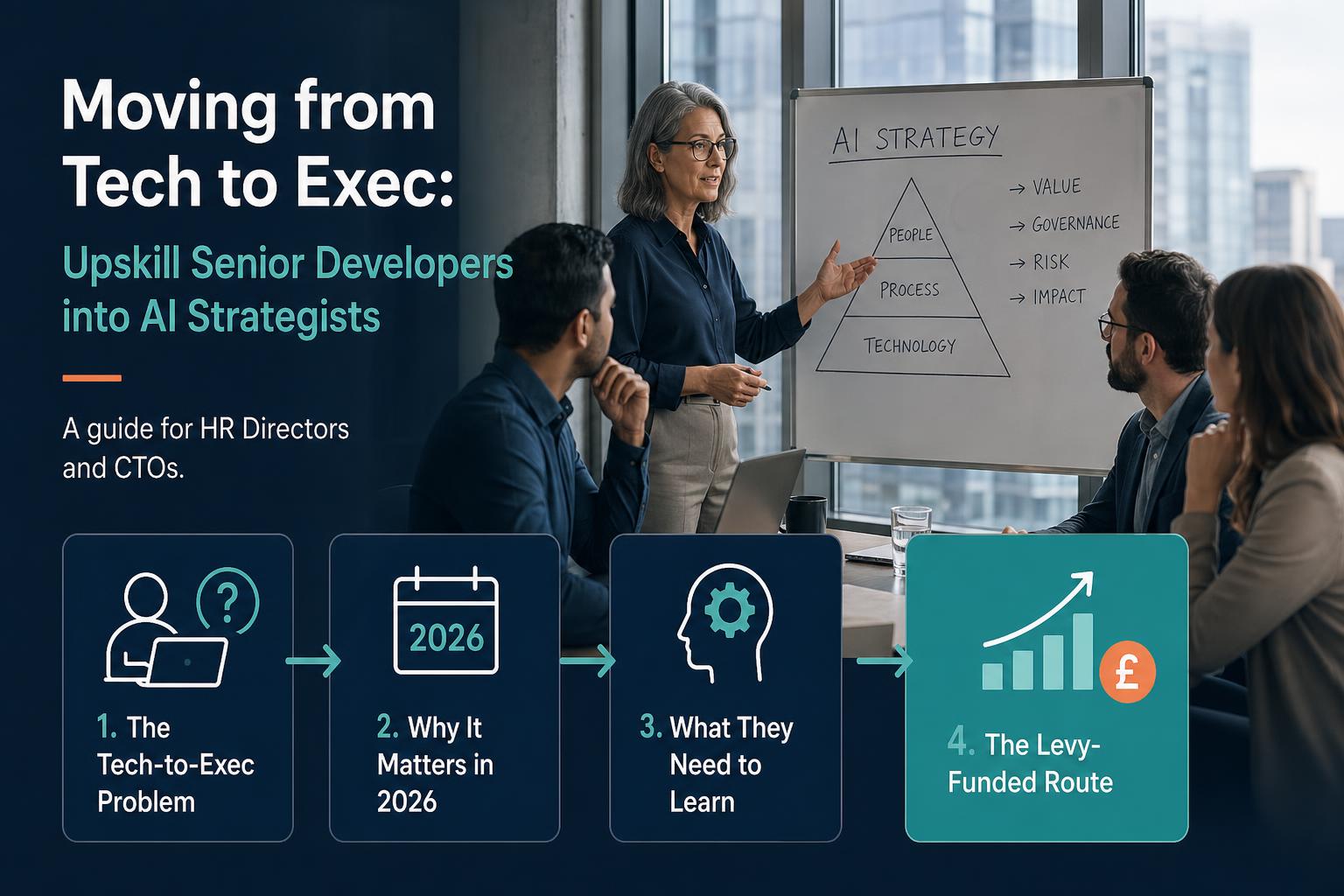
The Tech-to-Exec Problem
The pattern is familiar. An organisation has a talented senior developer or engineering lead who has built AI-powered products, understands machine learning architecture, and knows the technical landscape better than anyone else in the business. They get promoted into a Head of AI, Chief AI Officer, or AI Strategy Director role. And then something unexpected happens — or rather, does not happen. The technical insight that made them excellent in an individual contributor role is not generating the organisational impact the business expected from a leadership role.
The problem is not capability — it is capability type. Technical AI expertise and AI leadership expertise are overlapping but distinct skill sets. A senior developer who is exceptional at building AI systems may have very limited experience in:
- Translating AI decisions into business language for board and executive audiences
- Evaluating AI vendors from a commercial and contractual perspective
- Designing governance frameworks that balance innovation with risk management
- Managing the cultural change that AI adoption requires across non-technical departments
- Navigating AI ethics and regulatory compliance as a business responsibility
- Building stakeholder alignment across functions with different risk appetites
These are leadership and business competencies. They require development, not just experience. And they are systematically underinvested in when organisations promote technical talent into AI leadership roles without providing structured transition support.
Why This Matters Urgently in 2026
The gap between technical AI talent and AI leadership capability has always existed — the equivalent problem exists in every technical discipline, from engineering to finance. What makes it urgent now is the pace at which AI-related decisions are affecting the entire organisation, not just the technology function.
AI procurement decisions are now board-level issues. AI data governance is a regulatory compliance matter, not just an IT policy. AI-assisted hiring, performance management, and workforce planning decisions have legal and ethical dimensions that require HR, legal, and compliance input alongside technical input. The Chief AI Officer of 2026 needs to operate effectively across all of these domains — which means the traditional approach of letting technical experts grow into leadership roles organically is no longer adequate.
There is also a talent retention dimension. Senior developers who are promoted into AI leadership roles and then left without development support tend to struggle and disengage — creating exactly the kind of leadership vacuum that the promotion was meant to fill. Structured transition development is both a performance investment and a retention investment.
What Technical AI Experts Need to Learn
The development needs of a senior developer or tech lead moving into an AI strategy role are specific and learnable. The gaps are not in AI knowledge — they are in governance, communication, and business leadership.
AI Governance and Policy Design
Technical experts often approach AI governance from an engineering perspective: identify the technical safeguards and implement them. Organisational AI governance requires a different lens: who is accountable for AI decisions, how are those decisions audited, what happens when the system makes an error, and how does the organisation demonstrate compliance to regulators and clients? These are questions of policy design, accountability structures, and organisational process — not technical implementation.
AI Procurement and Commercial Evaluation
Technical experts are skilled at evaluating AI systems on technical merit — model accuracy, API reliability, integration complexity. AI procurement at a strategic level requires additional dimensions: contract terms and data handling provisions, vendor financial stability, exit strategy and data portability, liability clauses for AI errors, and alignment with the organisation's risk appetite. A senior developer moving into an AI strategy role may never have negotiated a significant vendor contract or evaluated commercial terms. This is a specific skill gap that requires targeted development.
Board and Executive Communication
The most consistent frustration expressed by board members and executives when working with technical AI leaders is communication: technical experts default to technical language and technical framing, while board-level decision-making requires business framing, risk framing, and financial framing. Learning to translate AI decisions — "we are considering deploying a large language model in our customer service function" — into executive language — "we have an opportunity to reduce customer service costs by 30% with manageable technology and data risk" — is a learnable communication skill that is rarely developed explicitly.
AI Ethics in Organisational Practice
Technical teams that build AI systems typically engage with AI ethics at a model level: fairness metrics, bias detection, explainability. Organisational AI ethics is broader: how does the organisation's AI use affect employees, customers, and communities? What are the reputational consequences of AI failures in public-facing applications? How does the organisation respond when an AI system makes a discriminatory or harmful decision? These are questions that a Chief AI Officer needs to be equipped to handle at an executive level — and they require a different frame than technical AI ethics.
Leading Non-Technical Teams Through AI Adoption
The most technically capable AI leader will fail in a leadership role if they cannot bring non-technical colleagues with them. Finance teams, HR teams, legal teams, and operations teams need to be helped to understand AI in their own context — not in engineering terms. Developing the ability to lead AI-sceptical or AI-anxious colleagues through adoption, address legitimate concerns about job displacement, and build cross-functional AI capability is a core leadership competency that most technical professionals have not had reason to develop.
Research on technical professionals moving into leadership roles consistently identifies the same challenge: the transition from being the expert to being the leader of experts. Technical professionals are used to being the most knowledgeable person in the room on technical questions. In an executive leadership role, the value is in enabling others — not in demonstrating personal technical superiority. This is a mindset shift that structured development can accelerate, but that experience alone rarely delivers quickly enough.
Designing the Development Programme
An effective upskilling programme for senior developers moving into AI strategy roles has three components that work together: structured learning, practical application, and peer network.
Structured learning covers the knowledge gaps — governance frameworks, procurement skills, communication techniques, ethics frameworks. This is the component that a structured training programme provides, and it needs to be explicitly business-focused rather than technically focused. A programme that covers AI governance, AI strategy, AI ethics, and executive communication in an integrated curriculum is significantly more effective than assembling disparate modules from different providers.
Practical application means applying the learning to a real AI challenge in the participant's own organisation. The most effective AI leadership programmes build in a workplace project element — a specific AI governance challenge, procurement decision, or strategy document that the participant develops during the programme. This converts learning into immediate organisational value and ensures the development is grounded in real context rather than abstract case studies.
Peer network is often underestimated as a development component. Senior developers moving into AI leadership roles benefit enormously from connecting with peers at similar career transition points in other organisations — sharing challenges, approaches, and lessons learned. A cohort-based programme that brings together technical professionals from different industries navigating similar transitions creates a peer learning environment that extends well beyond the programme itself.
The Levy-Funded Route for Tech-to-Exec Development
Two approved apprenticeship units may fit employees moving from technical work into leadership: AU0009 for AI strategy and opportunity, and AU0010 for adoption, procurement and governance. Each is a separate Level 5, 30-hour unit with maximum funding of £750. Initial assessment must connect the published outcomes to the employee's role and identify a genuine skills need; a technical background alone does not establish eligibility.
For levy-paying employers, this means the tech-to-exec development programme for your senior developers can be funded from your existing levy account — with no additional cost to the business. The unit runs over 4–16 weeks alongside the participant's day-to-day role, which is appropriate for senior employees who cannot step back from their responsibilities for an extended period.
Frequently asked questions
What skills do senior developers need to become AI strategists?
Senior developers moving into AI strategy roles typically need to develop competencies in four areas that are not covered by technical AI training: AI governance and ethics (setting policy rather than implementing technology); AI procurement and vendor evaluation (assessing commercial AI products from a business rather than engineering perspective); stakeholder communication (translating technical AI decisions for board-level audiences); and organisational change management (leading teams through AI adoption). These are leadership and business competencies that require structured development, not additional technical training.
What is the difference between a CTO and a Chief AI Officer?
The emerging Chief AI Officer (CAIO) role is distinct from the CTO in its primary focus: where a CTO is responsible for the organisation's technology infrastructure and engineering capability, a CAIO is specifically responsible for AI strategy, AI governance, and ensuring AI is used safely and effectively across the entire organisation — including non-technical departments. The CAIO role requires deep AI knowledge combined with the business, governance, and communication skills to operate at board level. Many senior developers promoted into CTO or CAIO roles have the technical knowledge but lack the governance and business dimensions.
Can I use the apprenticeship levy to upskill my tech leads into AI strategy roles?
Potentially. AU0009 (AI strategy and opportunity) and AU0010 (AI adoption, procurement and governance) may fit technical employees moving into leadership responsibilities, provided they meet the role and funding rules. Each approved unit is Level 5, has a 30-hour delivery minimum and carries up to £750 funding. The learner must be employed, aged 19 or over and have leadership autonomy to deliver technological change and inform investment decisions.
Sources & further reading
- GOV.UK: UK AI Opportunities Action Plan — gov.uk/government/publications/ai-opportunities-action-plan
- Skills England: AI skills and the Growth and Skills Levy — skillsengland.education.gov.uk
- CIPD: Technical professionals in leadership roles — cipd.org