
Last updated: 1 November 2026
Executive Summary
Across the UK apprenticeship sector, Learning Support Funding (LSF) is one of the highest-risk lines on a training provider's balance sheet. While the £150/month ILR claim is vital for supporting the 20%+ of vocational learners with dyslexia, ADHD, dyspraxia, and dyscalculia, DfE funding auditors have tightened scrutiny on month-by-month delivery proof. In this guide, we examine why legacy cognitive screening tools leave providers exposed to six-figure clawbacks—and how embedding assistive multimodal adjustments directly into the apprentice's weekly workflow generates indisputable monthly audit proof automatically.
1. Why DfE Auditors Are Targeting £150/Month LSF Claims
Over the past two audit cycles, a clear pattern has emerged in ESFA / DfE Funding Assurance reviews:
At onboarding, a training provider runs an automated cognitive screening assessment (such as Cognassist or BKSB). The screen flags that the apprentice has traits consistent with dyslexia or working-memory challenges. The MIS team ticks the ILR Learning Support flag (`LSF1`) and begins claiming £150 per month across an 18-month programme (£2,700 per learner).
Fifteen months later, the funding auditor arrives and asks a deceptively simple question:
🔍 The Funding Auditor's Question:
"You claimed £150 of Learning Support Funding in October, November, and December. Show me the dated evidence that a specific reasonable adjustment or specialist support intervention was delivered in each of those three calendar months—and show me how it impacted the learner's KSB progression."
When the provider opens their legacy e-portfolio, they find a generic tick-box on a quarterly progress review saying: "Learner offered extra time if needed."
Under the 2025/26 and 2026/27 Apprenticeship Funding Rules, **passive availability of support is not an eligible LSF claim**. If no evidenced adjustment or support activity occurred in a specific calendar month, the £150 claim for that month must be switched off in the ILR—or every penny is clawed back at audit.
2. Interactive Calculator: Model Your LSF Clawback Exposure
Use the interactive audit simulator below to calculate your organisation's total LSF revenue and potential clawback exposure if monthly reasonable adjustments are not continuously evidenced:
LSF Revenue & Audit Clawback Exposure Calculator
3. The 3 Fatal LSF Compliance Mistakes in Legacy Portfolios
Why do well-intentioned training providers repeatedly fail LSF sampling audits? Because legacy e-portfolios treat Learning Support as a detached PDF form rather than an active learning workflow:
- Relying Solely on Automated Screening Modules: Sending a learner three generic e-learning reading modules per month without human tutor review or connection to their actual apprenticeship standard is routinely rejected by ESFA auditors.
- The "Quarterly Gap" Trap: Progress reviews happen every 8 to 12 weeks, but LSF is claimed every single calendar month. If a review happens in Month 3 and Month 6, Months 4 and 5 often have zero documented LSF activity.
- Copy-Pasted Tutor Notes: Tutors under caseload pressure paste the exact same sentence ("Learner continues to receive extra time for assignments") across six consecutive monthly logs—an immediate red flag for audit sampling.
4. Ambient Proof: How Multimodal Voice Capture Audits LSF Automatically
Consider what a genuine reasonable adjustment actually looks like for an apprentice electrician or engineer with dyslexia or ADHD: replacing a 1,000-word written essay requirement with structured voice reflection and Socratic audio coaching.
In TIQPlus, when a learner has an active Individual Learning Support Plan (ILSP), every assistive interaction automatically writes a contemporaneous entry to their Monthly LSF Audit Pack:
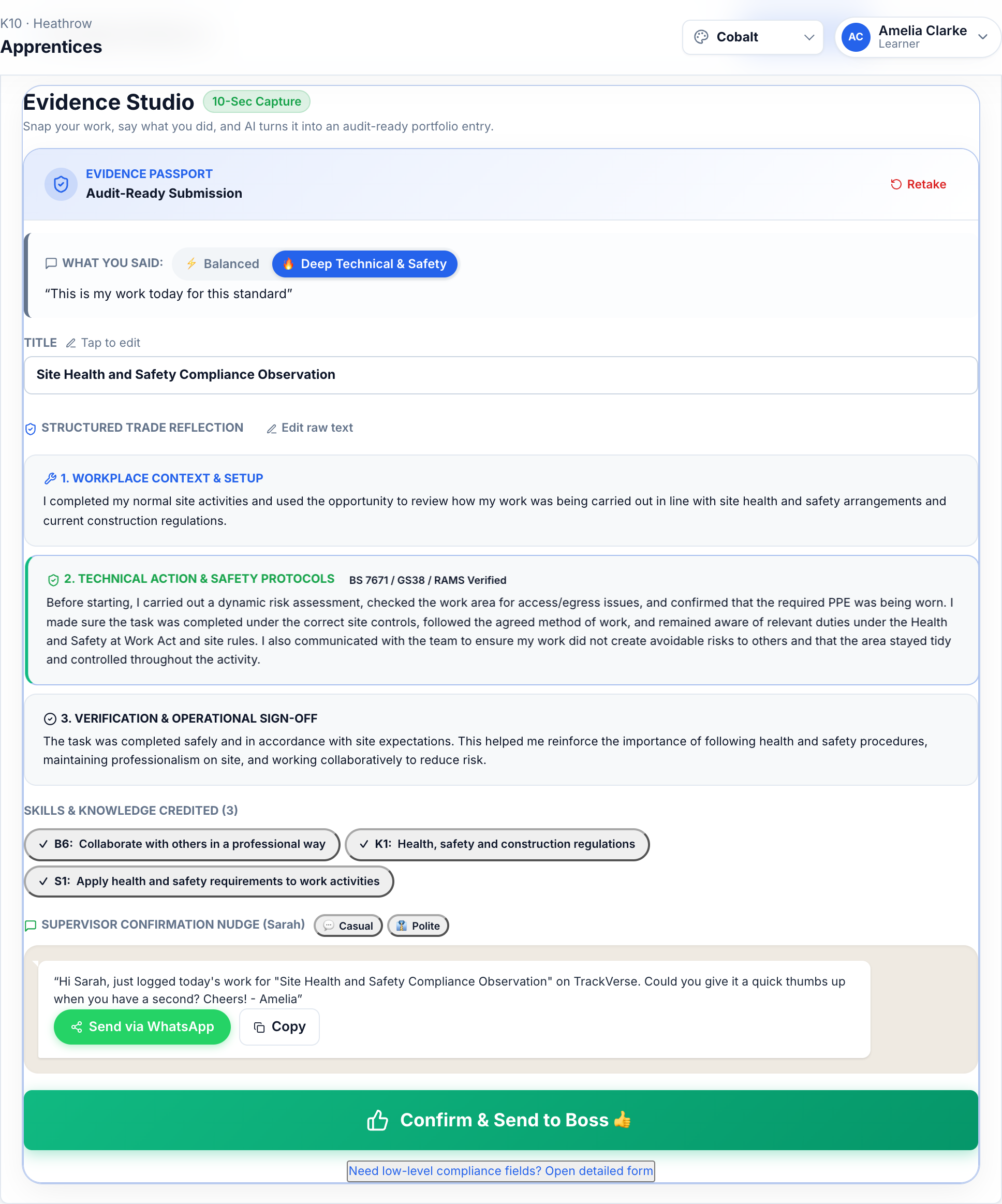
- Timestamped Assistive Modality Log: Records the exact dates in the calendar month that the apprentice utilized speech-to-STAR structuring and audio Socratic prompts to overcome written articulation barriers.
- 1-Click Tutor Monthly Impact Sign-Off: On the 25th of each month, before the ILR R-return closes, TIQPlus prompts the tutor with a pre-compiled summary of the learner's assistive usage and KSB progress. The tutor adds a 15-second voice or text evaluation of impact and signs off.
- Automatic ILR / MIS Pause Alert: If a learner was on a break in learning or had zero evidenced support interactions in a given month, TIQPlus alerts the MIS team before the ILR submission window so the £150 claim is paused cleanly—preventing audit errors before they happen.
5. Protecting Excess LSF (>£150/mo) & Exceptional Learning Support (ELS)
For learners requiring specialist 1-to-1 human mentoring, sign-language interpretation, or specialist ergonomic/assistive hardware exceeding £150 in a calendar month, providers claim the top-up via the Earnings Adjustment Statement (EAS).
Under the tightened DfE rules, EAS claims above £150/month require actual cost evidence and invoices, not flat-rate estimates. TIQPlus binds specialist tutor session logs and external supplier invoices directly to the monthly ILSP ledger—ensuring your MIS and Finance teams have a single, audit-proof zip pack ready the moment an ESFA auditor requests a sample.
"An initial cognitive screening test at onboarding does NOT protect your £150/month Learning Support Funding (LSF) claims at audit. DfE funding auditors are clawing back LSF for any calendar month where providers cannot show dated proof that a reasonable adjustment was actively delivered and reviewed."
Frequently asked questions
What is the standard Learning Support Funding (LSF) rate in apprenticeships?
Training providers can claim a fixed rate of £150 per month via the Individualised Learner Record (ILR) for any apprentice who has an identified learning difficulty or disability (such as dyslexia, dyspraxia, ADHD, or autism) that directly impacts their ability to complete the apprenticeship without reasonable adjustments.
Why do training providers lose LSF funding during DfE / ESFA audits?
The most common reason for LSF clawback is claiming £150 in a given calendar month without holding contemporaneous, dated evidence that a reasonable adjustment or support intervention was actually delivered and reviewed during that specific month. An initial cognitive screening assessment alone is not sufficient for ongoing monthly claims.
What counts as valid monthly LSF evidence?
Auditors require three connected elements every month: (1) a documented reasonable adjustment plan tied to a diagnosed or assessed need; (2) timestamped evidence that an adjustment or support session occurred in the claim month; and (3) evaluation of the impact on the learner's progress toward Gateway.
When are invoices required for Learning Support Funding?
Under the updated funding rules, when a provider claims Excess Learning Support above the £150/month fixed rate via the Earnings Adjustment Statement (EAS), or Exceptional Learning Support (ELS) over £19,000/year, they must retain actual cost evidence and invoices proving the expenditure incurred.
Sources & further reading
- DfE / ESFA Apprenticeship Funding Rules: Learning Support Funding (LSF) & Earnings Adjustment Statement (EAS) — gov.uk/guidance/apprenticeship-funding-rules
- Ofsted Further Education and Skills Inspection Framework: Learners with SEND — gov.uk/government/publications/education-inspection-framework
- FE Week Investigations: Learning Support Funding Audit Clawbacks — feweek.co.uk