Published: 4 August 2026
The UK does not lack training activity. It lacks enough training that changes capability deeply and visibly. Learning and Work Institute reported in March 2026 that employer investment in skills had fallen 30% per employee compared with 2011, while 58% of UK training episodes lasted one day or less.
That does not make short training inherently poor. A focused session can solve a specific need. The problem is a delivery model where attendance and completion become the only durable outputs, even when learners have investigated valuable workplace problems during the programme.
Training providers can improve that model by designing for two results at once:
- A learner outcome: the person develops and demonstrates relevant knowledge or skill.
- An employer asset: the organisation retains approved operating knowledge created through that learning.
Completion evidence is necessary—but it has a different job
Completion records answer legitimate questions. Did the learner attend? Did they complete the required activities? Did they pass the relevant assessment? Can the provider evidence delivery?
They do not normally answer:
- How does this role or workflow actually operate?
- Which decisions depend on experienced judgement?
- Where are delays, exceptions or knowledge bottlenecks?
- What may be safely assisted by AI?
- Which controls and human checks are required?
- Who confirmed that this description is accurate?
A learner may answer these questions inside an assignment, but that does not automatically make the result easy for the employer to find, trust or reuse. The submission may contain reflective material, assessment commentary or personal information that should not become company guidance.
The learner portfolio proves learning. The employer asset preserves approved organisational knowledge. They can be connected without being treated as the same record.
What counts as an employer asset?
An employer asset is structured, organisation-specific and reviewed by someone authorised to confirm its accuracy. Examples include:
- a role playbook describing responsibilities, decisions, systems and dependencies;
- a current-state workflow with triggers, steps, handoffs and exceptions;
- a set of workflow-specific AI and data-handling controls;
- a manager-approved example of good work with acceptance criteria;
- a record of knowledge risks and single-person dependencies;
- a prioritised improvement or automation opportunity;
- an implementation experiment with an owner and review measure.
A generic worksheet is not yet an employer asset. It becomes useful when it describes real work, follows a consistent structure, has been reviewed and can be retained independently of the learner's private evidence record.
Five principles for designing asset-producing training
1. Start with a workplace object
Choose the role, workflow, decision, control or problem the learner will examine before the programme begins. “Apply this to your job” is too broad. “Map one recurring workflow with a named owner and measurable pain point” is actionable.
2. Teach immediately before application
Connect each learning block to a small workplace output. Process-mapping content leads to a workflow draft. Governance content leads to control fields. Value-assessment content leads to an opportunity hypothesis. This keeps application close to instruction and creates momentum.
3. Structure the capture
Open essays make comparison and reuse difficult. Use consistent fields, definitions and status labels. Structure should support the learner's thinking rather than reduce the activity to form filling.
For workflow capture, request the trigger, inputs, steps, decisions, handoffs, exceptions, systems, information, controls and outputs. For an improvement opportunity, distinguish observed facts from assumptions and expected benefits.
4. Give managers a defined review role
A learner understands their experience of the work. A manager may see cross-team dependencies, policies and risks the learner cannot. Their job is to correct, challenge and approve the organisational description—not to mark the learner's assignment.
Keep submissions in draft until reviewed. Allow the manager to request changes and preserve the approval history. Make it clear that approval of a documented opportunity does not by itself authorise implementation.
5. Package and hand over the approved result
Do not leave approved knowledge distributed across individual portfolios. Give the employer an accessible collection organised by role, workflow or business area. Include owners, dates and review responsibilities so assets can be maintained as work changes.
Worked example: customer complaints training
A provider delivers a customer-service improvement programme. One learner documents the complaint-escalation workflow used by their team. The learning activity develops their understanding of service recovery, decision-making and data handling.
The structured submission captures the complaint trigger, four handling stages, the severity decision, two common exceptions, information used, response standard and escalation owner. The learner attaches an anonymised example of a strong response and explains why it meets the required standard.
The line manager corrects the escalation threshold, removes an outdated system reference and approves the revised version. The learner retains their programme evidence. The employer receives:
- an accurate complaint-handling workflow;
- a manager-approved quality example;
- a documented escalation control;
- one opportunity to assist response drafting while retaining human approval.
The same learning activity has produced individual development and reusable organisational value.
How to measure employer value honestly
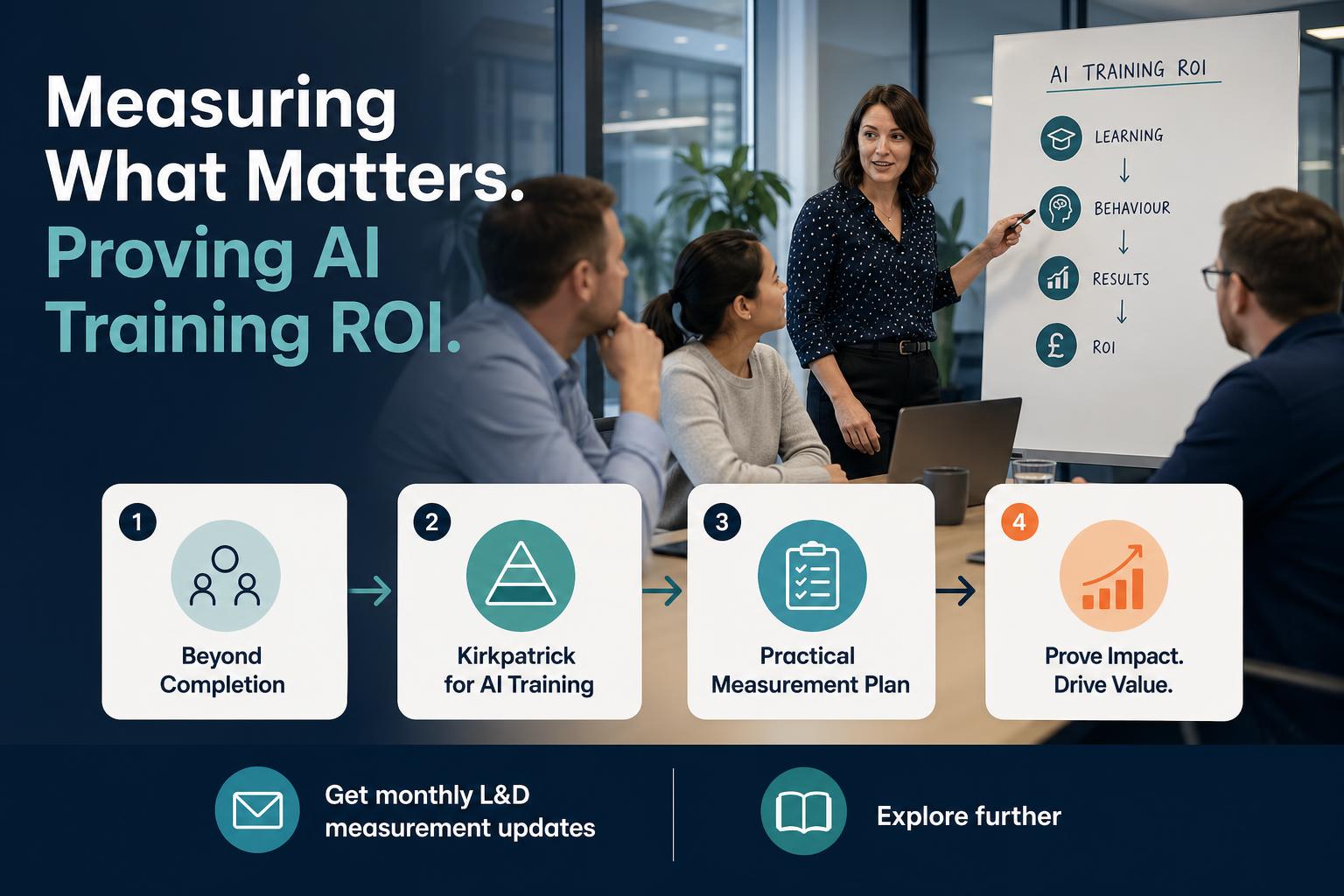
Use a progression of measures rather than treating every identified idea as ROI:
| Stage | Useful measure |
|---|---|
| Participation | Learners and managers actively involved |
| Production | Structured outputs drafted |
| Validation | Outputs approved or returned for changes |
| Reuse | Assets used in onboarding, review or improvement work |
| Implementation | Opportunities taken into controlled experiments |
| Impact | Measured time, quality, risk or customer change against a baseline |
This prevents inflated claims. A mapped workflow is useful, but it is not a saving. An approved opportunity is promising, but it is not an implementation. Clear states make provider reporting more credible.
Pilot the model with one cohort
Providers do not need to redesign their complete portfolio. Choose one programme with genuine workplace application and committed employer involvement. Define one or two output templates, brief managers, and measure the review experience.
At the end of the pilot, evaluate:
- Did learners understand the workplace task?
- Did the activity support the curriculum and assessment requirements?
- Could managers review without excessive administration?
- Were the approved outputs useful to the employer?
- What was reused 30 or 90 days later?
Completion will remain an important programme outcome. The opportunity is to make sure it is not the only thing the organisation has left when the training ends.
Frequently asked questions
What is an employer asset in workplace training?
It is a structured, reusable output created through genuine workplace learning, such as an approved workflow map, role playbook, control set, quality example or improvement opportunity.
Does an employer asset replace learner evidence?
No. Learner evidence supports learning, assessment and funding requirements. The employer asset serves a different purpose: it preserves approved organisational knowledge for reuse. One activity can contribute to both, but the records and access controls should remain clear.
Should every learner submission become company guidance?
No. Submissions should remain drafts until an authorised manager checks their accuracy and approves them for organisational use.
Sources & further reading
- Learning and Work Institute — UK training and skills tick-box culture puts job mobility and growth at risk
- Skills England and DWP — Skills for AI: What works for AI upskilling in the UK
- OECD — AI and skills