Last updated: 6 September 2026
The 12-Month Levy Expiry Cliff in Numbers
Between 2017 and 2025, employers paying the UK Apprenticeship Levy operated under a relatively generous 24-month fund expiration window. Even if an enterprise organisation delayed starting new cohorts, their unspent levy contributions sat safely in their Digital Apprenticeship Service (DAS) account for two full years before being returned to HM Treasury.
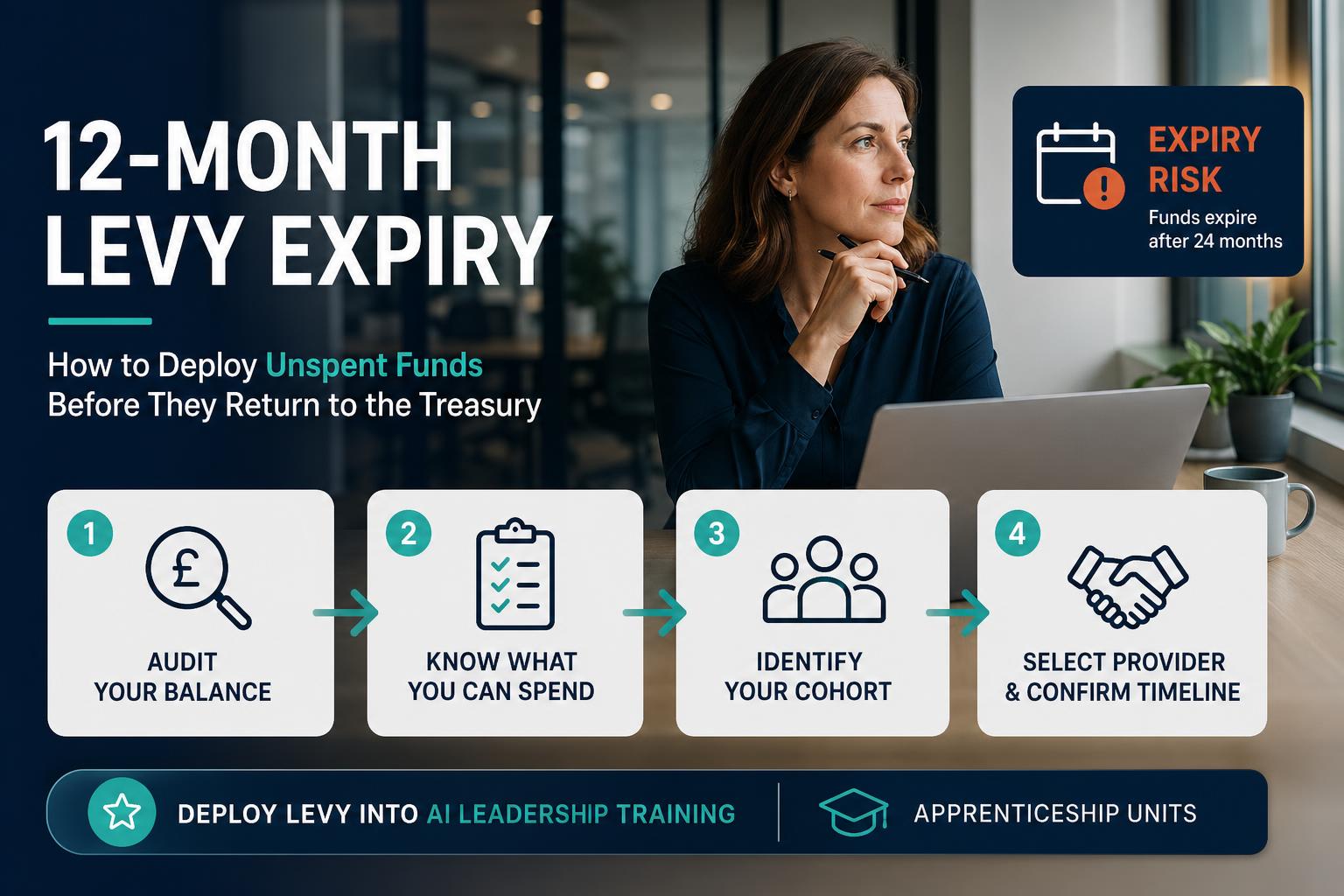
Under the Labour government's Growth and Skills Levy reforms, that safety net has vanished. For all new monthly levy contributions entering employer accounts from 1 August 2026 onwards:
- Expiry window slashed by 50%: Funds now expire after just 12 months on a strict rolling monthly basis.
- Top-up eliminated: The government's 10% co-investment top-up on monthly PAYE levy contributions has ceased for new funds.
- Mixed account balances: Employers now manage complex hybrid accounts where older balances (pre-August 2026) expire on the 24-month schedule, while all current receipts burn twice as fast.
Government expenditure data shows that over £1.2 billion in unspent levy funds was returned to the Treasury in the previous financial year alone. With the 12-month cutoff now active, that clawback rate is set to surge dramatically unless training providers intervene.
Why Employers Let Their Funds Burn (And How Providers Capitalise)
Independent Training Providers (ITPs) often assume that when an employer lets £250,000 in levy funding expire, it is because they have no training needs. In reality, it is caused by structural friction in traditional apprenticeship sales:
- The Multi-Year Commitment Fear: Line managers resist releasing valued team members for 18 to 24 months. In fast-paced sectors like financial services, digital media, or logistics, managers cannot plan their team headcount two years in advance.
- The 20% Off-The-Job (OTJ) Anxiety: Despite OTJ rules being refined to a minimum baseline (typically 6 hours per week for full-time staff), department heads still perceive apprenticeships as losing an employee for one day a week.
- Unspent Funds Inertia: Because the levy deduction appears as an automated PAYE tax line on the payroll balance sheet, CFOs treat it as a sunk operational cost rather than an active training asset.
This is where progressive training providers are winning significant market share. Instead of pitching generic, multi-year apprenticeships, consultative provider sales teams position themselves as workforce budget preservation partners.
The Commercial Opportunity for Providers
Every pound of expiring levy is already paid for by the employer. They do not need to secure a new budget approval from the board. If a training provider can demonstrate that an employer will lose £80,000 over the next 90 days, the psychological sales trigger shifts from "Do we want to spend money on training?" to "How do we stop the Treasury taking our money?"
The Growth & Skills Levy Modular Unit Opportunity
The single most powerful weapon in the provider sales arsenal in 2026 is the 50% Flex Allowance for approved Apprenticeship Units. Skills England now permits employers to deploy up to half of their annual levy allocation toward accredited modular units rather than full standards.
Consider the approved Level 5 AI Leadership units launched under the reformed catalogue:
- AU0009: AI Strategy, Readiness & Opportunity Assessment (30 hours delivery, £750 maximum funding).
- AU0010: AI Procurement, Ethics & Governance Frameworks (30 hours delivery, £750 maximum funding).
- AU0011: AI Transformation & Workflow Implementation (30 hours delivery, £750 maximum funding).
For an employer with £60,000 in imminent expiring funds, committing 15 senior managers to a 2-year Level 7 Senior Leader apprenticeship is an impossible internal sell. However, enrolling 80 mid-level managers into AU0009 and AU0010 over a 12-week sprint is an immediate, high-impact win that absorbs the expiring funds, upskills key leaders, and requires zero long-term retention risk.
The "Levy Account Health Check" Sales Framework
Leading ITP sales representatives do not begin meetings with brochures or course catalogues. They execute a 15-minute Levy Account Health Check. Here is the consultative script and process:
| Diagnostic Step | What the Provider Examines in DAS | The Insight Presented to the Employer | Commercial Next Step |
|---|---|---|---|
| 1. Expiry Trajectory Analysis | The rolling 12-month expiry projection line on the employer's DAS home dashboard. | "You are currently burning £14,500 every month. If unspent, £87,000 will be clawed back by December." | Establish the total capital amount at immediate risk of forfeiture. |
| 2. PAYE Payroll Recalculation | Total annual wage bill changes and monthly levy generation rates. | "With recent wage inflation, your monthly deposit has increased to £22,000, accelerating your expiry rate." | Calculate ongoing monthly capacity vs. current active learner commitments. |
| 3. Flex Allowance Sizing | Calculating 50% of the annual account generation. | "You have £110,000 eligible for short modular units without touching your full apprenticeship commitments." | Package a multi-cohort modular unit proposal. |
| 4. Levy Transfer Opportunities | Unused 50% transfer allowance to supply chain partners. | "You can transfer remaining funds to key SME suppliers to strengthen your supply chain resilience." | Position the provider to manage their supply chain training academy. |
Overcoming Common Employer Pushback
Objection 1: "We don't have time to put staff on apprenticeships right now."
Provider Response: "We completely agree—a full two-year standard is too heavy for your current operational quarter. That is why Skills England introduced Apprenticeship Units under the Growth & Skills Levy. These are focused 30-hour modular programmes designed to solve immediate problems like departmental AI workflows or compliance. Your staff complete them in 8 to 12 weeks, and the funding is fully covered by the £45,000 you are currently scheduled to lose to the Treasury."
Objection 2: "Our HR team doesn't have the capacity to manage more paperwork."
Provider Response: "Our delivery platform (TIQPlus) manages the digital compliance burden for you. From Digital Apprenticeship Service cohort approvals and learner onboarding to automated tripartite reviews and mentor feedback, your managers spend under 15 minutes a month on administrative tasks. We handle the ESFA audit requirements end-to-end."
A 4-Step Sales Workflow for Provider BD Teams
- Targeting the Dormant Account Tier: Export your CRM contacts and filter for levy-paying clients who haven't started an apprentice in the last 9 months. Send a personalised briefing: "Notice on your 12-month levy expiration risk under the 2026 Growth & Skills Levy."
- Run the Live Screen-Share Diagnostic: Ask the client to open their DAS dashboard on a 20-minute video call. Point out the rolling clawback date. When employers see the red negative balance warnings, urgency spikes.
- Propose a Two-Tier Workforce Package: Present a blended solution: 10 full apprenticeships for career-entry roles (attracting the 100% funding and £2,000 SME hiring incentive for young starters where applicable), plus 40 modular units for existing managers.
- Automated Enrolment & Onboarding: Use digital onboarding workflows to secure commitment statements and apprenticeship agreements before the end of the monthly clawback cycle.
Verbatim BD Script: The 15-Minute DAS Screen-Share Discovery
BD Rep: "Thanks for opening your Digital Apprenticeship Service screen, Sarah.
If you look at the 'Funds Expiry Forecast' tab on the bottom right, you'll notice
a line showing £12,800 scheduled for automatic removal next month.

Under the old rules, you had 24 months before those funds expired. But as of August 2026,
the government cut that window to 12 months, and eliminated the 10% top-up.
That means every month you don't allocate these funds, they are permanently clawed back.

Over the next two quarters, your account shows £76,800 returning to HM Treasury.
Rather than letting that capital disappear, Skills England now allows us to use your
50% flex allowance on accredited 30-hour Apprenticeship Units—such as AI Leadership
or Digital Operations.

We can enroll a cohort of 40 mid-level managers in an 8-week sprint. It requires zero
out-of-pocket budget, solves your departmental skills gaps, and absorbs 100% of the funds
you are currently scheduled to lose. Would next Tuesday work to review the cohort schedule?"
Deliver Higher Commercial Yield with TIQPlus
TIQPlus equips training providers with branded employer diagnostic reports, automated DAS reservation trackers, and multi-programme delivery suites for full standards and modular units—empowering your BD team to turn expiring levy balances into high-margin retained cohorts.
Frequently Asked Questions
Can employers transfer expiring levy funds to another company to stop them expiring?
Yes, employers can transfer up to 50% of their annual levy funds to other businesses, such as supply chain partners, SME subcontractors, or industry charities. However, transferred funds are also bound by the 12-month expiry clock once received, meaning the recipient must actively allocate them to confirmed starts.
What happens if a learner withdraws from an apprenticeship unit early?
Unlike full multi-year apprenticeships where completion payments represent 20% of total funding, apprenticeship unit funding is drawn down across milestones (typically initial assessment, midpoint compliance, and end-of-unit skills test). Providers must ensure tight learner attendance tracking to secure full milestone payments.
Does a provider need special approval to deliver modular apprenticeship units?
Yes. Providers must be approved on the Apprenticeship Provider and Assessment Register (APAR) and have their scope verified for unit delivery in the specific occupational sector.
Sources & further reading
- GOV.UK: Apprenticeship Funding Rules 2026-27 — Apprenticeship Service Account Expiry and Funding Guidance
- Skills England Catalogue — Approved Apprenticeship Units & Growth and Skills Levy Offer
- HM Treasury Data — Apprenticeship Levy Account Unspent Funds & Return Statistics