Last updated: 15 July 2026
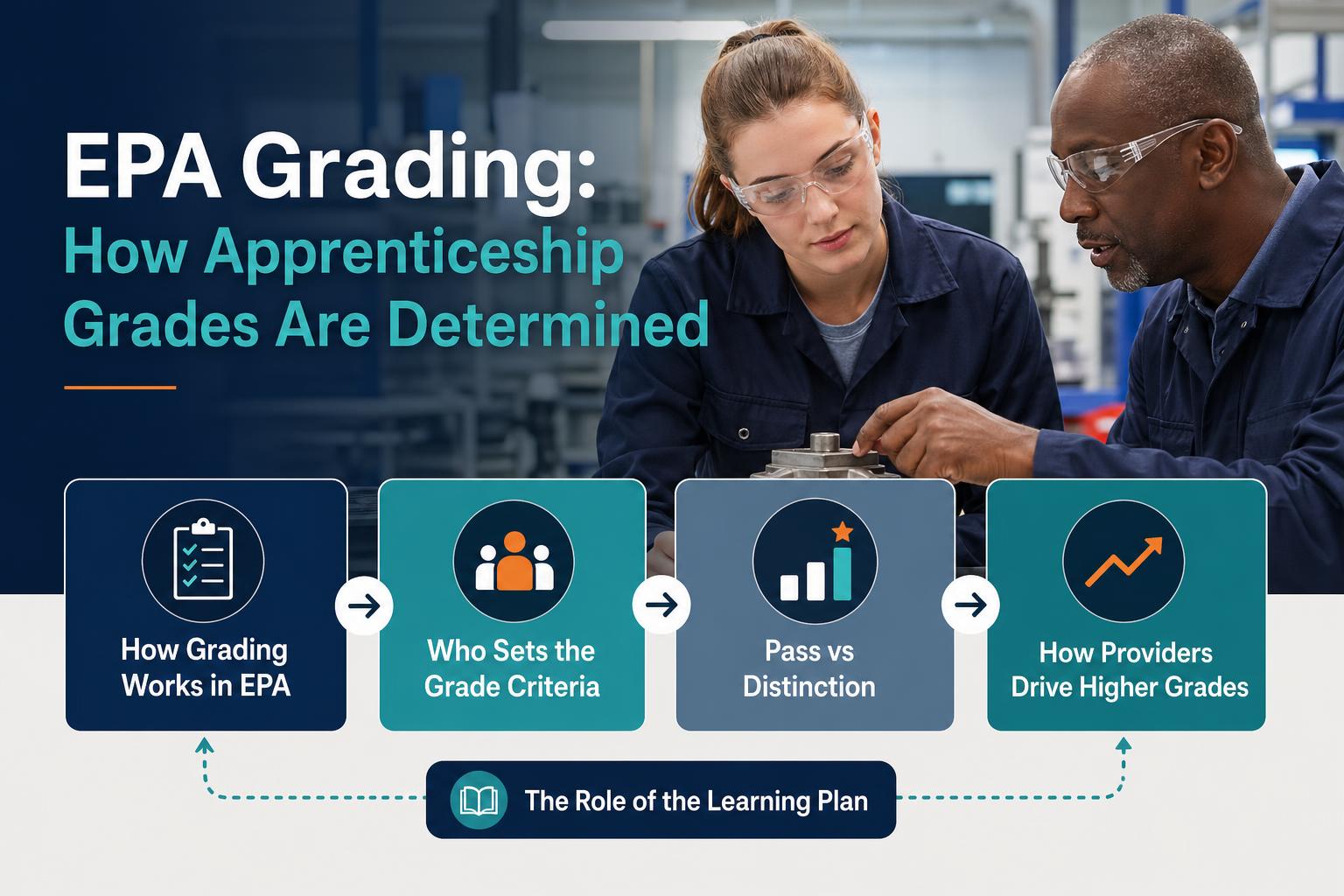
How Grading Works in EPA
In July 2026, providers are operating through a phased transition. EPA, EPAO and gateway to end-point assessment remain the correct terms for apprentices following an existing end-point assessment plan. When Skills England publishes and brings a revised plan into use, that plan uses apprenticeship assessment, assessment organisation (AO) and gateway to completion. Do not change an apprentice's process merely because the national terminology has changed: identify the exact standard version and follow the plan attached to it.
Existing EPA plans retain their published grading model. Depending on the standard version, that may be pass/fail, pass/distinction, pass/merit/distinction or another expressly stated structure. For revised apprenticeship assessment plans, the available grades are normally pass and distinction; any exception must be stated in the plan. Where one or more mandatory qualifications provide the sole assessment, the apprenticeship itself is graded pass/fail even if the qualification uses a wider grading scale.
The applicable plan and the EPAO's or AO's assessment specification determine which assessments must be passed and how the overall grade is calculated. Method names, combinations and aggregation rules are standard-specific, so a grading rule from one apprenticeship should never be copied into another.
Check the start date and standard version
The 2026 to 2027 funding rules apply to starts from 1 August 2026. Earlier apprentices continue under the rules for their start year, together with their applicable assessment-plan version. English and maths requirements also depend on age at start, apprenticeship level and the applicable rules; they are not a universal gateway condition for every apprentice.
Who Sets the Grade Criteria
Skills England works with the relevant occupational group, including employers and sector experts, to develop and publish revised apprenticeship assessment plans. These plans contain assessment outcomes, assessment requirements and performance descriptors. AOs then develop their detailed assessment approaches and clear marking criteria within those requirements.
Performance descriptors describe pass- and distinction-level performance and guide AO assessment design. Apprentices are not marked directly against the generic descriptors. Providers should therefore use both the published plan and the applicable AO specification, rather than inventing a scoring system from the descriptors alone.
Under some revised plans, a training provider may deliver and mark an assessment. The AO remains responsible for its assessment design and quality assurance, and the provider must work within the permitted delivery, marking and conflict-of-interest controls. Under existing EPA plans, the independent EPAO role and that plan's grading instructions continue to apply.
Assessment plan literacy is a quality issue
Tutors need to understand the plan that applies to each apprentice, including its outcomes, methods, grading rules, gateway or gateway-to-completion conditions and any AO specification. That knowledge supports coherent curriculum planning and accurate preparation; it does not mean teaching rehearsed answers or treating a generic mock as a substitute for occupational competence.
What Differentiates Pass from Distinction
The controlling source is always the applicable plan and AO assessment specification. The examples below are useful preparation principles only when those methods appear in that plan; they are not universal grade criteria. In revised plans, all assessment outcomes must be assessed and the assessment must give the apprentice an opportunity to demonstrate both pass and distinction.
Professional discussion
Where a professional discussion is specified, preparation should reflect the actual outcomes and marking criteria. Apprentices may need to explain occupational decisions, apply knowledge to context and respond to follow-up questions, but the required depth and evidence are defined by the AO materials for that standard.
Mocks can help apprentices practise the format and communicate authentic workplace competence. Use open follow-up questions and give criterion-referenced feedback, while protecting the independence and security of the live assessment.
Portfolio-based interview
A portfolio is not required by every plan and is not necessarily graded when it is used. Where a portfolio underpins an interview or discussion, follow the plan's rules on its purpose, content, authentication and submission. Help apprentices select valid, attributable evidence and understand their own work; do not assume that more evidence, or a more polished portfolio, automatically earns a higher grade.
Practical observation
Where observation is required, tutors should build repeated opportunities to perform the occupation safely and independently in realistic conditions. The AO's criteria determine what is observed and how it is graded. Fluency or speed should not be treated as an unofficial distinction criterion unless the assessment specification makes it relevant.
Written or online test
Where a test is included, its pass threshold, distinction threshold and contribution to the overall grade come from the applicable specification. Providers can support durable knowledge through retrieval, application and scenario practice, but should not assume a particular percentage threshold or weighting.
How Providers Can Support Higher Grade Outcomes
Strong outcomes are built through occupationally relevant teaching, practice, feedback and employer support throughout the programme. Final-stage preparation should familiarise the apprentice with the permitted assessment format and criteria; it cannot compensate for gaps in occupational competence.
Evidence quality over evidence volume
Collect only the evidence required for learning, progress and the applicable assessment. Where workplace evidence is used, quality means that it is valid, authentic, attributable and relevant — not simply voluminous. Map it to the plan or AO specification only where that mapping is required, and do not label evidence “distinction-level” unless the assessment criteria support that judgement.
Developing depth of reflection
Where the occupation and assessment require reflection, teach it as an occupational skill rather than as a portfolio-writing trick. Apprentices can practise explaining why they made a decision, what evidence informed it, its effect and what they would change. The plan's actual criteria determine whether and how that reflection contributes to a grade.
Mock EPA sessions
Use mocks only where they reflect the permitted assessment approach. Base them on public plan and AO information, make reasonable adjustments where required, and give specific feedback without reproducing live assessment materials. For revised plans, remember that performance descriptors inform AO design and are not themselves a direct marking grid for tutors.
Structured preparation reviews
Use progress reviews to discuss progress against the training plan, address gaps and agree actions. Reviews are normally held at least every three calendar months; an evidenced delivery reason can support a pre-agreed alternative cadence of no more than six months. They are three-way discussions, with the employer attending physically or virtually for the majority of reviews. Readiness should be discussed throughout, but a progress review does not replace the formal gateway or gateway-to-completion checks in the applicable plan.
The Role of the Training Plan in Grade Outcomes
The training plan should show how the agreed training develops the occupational standard, reflects prior learning and is kept current with the employer and apprentice. It is not a promise of a particular assessment grade.
Targets can still encourage greater independence, accuracy, judgement and application where these are appropriate to the occupation and published criteria. Keep them developmental and evidence-based. The funding rules require actions to be agreed and documented at progress reviews; they do not mandate a particular “SMART” wording or require every target to be written at distinction level.
For revised plans, employers should verify each behaviour before gateway to completion. Behaviours remain mandatory but do not contribute to the apprenticeship grade, and the AO or provider is not required to assess or quality-assure the employer's judgement. Build behavioural development and employer feedback into normal programme conversations rather than creating a duplicate assessment system.
Common Reasons Apprentices Achieve Pass When Distinction Was Possible
A pass is a valid demonstration of occupational competence. Where an apprentice was aiming for distinction, use the AO's result and feedback — where available — to identify a specific cause rather than relying on a generic explanation.
Possible causes include a gap against one assessment criterion, difficulty applying knowledge in the assessed context, incomplete or ineligible evidence where evidence was required, or unfamiliarity with a permitted assessment format. They may also include an assessment-design or reasonable-adjustment issue that should be raised through the AO's published process.
Review patterns across apprentices, standards, AOs and assessment methods, but compare like with like. A change in standard version or assessment plan can change the grade structure and method, so raw distinction rates are not automatically comparable across cohorts.
Grade data as a quality indicator
TIQPlus can segment assessment outcomes by cohort, tutor, standard version and assessment organisation. That context helps providers distinguish a delivery pattern from a change in plan, grading model or assessment method.
Grading and Resit Rules
For revised apprenticeship assessment, a resit involves no further training or learning; a retake follows further training or learning. The AO designs its policy in line with the appropriate regulatory framework. Wherever possible, an apprentice should repeat only an unsuccessful assessment or one they want to improve.
A revised-plan policy should not cap the apprentice below distinction unless a justified industry or regulatory requirement makes a cap necessary. This differs from some existing EPA plans, whose published component, waiting-period and grade-cap rules continue to apply to apprentices who remain on that version.
There is no safe universal rule that every apprentice receives exactly one funded attempt after failure. Confirm the applicable plan, AO policy, funding rules and contractual responsibility before telling an apprentice or employer who will pay. Record the outcome accurately in the ILR using the specification for the relevant year; failing an assessment does not by itself justify treating the learning actual end date as the assessment date.
EPA Grading Preparation Checklist
- Confirm the apprentice's start date, standard code and version
- Use the assessment plan attached to that version — existing EPA plan or revised apprenticeship assessment plan
- Obtain and follow the appointed EPAO or AO specification, including permitted support and reasonable-adjustment processes
- Explain the actual grade structure, methods and aggregation rules to the apprentice and employer
- Teach and assess occupational competence throughout the programme, not only in final-stage preparation
- Collect a portfolio or other evidence only where the applicable plan requires or permits it
- Use mocks that reflect the real format without reproducing secure materials or inventing unofficial grade thresholds
- For revised plans, obtain employer verification of every behaviour before gateway to completion
- Check English and maths, mandatory qualification and other completion conditions against the apprentice's applicable rules and plan
- Communicate the correct resit and retake policy before the first assessment
- Analyse outcomes by standard version and assessment model so cohort comparisons remain meaningful
Frequently asked questions
Can an apprentice retake EPA if they fail?
Check the assessment plan and the assessment organisation's policy for the apprentice's exact standard version. Under the revised assessment requirements, a resit involves no further training or learning, while a retake follows further training or learning. Wherever possible, only the unsuccessful assessment should be repeated, and a distinction should not be capped unless an industry or regulatory requirement justifies it. Existing EPA plans keep their own resit, retake and grading rules for apprentices who remain on that version.
Who decides the EPA grade?
It depends on the apprentice's standard version. Under an existing EPA plan, the end-point assessment organisation applies that plan's grading rules. Under a revised apprenticeship assessment plan, the assessment organisation designs the detailed assessment and grading approach from the published outcomes, requirements and performance descriptors. A training provider may deliver and mark an assessment where the revised plan allows it, with the assessment organisation retaining overall responsibility for the assessment design and quality assurance.
Does the provider's IQA process affect EPA grades?
Provider quality assurance should follow the exact assessment plan and the boundaries agreed with the assessment organisation. It matters directly where a revised plan permits the provider to deliver and mark an assessment. For existing EPA plans, it still helps the provider check the quality of teaching, evidence and preparation, but a portfolio, grade descriptors and provider marking are not universal features of every plan.
Sources & further reading
- Requirements and guidance for apprenticeship assessment — Requirements and guidance for apprenticeship assessment
- Apprenticeship standards — Apprenticeship standards
- Apprenticeship funding rules and assessment plan guidance, 2026 to 2027 — Apprenticeship funding rules and assessment plan guidance, 2026 to 2027