Last updated: 14 June 2026
Why Levy Leakage Happens
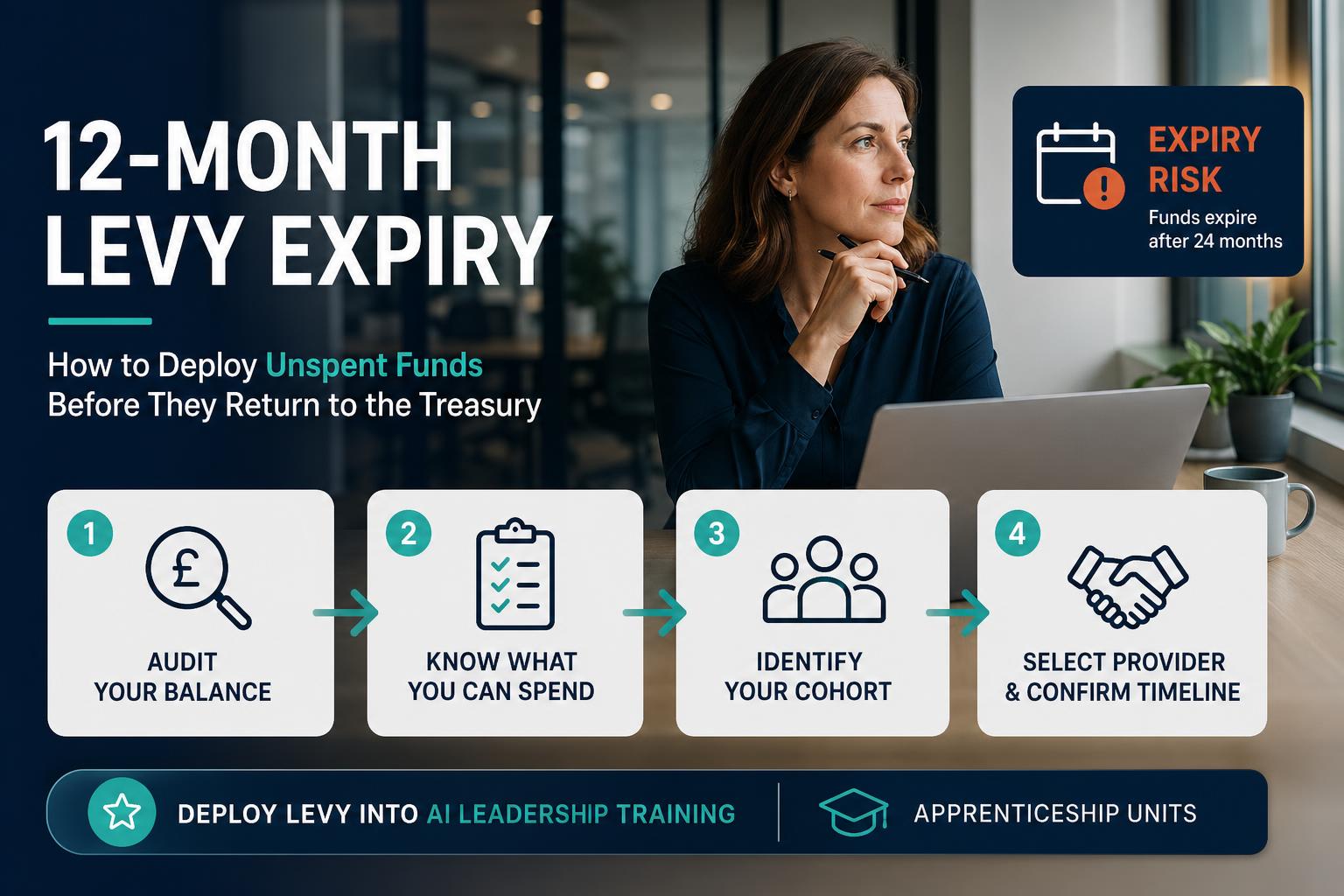
Most levy leakage is not caused by a lack of training need. It happens because three pieces of information sit in three different places: the apprenticeship service account shows funding, HR systems show roles and headcount, and L&D plans show training demand. When those views are not joined, employers can lose funding value while still having obvious skills gaps in the business.
The apprenticeship levy is paid by employers with an annual pay bill above £3 million. GOV.UK guidance describes the levy as 0.5% of the annual pay bill, with a £15,000 allowance, and the apprenticeship service guidance explains how levy-paying employers access and manage funds for apprenticeship training. That creates a simple commercial question for large employers: how much of the funding already generated by payroll is being turned into useful capability?
A free diagnostic works because it does not begin with a course catalogue. It starts with leakage: what funding exists, what is close to being lost or underused, where the workforce has priority gaps, and which funded routes are plausible enough to investigate.
Where is money already available, where is capability missing, and where can a funded programme or unit close the gap without creating unnecessary delivery complexity?
What the Review Covers
The Levy Leakage & Workforce Skills Review has three outputs.
Unused funding estimate. The review looks at the current levy balance, monthly contribution pattern, expected training commitments, and any visible expiry pressure. This is not a replacement for the official apprenticeship service account. It is a practical estimate that helps HR, L&D, and finance discuss the same number.
Priority skills gap map. The review identifies role groups where the gap is material enough to justify funded training. For most employers this includes managers who need AI leadership capability, operational teams whose processes are changing, technical or data roles with applied AI requirements, and frontline groups where compliance or productivity gaps are visible.
Funded route shortlist. The review maps each priority gap to possible routes: full apprenticeship standards, apprenticeship units, Skills Bootcamps, levy transfers, co-investment options, or commercial training where public funding does not fit. The goal is not to force every gap into the levy. The goal is to avoid paying commercially for training that a valid funded route could cover.
What Data You Need to Run the Diagnostic
The review is intentionally lightweight. A useful first pass can be produced from five inputs:
- Current apprenticeship service balance: available funds, current commitments, and any expiry view shown in the account.
- Monthly levy contribution: enough payroll context to estimate future inflow.
- Current learner commitments: active apprenticeships, planned starts, and known provider commitments.
- Workforce structure: role groups, headcount, location, and seniority bands.
- Skills priorities: strategic capability gaps already visible to HR, L&D, operations, or business unit leaders.
More data improves the output, but the review should not become a six-month workforce planning project. The commercial value is speed. Within a week, a competent review should be able to show whether the employer has a funding leakage problem worth acting on.
How Skills Gaps Map to Funded Routes
Not every training need is fundable. That is the point of the review. It separates four categories that are often blurred in employer conversations.
Full apprenticeship standards are best for deep occupational development where the employee needs a structured programme, work-based evidence, and a formal end-point assessment. They are higher commitment, but they remain the strongest route where the skills gap is tied to a role pathway.
Apprenticeship units are better for targeted, short-cycle capability gaps. Existing TIQPlus course pages map AI leadership topics to AU0009, AU0010, and AU0011, covering AI strategy, adoption and governance, and organisational transformation. Units are most useful when leaders need a focused block of new capability but a full apprenticeship would be disproportionate.
Skills Bootcamps can work where the gap is substantial, employer-sponsored, and aligned to a recognised skills outcome. They are often relevant for digital, data, technical, and sector-specific reskilling needs.
Commercial or internal training still has a place. Some gaps are too specific, too short, or too urgent for public funding. A good diagnostic says that plainly rather than bending the funding rules around the wrong intervention.
What You Receive
The output should be short enough for a decision meeting. A useful Levy Leakage & Workforce Skills Review includes:
- A one-page estimate of unused funding and near-term leakage risk.
- A role-group skills gap map showing where funded training has the strongest case.
- A route matrix showing likely fundable options by programme type or unit.
- A recommended first cohort, including approximate learner numbers and sequencing.
- A list of eligibility and evidence checks to complete before enrolment.
- A 30-day action plan that HR, L&D, finance, and procurement can agree.
The strongest reviews are specific. They do not say "use your levy for AI training." They say: this manager population has this capability gap, this unit or programme may fit, these people are the likely first cohort, these eligibility checks are still needed, and this is the operational next step.
Next Steps for Employers
Start with the official account. Confirm who owns the apprenticeship service login, who can see funding, and who can approve commitments. Then collect enough workforce data to make a sensible role-group map. Finally, test one priority gap against funded routes before trying to solve the whole workforce plan.
For many employers, the first useful move is an AI leadership cohort. It is visible, strategic, and directly connected to current board-level questions about AI adoption, procurement, governance, and workforce change. But the same method works for digital, data, compliance, operational leadership, green skills, and technical roles.
The review is free because it is the fastest way to establish whether there is a real funded training opportunity. If the numbers are small, you know quickly. If the gap is substantial, you have a structured way to move from unused funding to a funded training plan.
Frequently asked questions
What is a Levy Leakage & Workforce Skills Review?
It is a short diagnostic for UK employers that estimates unused apprenticeship funding, identifies priority workforce skills gaps, and maps those gaps to apprenticeship standards, apprenticeship units, Skills Bootcamps, or other funded routes where appropriate. The point is to turn scattered levy and workforce data into a practical action plan.
Who should request the review?
The review is designed for levy-paying employers, employer-providers, HR teams, L&D leaders, and workforce planning teams that suspect they are underusing apprenticeship funding or do not have a clear route from skills gaps to funded provision.
Does the review commit us to buying training?
No. The review is a diagnostic. It shows the likely scale of unused funding, the role groups where training has the strongest business case, and the programmes or units that appear fundable. Any training decision should still go through your normal procurement, provider due diligence, and funding eligibility checks.
Sources & further reading
- GOV.UK: Pay Apprenticeship Levy — gov.uk/guidance/pay-apprenticeship-levy
- GOV.UK: How to register and use the apprenticeship service as an employer — gov.uk/guidance/manage-apprenticeship-funds
- GOV.UK: Apprenticeship funding rules — gov.uk/guidance/apprenticeship-funding-rules