Last updated: 12 June 2026
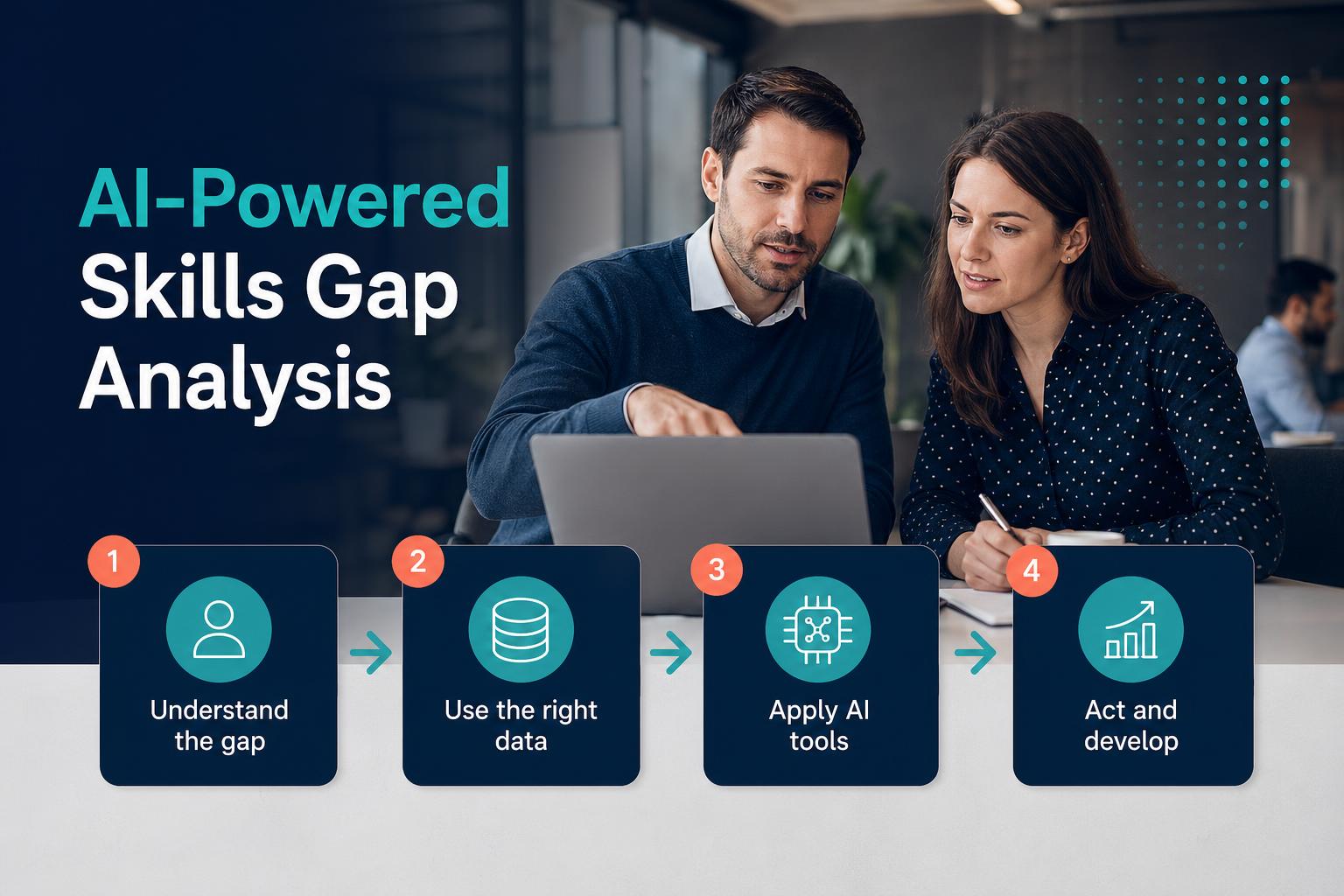
Start With a Specific Skills Gap
Funding route mapping fails when the starting point is too vague. "We need AI skills" is not a skills gap. "Middle managers cannot assess AI supplier claims or explain governance requirements to their teams" is closer. "Finance analysts need to use approved AI tools to summarise variance commentary while applying output verification controls" is better again.
A fundable route map needs four fields for each gap:
- Population: who needs the capability, by role group and headcount.
- Current capability: what they can do now, evidenced by assessment, manager input, performance data, or self-assessment.
- Target capability: what they need to do differently at work.
- Business consequence: what happens if the gap remains open.
Once those fields are clear, route mapping becomes much easier. You are no longer asking "what training can we buy?" You are asking "which funded route, if any, can credibly move this role group from current to target capability?"
Choose the Route Type Before Choosing the Provider
Employers often shortlist providers too early. The better sequence is route first, provider second. Route selection answers the strategic question: is this a deep occupational pathway, a targeted unit, a short reskilling intervention, a transfer opportunity, or commercial training?
Use a full apprenticeship standard when the gap is broad, role-defining, and worth a substantial programme. This is most appropriate where the employee needs structured development across knowledge, skills, behaviours, workplace evidence, and formal assessment.
Use an apprenticeship unit where the gap is narrower and the employee needs a focused capability block. AI leadership is a good example: a senior manager may not need a full apprenticeship, but may need a fundable unit on AI strategy, governance, procurement, or delivery.
Use a Skills Bootcamp where the gap is intensive, employer-sponsored, and aligned to recognised labour market needs. Bootcamps often fit digital, technical, data, and reskilling contexts.
Use levy transfer where the employer cannot spend enough internally but can support supply chain, sector, or community skills development through another employer.
Use commercial or internal training where the skills gap is too bespoke, too short, too confidential, or outside the scope of fundable provision.
A Practical Mapping Matrix
For each priority gap, score the route fit against five questions:
- Is the learner population eligible? Check employment status, location, existing funded learning, prior learning, and any restrictions in the relevant funding rules.
- Is the training itself eligible? The route must match an approved standard, unit, Bootcamp contract, or other recognised provision.
- Is the depth right? Do not use a year-long route for a short awareness gap, and do not use a short course for occupational retraining.
- Is the business timing realistic? The route must start and complete quickly enough to meet the business need and funding plan.
- Can the employer support completion? Funded routes require time, evidence, manager support, and administrative ownership.
The output is a matrix with one row per gap and one column per route. Mark each route as strong fit, possible fit, poor fit, or needs eligibility check. The "needs eligibility check" category matters because it stops the team from treating a sales claim as a funding decision.
A good route map tells you what to investigate next. It does not replace provider due diligence, official funding checks, or learner-level eligibility assessment.
Example: Mapping an AI Leadership Skills Gap
Suppose an employer has 80 managers who approve AI tools, manage AI-enabled workflows, or answer employee questions about AI adoption. The current gap is not technical model-building. It is leadership competence: strategy, procurement, governance, risk, and change management.
A full apprenticeship may be too much for most of that population. A generic AI awareness workshop may be too shallow. Apprenticeship units such as AU0009, AU0010, and AU0011 can be a stronger fit because they break AI leadership into focused blocks: strategy and opportunity, adoption and governance, and delivery and organisational transformation.
The route map might identify:
- First cohort: 12 senior managers with immediate AI governance responsibilities.
- Likely route: AU0010 for adoption, procurement, and governance.
- Second cohort: 20 managers responsible for implementation and workforce impact.
- Likely route: AU0011 for delivery and organisational transformation.
- Parallel route: internal AI literacy training for all employees who only need baseline awareness.
That is a practical funded plan. It does not overtrain the whole workforce, and it does not ignore the people with genuine accountability.
Evidence and Eligibility Checks Before Enrolment
Before any funded route is approved, run an evidence check. This should include learner eligibility, prior learning, employer agreement, role relevance, learning need, funding route, planned delivery model, assessment requirement, and reporting owner.
For apprenticeship units, be especially clear about what counts as delivery, how assessment is evidenced, and who in the employer will validate work relevance. For full apprenticeships, check off-the-job expectations, training plan quality, progress review cadence, and end-point assessment readiness. For Bootcamps, confirm outcome expectations and employer involvement requirements.
Where eligibility is uncertain, do not enrol first and tidy up later. Resolve the uncertainty before the start date.
Common Mapping Mistakes
- Starting with the provider's product list: this creates a sales-led plan rather than a skills-led plan.
- Ignoring prior learning: employees who already have most of the target capability may not be eligible or may need a different route.
- Overusing full apprenticeships: not every employed adult skills gap needs a long occupational programme.
- Underestimating manager support: funded training still needs protected time, workplace application, and line manager involvement.
- Treating funding as the objective: the objective is capability. Funding is a mechanism.
When the map is done well, it gives employers a defensible answer to a common boardroom question: which skills gaps can we close with funding we already generate, and which gaps require a different investment case?
Frequently asked questions
Can every workforce skills gap be funded through apprenticeships?
No. Apprenticeship funding is tied to eligible training, eligible learners, approved standards or units, and the relevant funding rules. Some gaps should be funded commercially or handled internally. The mapping process helps avoid forcing unsuitable training into a funded route.
When should an employer use a full apprenticeship instead of a unit?
Use a full apprenticeship when the gap is a substantial occupational development need and the employee can complete the programme, evidence requirements, and end-point assessment. Use a unit where the gap is narrower, targeted, and suited to a short-cycle intervention.
What data do we need to map gaps to funded routes?
You need role groups, current capability evidence, target capability, business priority, learner eligibility assumptions, and enough funding information to understand whether levy, co-investment, transfer, or another route is likely to apply.
Sources & further reading
- GOV.UK: Apprenticeship funding rules — gov.uk/guidance/apprenticeship-funding-rules
- GOV.UK: How to register and use the apprenticeship service as an employer — gov.uk/guidance/manage-apprenticeship-funds
- GOV.UK: Find apprenticeship training — findapprenticeshiptraining.apprenticeships.education.gov.uk