Last updated: 30 May 2026
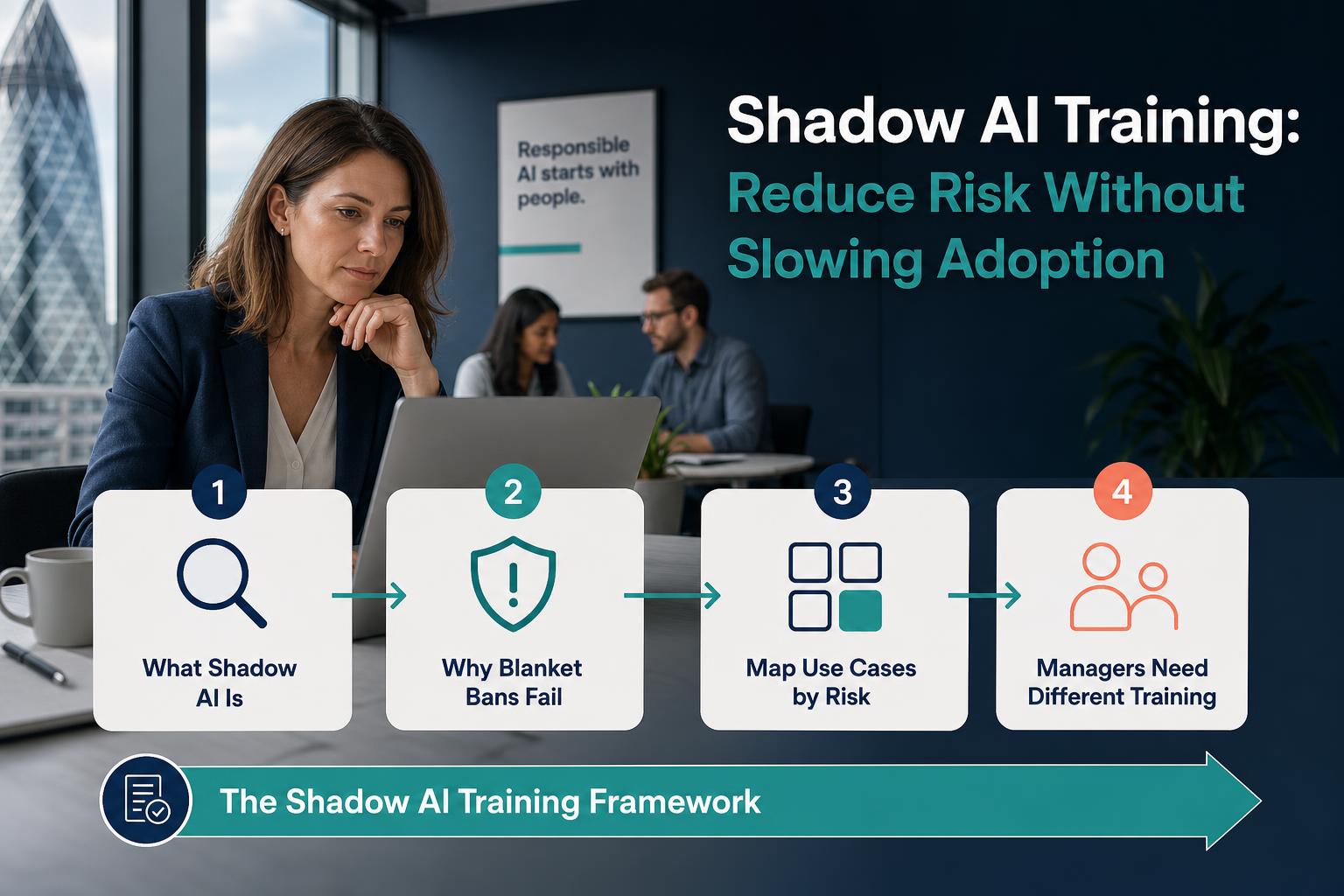
What Shadow AI Is
Shadow AI is the use of AI tools inside an organisation without formal approval, governance, training, or visibility. It is the AI version of shadow IT, but the risk moves faster because many AI tools are free, browser-based, easy to use, and already embedded in everyday work habits.
Examples include employees pasting customer data into public chatbots, using AI to draft client advice without review, summarising confidential meeting notes in unapproved tools, generating code without security checks, or relying on AI outputs in recruitment, performance, compliance, or finance workflows.
The issue is not that employees are interested in AI. That interest is commercially useful. The issue is that capability, policy, and oversight often arrive after usage has already started.
Why Blanket Bans Usually Fail
Some employers respond to shadow AI by banning public AI tools. That may be appropriate for specific teams, data types, or regulated workflows, but a blanket ban rarely solves the wider problem. Employees still face pressure to work faster, AI tools remain available outside managed systems, and many workers do not understand which use cases are genuinely risky.
A better response is controlled adoption. Employers should define approved tools, prohibited data, high-risk use cases, review requirements, escalation routes, and minimum training. The goal is not to slow useful experimentation. The goal is to make AI use visible, proportionate, and accountable.
The practical test
If an employee cannot explain whether a use case is allowed, what data they can enter, how they should check the output, and when they need human review, the organisation has a training gap.
Map AI Use Cases by Risk
Responsible AI training should start with use cases, not tools. The same AI tool can be low risk in one context and high risk in another. Summarising public research is different from summarising a confidential disciplinary meeting. Drafting a first version of a marketing email is different from generating regulated financial advice.
A simple risk map should separate use cases into four groups:
- Allowed with minimal controls: low-risk productivity tasks using non-sensitive information, such as brainstorming, formatting, or summarising public material.
- Allowed with review: work where AI can support drafting or analysis but a competent human must check accuracy, tone, and context before use.
- Restricted: use cases involving personal data, commercially sensitive information, legal or compliance implications, intellectual property, security, or automated decisions.
- Prohibited: use cases that breach law, contract, policy, client commitments, data protection rules, or professional standards.
This classification should appear in training, policy, manager guidance, and the approved tool list. If it only lives in a PDF policy, it will not change behaviour.
The Shadow AI Training Framework
Most employees do not need a technical AI course. They need practical judgement. A useful shadow AI training programme should cover seven areas.
Data safety. Employees need to know what information can and cannot be entered into AI tools, including personal data, client data, trade secrets, credentials, contracts, and confidential internal information.
Output reliability. Employees need to understand that AI outputs can be plausible and wrong. Training should include source checking, factual verification, uncertainty, hallucination, and when to involve a subject expert.
Human accountability. The person using AI remains accountable for the work. AI cannot be treated as the decision-maker, especially in regulated, HR, finance, legal, care, education, or safety-critical contexts.
Bias and fairness. Employees should understand how AI can amplify bias in hiring, assessment, customer segmentation, performance review, and resource allocation.
Intellectual property. Training should cover copyright, confidential source material, generated content ownership, and the risk of using AI outputs without review.
Disclosure and record keeping. Teams need rules for when AI assistance must be disclosed, logged, or reviewed. This is especially important for client work, regulated decisions, and formal documents.
Escalation. Employees need a simple route for questions. If the only options are guess or stop, many will guess.
Managers Need Different Training
Managers need more than user-level AI literacy. They are responsible for workflow design, team norms, review quality, and risk escalation. A manager who cannot evaluate AI-assisted work cannot supervise it effectively.
Manager training should cover how to spot unmanaged AI use, how to set team-level rules, how to review AI-assisted outputs, how to handle mistakes, how to protect psychological safety when employees disclose AI use, and how to identify work that should be redesigned rather than simply accelerated.
Managers also need guidance on performance. If AI skills become part of job expectations, the organisation must define what good looks like. Otherwise, teams will reward visible speed while ignoring quality, risk, and accountability.
Evidence and Audit Trail
For L&D teams, the training record matters. Completion alone is weak evidence. Employers should track who completed which AI training, which policy version they acknowledged, which role-based pathway applies, whether they passed the assessment, whether refreshers are due, and whether managers completed additional governance training.
Evidence should also connect to incidents and exceptions. If a team has repeated AI misuse, the employer should be able to see whether the issue is training coverage, unclear policy, lack of approved tools, manager oversight, or deliberate non-compliance.
This is where a training platform becomes part of the governance model. The organisation needs a record of capability and acknowledgement, not just a folder of policy documents.
A 90-Day Rollout Plan
Days 1-30: discover current AI use. Survey teams, review tool access, identify high-risk workflows, and create an interim acceptable-use statement. Do not wait for a perfect policy before setting basic guardrails.
Days 31-60: launch role-based training. Start with all-staff responsible AI basics, then add manager, HR, finance, legal, technology, and customer-facing modules where risk is higher.
Days 61-90: move from awareness to control. Track completion, policy acknowledgements, assessment results, approved use cases, exceptions, and manager reviews. Use the data to refine policy and training.
The target is not zero AI use. The target is visible, trained, accountable AI use that improves productivity without creating unmanaged legal, data, or quality risk.
Frequently Asked Questions
Sources & further reading
- GOV.UK - AI Skills for Life and Work: employer survey findings — GOV.UK - AI Skills for Life and Work: employer survey findings
- GOV.UK - Free AI training for all programme expansion — GOV.UK - Free AI training for all programme expansion
- CIPD - AI skills planning guidance — CIPD - AI skills planning guidance
- ITPro - UK firms and shadow AI training risk — ITPro - UK firms and shadow AI training risk