Last updated: 15 July 2026
Degree apprenticeships: a complete guide for employers and training providers
Degree apprenticeships are the fastest-growing segment of the apprenticeship market — but they come with a different set of delivery requirements, compliance obligations, and stakeholder relationships than standard apprenticeships. This guide covers how they work, what employers need to know, how the HEI relationship works, and what the gateway process looks like at degree level.
What is a degree apprenticeship?
A degree apprenticeship is an apprenticeship programme that includes a full bachelor's or master's degree as an integral component. The apprentice is employed by an organisation, earns a wage throughout the programme, and studies for their degree at a university — all simultaneously. Because the programme is funded by the apprenticeship levy (or through co-investment), the apprentice does not pay tuition fees.
Degree apprenticeships exist at two levels:
- Level 6 — bachelor's degree standard (e.g. Digital and Technology Solutions Professional, Chartered Surveyor)
- Level 7 — master's degree standard (e.g. Senior Leader, Chartered Manager, Solicitor)
The degree is not optional or parallel — it is part of the apprenticeship standard. Completing the degree is a gateway requirement. An apprentice who drops out of the degree element cannot progress to EPA even if they have met all other gateway criteria.
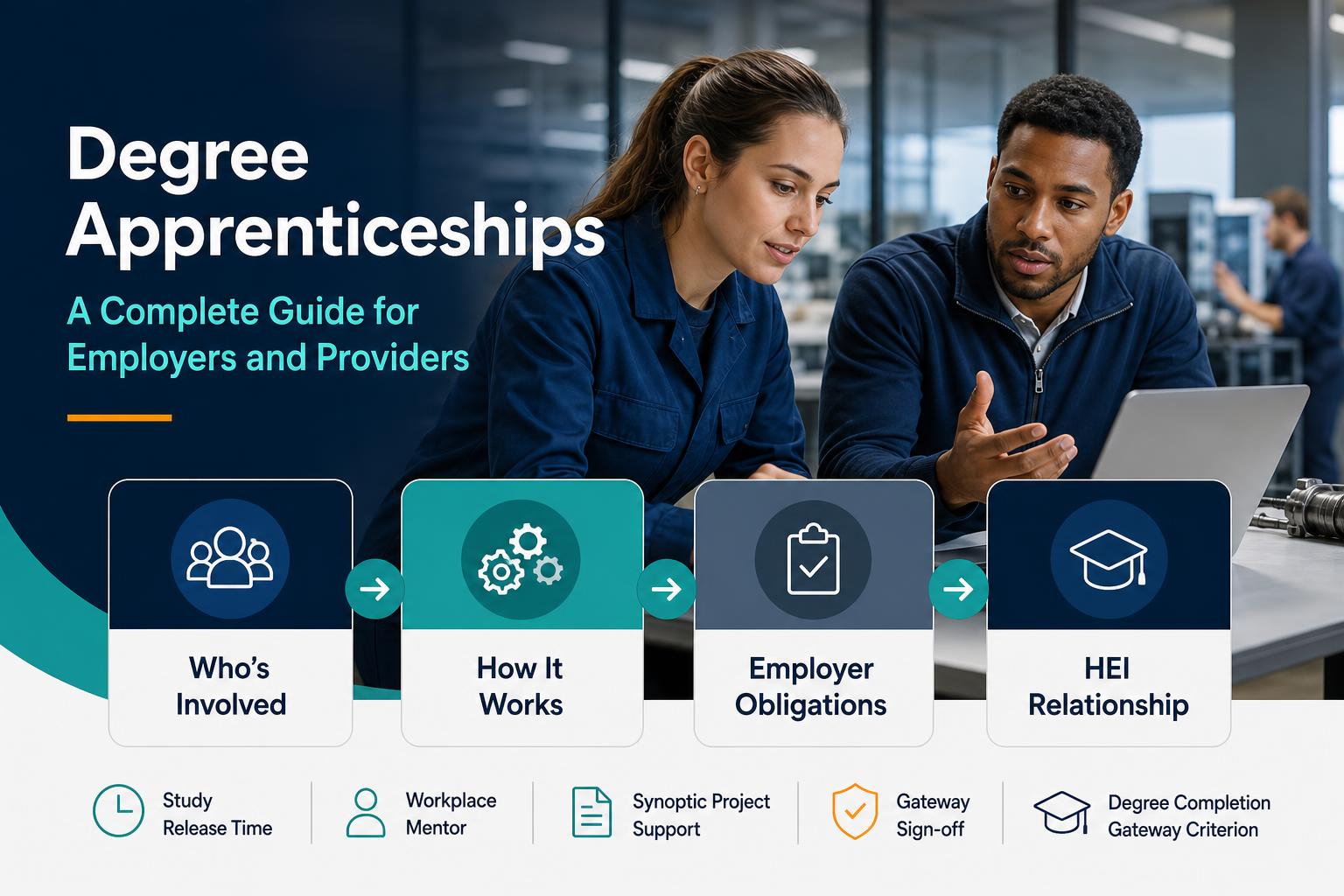
Who is involved in a degree apprenticeship
Degree apprenticeships involve more parties than standard apprenticeships:
- The employer — hires the apprentice, pays them a salary, provides workplace experience, and participates in reviews and gateway sign-off
- The higher education institution (HEI) — the university that delivers the degree and, in most cases, acts as the main apprenticeship provider registered with ESFA
- The apprentice — works, studies, and builds evidence for both the degree and the apprenticeship standard KSBs
- The training provider — in some arrangements, a separate training provider delivers the work-based apprenticeship elements while the HEI delivers academic content. This is a subcontracting arrangement.
- The EPA organisation — an ESFA-approved independent End-Point Assessment organisation that conducts the final assessment
How degree apprenticeships work
The structure varies by standard but the typical pattern for a Level 6 degree apprenticeship is:
Years 1–3: Integrated learning and work — the apprentice splits their time between the university (typically one or two days per week, or block study weeks) and the employer (three or four days per week). During this period they complete university modules, develop workplace competency against the KSBs, and build their portfolio of evidence.
Final year: Synoptic project and gateway preparation — the final year typically includes a synoptic work-based project (often the dissertation equivalent) that integrates academic and workplace learning. This feeds directly into EPA preparation.
Gateway: Three-way sign-off — the employer, HEI, and apprentice must all sign off that gateway criteria have been met. This includes confirmation that the degree has been completed (or that results have been confirmed) alongside the standard KSB and OTJ gateway requirements.
EPA: Independent assessment — the EPA organisation conducts the end-point assessment, which may include a professional discussion, portfolio review, or interview. The grade (Pass, Merit, Distinction) is independent of the degree classification.
Employer obligations for degree apprenticeships
Employers taking on degree apprentices have the same core obligations as for standard apprenticeships — plus additional requirements specific to degree programmes:
Study release time
Employers must release the apprentice for university attendance. The timetable may use one or two days per week during term time or equivalent block release, but that delivery pattern is not a universal funding percentage. For starts from 1 August 2025, the training plan must meet the minimum OTJ volume published for the exact standard, adjusted for evidenced Recognition of Prior Learning subject to the funding-rules floor. Earlier starts retain the OTJ rules that applied on their start date.
Employers who do not plan release time carefully often find that apprentices are struggling to balance work demands with university attendance. Unlike a standard apprenticeship where OTJ can be delivered more flexibly, university timetables are fixed — the employer must build around them.
Workplace mentor
Most degree apprenticeship standards require a named workplace mentor who supports the apprentice in developing the KSBs through their work role. The mentor is typically a line manager or senior colleague, not a tutor from the HEI. The mentor's involvement should be documented in progress reviews.
Synoptic project support
The synoptic project (final-year work-based project) requires employer cooperation — the apprentice needs access to company data, processes, or problems to complete it. Employers should be briefed on this requirement before the apprentice starts, not when the project brief arrives in year three.
Gateway sign-off
Degree apprenticeship gateway requires written employer confirmation that the apprentice has met all gateway criteria. This is not a formality — employers should be tracking the apprentice's development throughout the programme so that gateway sign-off is a substantive confirmation, not a rubber stamp.
The HEI relationship
The relationship between the HEI and the employer (and in some cases, a separate training provider) is the most complex aspect of degree apprenticeship delivery. Key things to understand:
Who is the main provider?
In most degree apprenticeships, the HEI is the ESFA-registered main provider and is responsible for ILR reporting, funding compliance, and the apprenticeship framework. If a separate training provider is involved, they typically subcontract from the HEI and the HEI remains accountable for compliance.
Degree completion as a gateway criterion
The degree must be completed before or at gateway. In practice, this means the HEI must confirm that the apprentice has passed all required modules and that the degree will be awarded before the EPA takes place. This creates a dependency between the university's assessment processes and the apprenticeship gateway timeline — both must be managed in parallel.
A common problem is that university results are released on a fixed schedule that does not align with the provider's planned gateway date. The gateway should be planned backward from the confirmed degree results date, not forward from an arbitrary end date.
Tripartite reviews
Progress reviews in degree apprenticeships should involve the employer, the HEI (or training provider), and the apprentice. In practice, some HEIs treat the degree programme reviews and the apprenticeship programme reviews as separate processes — this creates duplication and gaps. The most effective programmes integrate both into a single tripartite review that covers academic progress, KSB development, and OTJ pace together.
OTJ and compliance requirements
OTJ planning is start-date and standard specific. For starts from 1 August 2025, use the minimum OTJ volume published for the exact apprenticeship standard, then adjust for evidenced Recognition of Prior Learning subject to the funding-rules minimum floor. Do not apply a generic 20% calculation to those starts. Apprentices who started earlier remain under the rules that applied when they began.
University lectures, seminars, tutorials, and qualifying directed study during normal working hours can count as OTJ where they meet the funding-rule definition. Providers must plan, track and evidence enough qualifying activity to meet the learner's applicable standard-specific minimum.
The most common OTJ compliance failure in degree apprenticeships is insufficient documentation of university attendance as OTJ. Attendance records from the HEI do not automatically translate into OTJ records for ESFA purposes — the provider needs a system that captures and categorises time appropriately.
Gateway and EPA at degree level
Gateway requirements for degree apprenticeships include all standard gateway criteria plus degree-specific requirements:
- All KSBs evidenced to the standard specified in the assessment plan
- Applicable standard-specific OTJ minimum completed and evidenced under the learner's start-date rules
- English and Maths requirements met (unless exempt)
- Degree completed and results confirmed — this is the unique gateway criterion for degree apprenticeships
- Synoptic project or equivalent final-year assessment completed
- Three-way gateway sign-off: employer, HEI (or provider), and apprentice
The EPA for degree apprenticeships is typically shorter and more focused than the degree itself — it may be a 45-60 minute professional discussion, a portfolio review, or a presentation. The grade awarded at EPA (Pass, Merit, Distinction) appears alongside the degree classification on the apprentice's certificate but is determined independently.
Degree apprenticeships vs standard apprenticeships: key differences
- Duration — 3–5 years vs 12–24 months for most standard apprenticeships
- Funding band — typically higher, up to £27,000 for some standards
- Delivery complexity — three parties (employer, HEI, apprentice) vs two; university timetable constraints
- Gateway — degree completion is a mandatory gateway criterion with no equivalent in standard apprenticeships
- Employer investment — more sustained over a longer period; employers need to plan for 3–5 years of study release
- Apprentice profile — typically (though not exclusively) taken by school leavers or people making a significant career change; increasingly also used by experienced workers at Level 7
Popular degree apprenticeship standards
Some of the most widely used degree apprenticeship standards across UK employers:
- Digital and Technology Solutions Professional (Level 6) — one of the most popular; covers software engineer, cyber security analyst, data analyst, and IT consultant pathways
- Chartered Manager Degree Apprenticeship (Level 6) — management and leadership; widely used across sectors
- Senior Leader (Level 7) — strategic leadership; typically for managers moving into senior roles
- Solicitor (Level 7) — qualifies apprentices as solicitors while working at a law firm
- Chartered Surveyor (Level 6) — property, construction, and infrastructure sectors
- Nurse (Level 6) — healthcare; delivered in partnership with NHS trusts and HEIs
- Aerospace Engineer (Level 6) — defence and aerospace sector
The full list of IfATE-approved apprenticeship standards, including degree apprenticeships, is available on the Institute for Apprenticeships and Technical Education website.
Sources
Frequently asked questions
What is a degree apprenticeship?
A degree apprenticeship is an apprenticeship that includes a full bachelor's or master's degree as part of the programme. The apprentice works for an employer, earns a wage, and studies for a degree at a university — all at the same time. The degree is funded by the apprenticeship levy (or co-investment), meaning the apprentice does not pay tuition fees. Degree apprenticeships are available at Level 6 (bachelor's degree) and Level 7 (master's degree).
What is the difference between a degree apprenticeship and a higher apprenticeship?
Higher apprenticeships are Level 4 or Level 5 programmes and may include a higher education qualification such as a Foundation Degree or HNC/HND but do not typically include a full bachelor's or master's degree. Degree apprenticeships are Level 6 or Level 7 programmes that include a full degree as an integral part of the apprenticeship standard. The EPA and gateway requirements for degree apprenticeships are more complex because the degree completion must be confirmed before or at gateway.
How long does a degree apprenticeship take?
Most Level 6 degree apprenticeships take 3–4 years. Level 7 (master's level) degree apprenticeships typically take 2–3 years, though evidenced Recognition of Prior Learning can change an individual plan. For starts from 1 August 2025, the practical period must last at least eight months and the exact standard may require longer; earlier starts remain under the duration rules that applied on their start date.
Who delivers degree apprenticeships — the university or the training provider?
In most degree apprenticeships, the university (higher education institution, or HEI) acts as the main provider and is responsible for both the degree and the apprenticeship programme. In some arrangements, a training provider delivers the work-based apprenticeship elements while the HEI delivers the academic component — this is a subcontracting arrangement and must comply with ESFA subcontracting rules. The main provider (whether HEI or training provider) takes ultimate responsibility for ESFA compliance.
Sources & further reading
- Apprenticeship Standards — Institute for Apprenticeships and Technical Education (IfATE) — Apprenticeship Standards — Institute for Apprenticeships and Technical Education (IfATE)
- ESFA Apprenticeship Funding Rules — GOV.UK — ESFA Apprenticeship Funding Rules — GOV.UK
- Apprenticeships: guide for employers — GOV.UK — Apprenticeships: guide for employers — GOV.UK