Last updated: 13 June 2026
Why Open-Source AI Changes the Conversation
Open-source AI can be attractive for public services because it offers more transparency, more adaptability, and potentially lower barriers to experimentation than closed vendor systems. For NHS trusts, councils, libraries, colleges, and training providers, that sounds like an opportunity.
But open source does not remove the implementation burden. It often increases the need for internal capability. Public bodies still need to decide which use cases are appropriate, what data can be used, how models are evaluated, how risks are governed, and how service impact is measured.
The Real Skills Gap
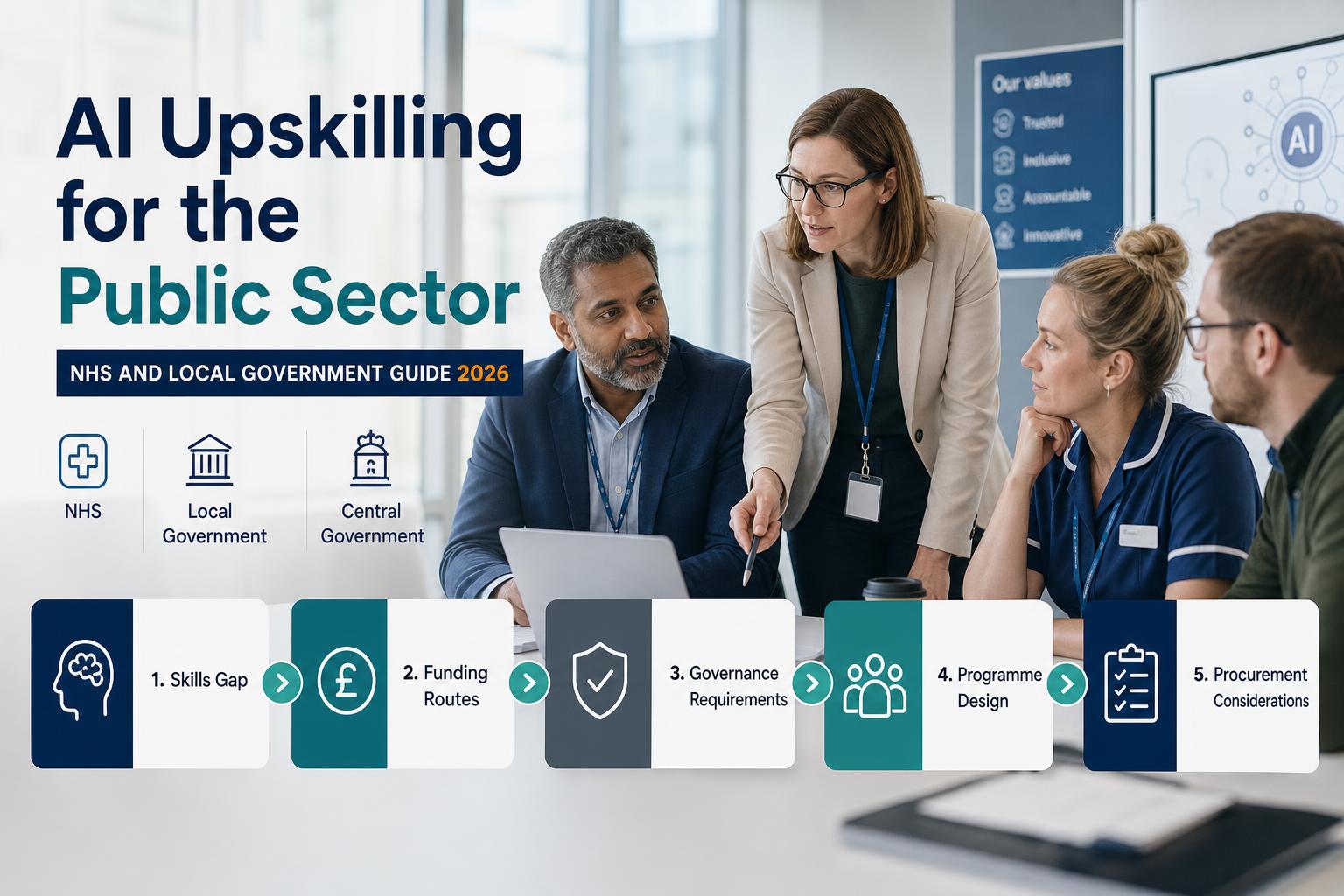
The public sector AI skills gap is not simply "we need more coders". It is broader and more operational.
- Use case selection: knowing which service problems are suitable for AI and which are not.
- Data protection: understanding personal data, special category data, retention, consent, and lawful basis.
- Model evaluation: checking quality, bias, reliability, explainability, and failure modes.
- Human oversight: designing workflows where people remain accountable.
- Procurement and supplier risk: understanding licensing, support, security, and maintenance obligations.
- Service redesign: changing the work process, not just adding a tool.
Who Needs Training?
Senior leaders need enough AI literacy to approve strategy, risk appetite, governance, and investment. They do not need to become engineers, but they do need to ask better questions.
Service managers need to understand where AI changes workflow, staffing, escalation, and user experience.
Information governance and data protection teams need AI-specific evaluation routines, not generic software review checklists.
Procurement teams need to understand open-source licensing, support models, hosting choices, security, and supplier dependency.
Frontline supervisors need to know how AI affects daily decisions, quality assurance, and staff confidence.
Open source is not automatically safer
Transparency helps, but public bodies still need model evaluation, data governance, security controls, equality impact assessment, and human oversight.
A Practical Training Plan
Stage 1: baseline AI literacy. Give all relevant staff a shared understanding of AI, risks, safe use, data protection, bias, and human accountability.
Stage 2: role-specific training. Train leaders, service managers, procurement, IG teams, and frontline supervisors against the decisions they actually make.
Stage 3: use case labs. Work through real service scenarios: triage, document search, call summarisation, case-note support, service navigation, or training support.
Stage 4: governance evidence. Record decision logs, risk assessments, model evaluations, policy sign-off, staff training, and service impact evidence.
What Evidence Should Public Bodies Keep?
Public service AI adoption needs a stronger evidence trail than most commercial pilots. Keep records of training completed, use cases approved, data protection assessment, equality impact, model testing, user feedback, decision ownership, incident handling, and review dates.
The evidence should be easy to retrieve. If AI governance evidence is stored across inboxes, shared drives, and meeting notes, leaders will struggle to prove that responsible use is actually managed.
Frequently Asked Questions
Is open-source AI cheaper? Sometimes. The licence may be cheaper, but hosting, security, maintenance, integration, support, and governance still cost money.
Should public bodies build their own AI tools? Only where they have the technical, governance, and support capability to maintain them safely. Many teams should start with narrow pilots and strong oversight.
What should training providers offer? Training providers can help public bodies build AI literacy, manager confidence, governance routines, and role-specific implementation capability.
Sources & further reading
- ITPro — The UK is betting big on the power of open-source AI
- GOV.UK — AI Opportunities Action Plan
- GOV.UK — Responsible AI Toolkit