Last updated: 15 July 2026
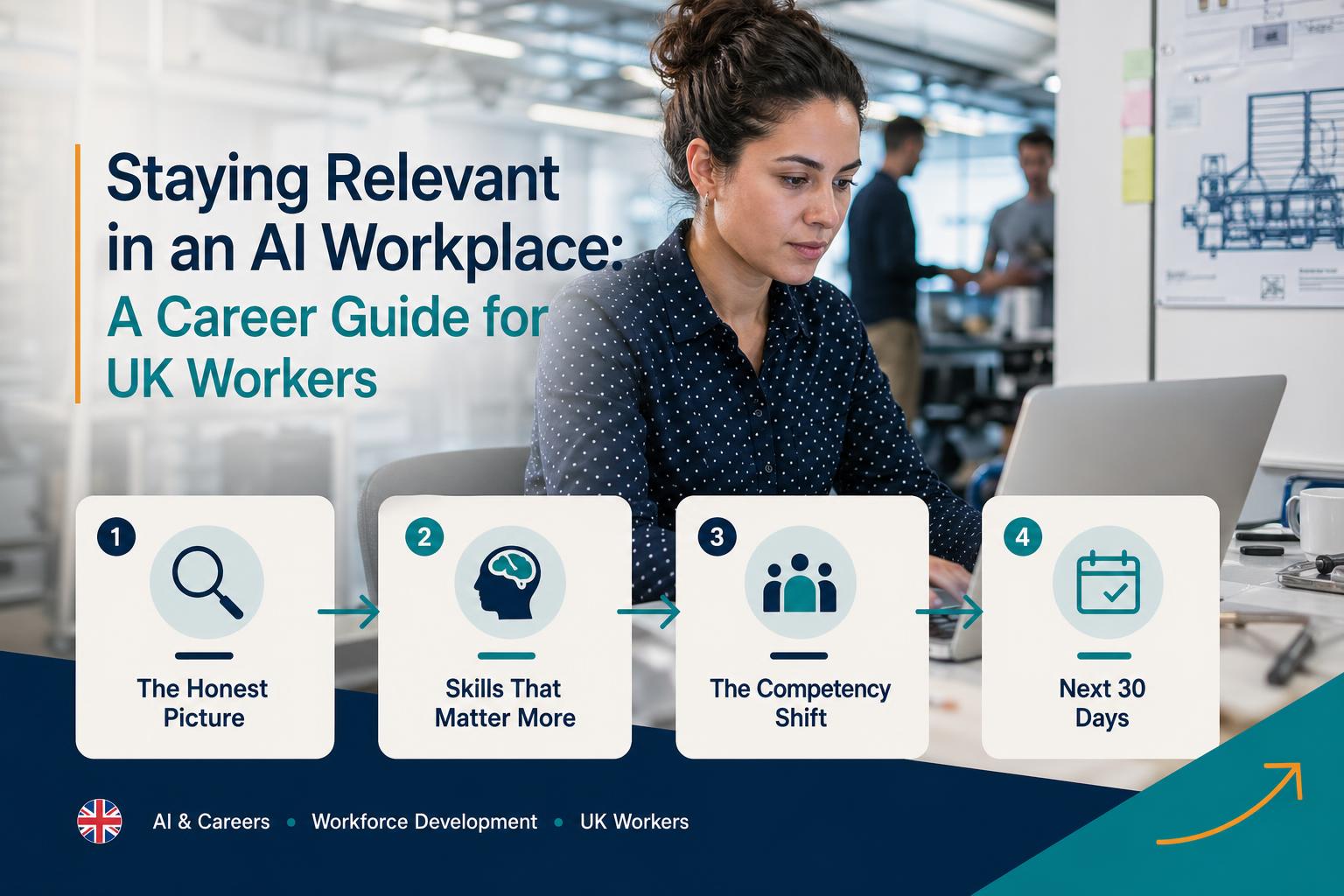
The Honest Picture: Not Hype, Not Panic
If you have opened this guide because you are worried about what AI means for your career, that is a reasonable place to be. The concern is real, the pace of change is real, and anyone who tells you “don’t worry, AI will create more jobs than it destroys” without addressing the present-tense disruption isn’t helping you. So let’s start with what the data actually says — not the most alarming headline number, and not the most reassuring spin.
- 7.4% of UK jobs face high automation risk — meaning the majority of tasks in those roles could be automated with current technology (ONS analysis)
- 25–30% of all UK jobs will see significant task change as AI augments core workflows
- 70%+ of UK work is not facing displacement in any near-term scenario
- 85 million jobs may be displaced globally by 2030, but 97 million new roles may emerge — a net positive in volume, though not necessarily for the same people in the same places (WEF Future of Jobs Report 2025)
The 7.4% high-risk figure is not nothing. If you work in a role that involves routine data entry, straightforward document processing, or predictable information handling, AI tools are already doing a meaningful share of work that was previously done by people — and that share will grow. Being honest about that matters.
But the figure that most people do not sit with long enough is 70%. The majority of UK work is not being replaced by AI in any near-term scenario. It is being changed — which is a different problem, and a more manageable one.
What IS changing across virtually every sector and every level of work is the baseline expectation of what a competent professional looks like. The floor is rising. Workers who use AI tools effectively will do more, faster, and better than those who do not — and employers will notice, promotions panels will notice, and clients will notice. The change is not abrupt; it is gradual and then suddenly obvious.
The career risk is not being replaced by AI. It is being replaced by a person who uses AI better than you do.
That reframe matters because it points to an action. You cannot stop AI from existing. You can decide what to do about it.
The Skills That Matter More in an AI World
Here is the inversion that most discussions of AI and work miss: as AI takes on more routine cognitive tasks — drafting, summarising, data retrieval, pattern recognition — the things that only humans can do genuinely well become scarcer and therefore more valuable, not less. The economics of scarcity do not stop applying because the technology changes.
Six categories of human capability are consistently identified by research and practitioner experience as increasing in relative value as AI handles more cognitive work.
1. Judgment and discernment
AI tools produce outputs that are fluent, coherent, and confident in tone — regardless of whether they are correct. The skill of knowing when to trust an AI output, when to question it, when the stakes are too high to delegate to an algorithm, and when a situation is genuinely too complex for a formula — that is judgment. It is not replaceable by AI because it requires knowing what you do not know, and being willing to act responsibly in that uncertainty. Every consequential decision-making role — at every level of every organisation — requires more of this skill, not less, as AI becomes more capable.
2. Relationship and trust
Client relationships, team leadership, negotiation, mentoring, and stakeholder management are all areas where the human connection is not incidental to the work — it is the work. AI can draft the proposal, prepare the briefing, and summarise the call notes. It cannot build the trust that makes a client stay through a difficult project, or the safety that makes a team member raise a concern before it becomes a crisis. In an AI-augmented workplace, the people who maintain deep professional relationships have something that cannot be automated, and it shows in outcomes.
3. Contextual expertise
Deep domain knowledge — the kind that comes from years of experience in a specific sector, role, or discipline — is what allows you to direct AI tools effectively and to verify whether their outputs are actually correct. The generalist without deep knowledge in any area is the profile most at risk: they may be able to use AI tools, but they cannot reliably tell when the tool is wrong. The expert who uses AI is more capable than ever; the expert who does not use AI will eventually be outpaced. Invest in going deeper in your area, not broader in the hope that breadth substitutes for depth.
4. Ethical reasoning
As AI tools become involved in more consequential decisions — hiring screening, performance assessment, financial recommendations, clinical support — the humans in those workflows carry responsibility for what the AI recommends. The ability to see the fairness implications of an AI-assisted decision, to recognise when training data may have encoded historical bias, and to have the professional confidence to escalate or override an AI recommendation when it is wrong — these are skills that are increasing in importance in HR, healthcare, finance, public services, and anywhere that decisions affect people’s lives.
5. Communication of complex ideas
AI can generate large volumes of content at low cost. What it cannot do is interpret and communicate that content for a specific audience, with a specific decision to make, in a specific organisational or political context. As AI generates more analysis and more drafts, the ability to take that raw material and turn it into communication that actually influences a real person — knowing what to emphasise, what to simplify, what to challenge, and how to frame implications — becomes rarer and more valuable. Writing and communication skills are not threatened by AI; they are amplified by it for the people who develop them seriously.
6. Learning agility
Perhaps the most important single capability for the current period is the willingness and ability to continuously update your skills as tools and requirements change. The specific AI tools in use today will be different in two years. The workflows they enable are evolving. Workers who treat learning as a phase of their career rather than a permanent feature of it will face recurring disruption. Workers who have developed habits of active learning — experimenting with new tools, seeking out training, updating how they work based on what they learn — will find each cycle of change easier than the last.
The Competency Shift Happening in Every Sector
The abstract argument about human skills is more useful when you can see it playing out in a context you recognise. The table below maps the shift in what it means to be a high-performing professional in six major sectors — from where the value was concentrated before, to where it is concentrating now.
| Sector | Previously valued for | Now valued for |
|---|---|---|
| Finance | Data collection, report generation, manual modelling | AI oversight, model interpretation, client advisory and judgment |
| Healthcare | Documentation, information retrieval, protocol adherence | Clinical judgment, empathetic communication, ethical decision-making that AI cannot replicate |
| Law | Legal research, document drafting, contract review | Strategy, client judgment, risk interpretation, AI governance of legal processes |
| Marketing | Content production volume, campaign execution | Creative strategy, audience insight, directing AI tool output towards genuine brand differentiation |
| HR | Administrative processing, policy documentation, compliance tracking | People judgment, culture development, ethical oversight of AI-assisted hiring and performance processes |
| Operations & logistics | Manual tracking, scheduling, inventory management | Exception management, AI system oversight, process redesign around AI-augmented workflows |
The pattern is consistent. In each sector, the tasks that AI handles most effectively are being automated out of the high-value job description — and the tasks that remain are the ones requiring judgment, relationships, and contextual expertise. The “valuable employee” profile is not disappearing; it is shifting. The question is whether you are shifting with it.
A Practical Self-Assessment: Where Do You Stand?
The following six questions are worth sitting with honestly. They are not a test — they are a diagnostic. The point is to identify where you actually are, so you know where to put your energy.
- Can you use at least one AI tool to complete a work task faster or better than without it? Not in principle — in practice, on a real task you do regularly. If the answer is no, that is the most immediate gap to close.
- Do you know the AI tools your industry uses most, and have you actually tried them? Awareness and use are different things. Knowing that AI exists in your sector and knowing how to work with it day-to-day are different levels of readiness.
- Can you evaluate an AI output for accuracy and tell when it is wrong? AI tools produce plausible, well-structured outputs that are sometimes factually incorrect. Being able to catch those errors before they cause a problem is a core professional skill in 2026.
- Can you describe where AI is being used in your organisation or sector? If you cannot answer this question specifically, you do not yet have the situational awareness to anticipate how your role is changing.
- Do you know what training is available to you through your employer or government funding? Most UK workers have access to significantly more funded training than they realise. Not knowing about it is leaving real value on the table.
- Are you the person in your team who knows more about AI, or less, than most of your colleagues?
That last question is worth dwelling on. If you know less than most of your colleagues about how AI is being used in your field, that gap will not close by itself — but it also means you have the most to gain from closing it quickly. The person who goes from least AI-literate on their team to most AI-literate in six months will be very visible, in a good way. Being behind right now is not a permanent position. It is an opportunity to accelerate.
The Three Things to Do in the Next 30 Days
Long-term career strategy is important. But the most effective thing you can do right now is build momentum with concrete actions — not wait until you have a perfect plan. These three steps are low-cost, low-time, and high-return.
1. Pick one AI tool and use it on real work tasks for two weeks
Not to learn about AI. Not to complete a training module. To actually use it on the work you do every day — drafting emails, summarising documents, preparing for meetings, researching topics, structuring presentations. The AI tools most accessible to UK workers right now are ChatGPT, Claude, and Microsoft Copilot (the last of which is embedded directly into Microsoft 365, so you may already have access through your employer). Two weeks of daily use on real tasks will teach you more about what AI can and cannot do in your role than any amount of passive reading. You will discover where it genuinely saves time, where it produces outputs you need to heavily edit, and where it is not worth the effort. That knowledge is the foundation for everything else.
The most common barrier here is not cost or access — it is starting. The first AI output you produce will probably be underwhelming. That is normal. The skill of getting useful outputs from AI tools develops with practice, and it develops quickly if you persist.
2. Identify the training route most relevant to your role and find out if your employer will fund it
There are structured training routes that may be funded for eligible workers in England — detailed in the next section. Before the end of the month, identify the one route that is most relevant to where you want to develop, then ask your manager, HR team, or L&D function to verify the live offer, your eligibility, release time and employer contribution. If your organisation falls within the territorial scope of the EU AI Act, Article 4 may add a compliance case for role- and risk-appropriate AI literacy measures. It is not a universal legal obligation on every UK employer, so check scope rather than leading with that assumption.
3. Find one person who uses AI well in your field and ask them what they actually do
The single fastest way to close the gap between theoretical knowledge of AI and practical working knowledge of it is to talk to someone who is already using it effectively in a role similar to yours. Ask them what tools they use, which tasks they use AI for, what they have learned does not work, and what has genuinely changed about how they work. Most people who are enthusiastic about AI in their work are happy to talk about it — and a 30-minute conversation with someone who has already figured out the practical application in your field is worth more than hours of generic AI articles.
Funded Routes to Build AI Skills — What’s Available Without Cost to You
One of the most underused facts about AI skills development in the UK is that there is a meaningful amount of government and employer funding available — and most of it goes unclaimed because workers do not know it exists. Here is what is currently available.
These are two separate offers in England. Adults aged 19 or over who meet residency rules and are assessed as having digital skills below Level 1 can receive fully funded Essential Digital Skills or Digital Functional Skills qualifications up to Level 1. Free Courses for Jobs covers selected Level 2 and Level 3 qualifications, including some digital subjects, with eligibility depending on age, prior attainment, earnings, unemployment and local funding rules. Check the digital entitlement guidance and Free Courses for Jobs before applying.
Skills Bootcamps last up to 16 weeks and are free to the individual learner. For an existing employee, current national employer guidance sets a 10% training-cost contribution for employers with 1–249 employees and 30% for employers with 250 or more. Subject availability, eligibility, entry route, timetable and delivery mode vary by commissioned offer, so an AI or data place is not guaranteed in every area. Search the National Careers Service course finder for live offers and ask the provider what the employee and employer must commit.
The current Skills England record for ST1512 is version 2.1, Level 4, approved and available. It lists a typical duration of 18 months, 420 minimum compliance hours and maximum funding of £18,000; its revised assessment plan applies from 22 May 2026. Your employed role must support the occupation and the employer must protect the planned training. For starts from 1 August 2026, eligible non-levy apprentices aged 16–24 are government funded up to the band maximum; for non-levy apprentices aged 25 or over, the employer pays 5% and government pays 95%. A levy payer with insufficient account funds pays 25% of the eligible shortfall and government pays 75%. The employer pays above the band; earlier starts normally keep their start-date rules. The apprentice must not be charged for eligible training or assessment.
Article 4 has applied since 2 February 2025 to providers and deployers within the EU AI Act’s territorial scope. A UK organisation can be in scope, for example, where it is established in the EU or the output of its AI system is used in the EU; simply processing personal data or using an AI tool in the UK does not by itself establish scope. In-scope organisations must take measures, to their best extent, to provide sufficient AI literacy for staff and others operating or using AI systems on their behalf, taking account of their knowledge, role, context and system risk. The rule does not prescribe one course, annual certification or a universal assessment record. If relevant, ask your employer how it has assessed scope and what measures apply to your role.
The Mindset That Separates People Who Thrive
Every major technological shift in the history of work has produced two groups of people: those who treated the change as a threat to defend against, and those who treated it as a capability to master. The outcomes for those two groups have consistently been different — and the difference has rarely been about starting position, technical aptitude, or access. It has been about orientation.
The workers who will look back at the current period as one of career acceleration rather than career threat are not necessarily the most technically gifted. They are the ones who decided to engage rather than wait. They started using AI tools before they felt ready. They asked questions, made mistakes in low-stakes contexts, found out what worked, and built from there. They treated the discomfort of not knowing as information about where to put their energy, rather than a reason to avoid the whole subject.
This is not about becoming a technology expert. Most of the workers who will benefit most from AI in the next decade are not going to write code or build models. They are going to be finance professionals who use AI to do better analysis, teachers who use AI to personalise support for their students, HR managers who use AI to spend less time on administration and more time on the people work that actually matters, and nurses who use AI to reduce documentation load so they have more time with patients. The value is not in the technology. The value is in the human work that the technology makes space for.
Curiosity and adaptability, rather than defensiveness and avoidance — that is the mindset. It is not a natural talent. It is a choice you make and then practise until it becomes the default.
The pace of AI change is not slowing down. The best time to start building AI skills was a year ago. The second-best time is today.
Frequently asked questions
Will AI take my job?
ONS analysis suggests 7.4% of UK jobs face high automation risk — meaning the majority of tasks in those roles could be automated with current technology. A further 25–30% of jobs will see significant task change. That is real and it deserves honest acknowledgment. But it also means that more than 70% of UK work does not face imminent displacement — and even in roles that are changing significantly, what is being automated is usually a portion of the tasks, not the role itself. The more accurate framing is not 'will AI take my job?' but 'how is AI changing what my job requires?' — and then: what do I need to do about it?
What skills will be most valuable in an AI workplace?
As AI handles more routine cognitive work, the skills that become most valuable are the ones AI cannot genuinely replicate: judgment and discernment (knowing when AI output is wrong or insufficient), relationship and trust (client relationships, leadership, negotiation where human connection is the product), contextual expertise (deep domain knowledge that lets you direct AI and verify its outputs), ethical reasoning (seeing the implications of AI-assisted decisions), communication of complex ideas (synthesising and persuading at a human level), and learning agility (continuously updating your skills as tools and requirements change). These are not new skills — they are skills that have always differentiated excellent professionals. What is new is that AI is removing the tasks that used to obscure how important they are.
How do I build AI skills without spending a lot of money?
In England, eligible adults assessed below Level 1 can access fully funded Essential Digital Skills or Digital Functional Skills qualifications up to Level 1. Free Courses for Jobs is a separate offer covering selected Level 2 and Level 3 qualifications, with eligibility based on factors such as age, prior attainment, earnings, unemployment and local rules. Skills Bootcamps last up to 16 weeks, but subjects, entry criteria and timetables vary by commissioned offer; an employer training an existing employee currently contributes 10% if it has 1–249 employees or 30% if it has 250 or more. The current Level 4 AI and Automation Practitioner apprenticeship (ST1512 version 2.1) typically lasts 18 months. Its employer contribution depends on the learner's start date, age and the employer's levy position, not simply employer size.
How do I make the case to my employer to fund AI training?
Start with specific role outcomes: explain what you want to do differently after training and how that will improve quality, speed or risk control. Then identify a live route and verify eligibility and employer cost rather than assuming it is free. EU AI Act Article 4 can strengthen the case only where the employer is a provider or deployer within the Act's territorial scope, for example because it is established in the EU or an AI system's output is used there. In scope, the obligation is to take role- and risk-appropriate measures to provide sufficient AI literacy; it is not an automatic requirement for every UK employer to buy a particular course.
Sources & further reading
- ONS: Automation and the UK labour market — ons.gov.uk - Which occupations are at higher risk of being automated?
- World Economic Forum: Future of Jobs Report 2025 — weforum.org/reports/the-future-of-jobs-report-2025
- GOV.UK: Skills Bootcamps for employers — find-employer-schemes.education.gov.uk/schemes/skills-bootcamps
- Skills England: AI and Automation Practitioner (ST1512), version 2.1 — skillsengland.education.gov.uk/apprenticeships/st1512
- European Commission: AI literacy questions and answers — digital-strategy.ec.europa.eu/en/faqs/ai-literacy-questions-answers