Last updated: 30 May 2026
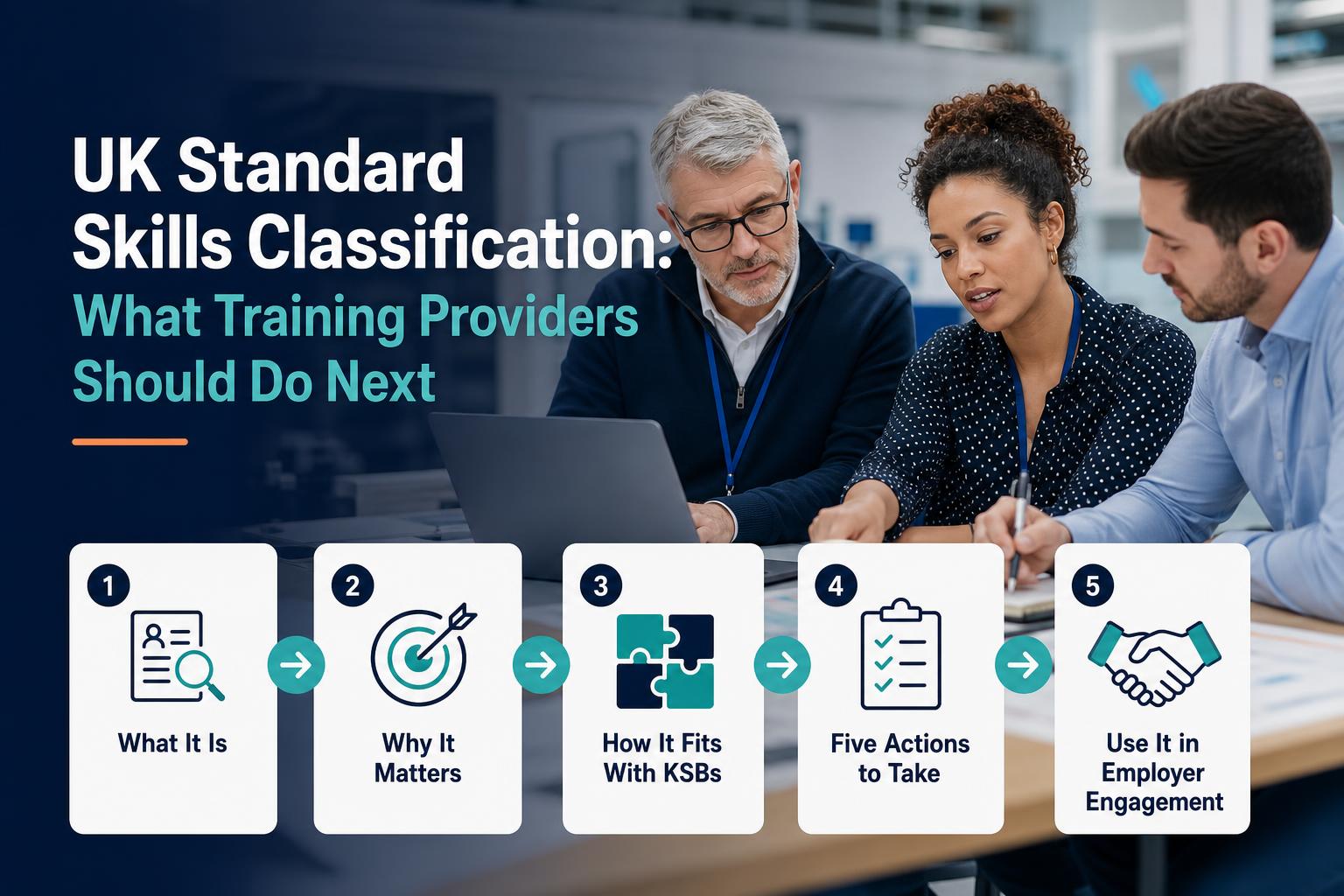
What the UK Standard Skills Classification Is
The UK Standard Skills Classification is a shared system for describing skills, knowledge, and tasks across occupations. It was launched in May 2026 as part of Skills England's work to make the skills system easier to navigate for employers, providers, jobseekers, and government bodies.
The point is not to create another layer of terminology for its own sake. The point is to reduce translation loss. Employers describe business needs in one language, providers describe programmes in another, apprenticeship standards use KSBs, labour market data uses occupational classifications, and learners describe experience in practical terms. A shared skills classification gives those groups a better chance of talking about the same capability.
For providers, this is an opportunity to make skills data more usable. The classification can support employer needs analysis, curriculum design, prior learning checks, learner diagnostics, skills gap reporting, and progression planning.
Why It Matters for Providers
The strongest providers already think in skills, not just programmes. They ask what employers need people to do, what learners can already do, what training will close the gap, and how progress will be evidenced. The classification gives that operating model a more consistent vocabulary.
That matters commercially. Employers are increasingly buying outcomes rather than attendance. They want to know whether a provider can solve a workforce problem, not simply deliver a course. A provider that can translate employer demand into recognised skills language, then map it to training and evidence, will be easier to buy from.
It also matters for public funding. Skills England's role is to align provision with national and regional priorities. Providers that can show clear links between occupational demand, skills needs, curriculum, and evidence will be better positioned as the system moves toward more data-led planning.
How It Fits With Apprenticeship KSBs
The classification does not replace Knowledge, Skills and Behaviours in apprenticeship standards. KSBs remain the formal framework for full apprenticeship delivery and assessment. Providers still need to map evidence to the relevant standard and end-point assessment requirements.
The better way to think about the classification is as a broader skills intelligence layer. KSBs tell you what must be achieved for a specific apprenticeship standard. The classification can help you connect that standard to employer job roles, occupational tasks, adjacent skills, prior learning, and progression routes.
For example, an employer may ask for training in AI governance, data handling, or team leadership. The provider can map those needs to common skills language, then identify whether the best route is an apprenticeship standard, an apprenticeship unit, a Skills Bootcamp, a commercial short course, or a bespoke programme.
Use it as a bridge, not a replacement
KSBs remain mandatory for apprenticeships. The UK Standard Skills Classification is most useful when it connects KSBs to employer language, workforce planning, skills diagnostics, and programme choice.
Five Provider Actions to Take Now
1. Map your priority programmes. Start with programmes that are strategically important or commercially active. Identify the core skills and tasks each programme develops, then align them to the classification where possible.
2. Update employer discovery templates. Employer conversations should capture business problem, job role, task change, required skills, current capability, urgency, and evidence of success. Using classification language at this stage makes later mapping easier.
3. Improve skills gap diagnostics. A useful skills scan should not just ask whether a learner has experience. It should identify which tasks they perform, how independently they perform them, what evidence exists, and what level of support they need.
4. Connect skills to evidence. If a programme claims to build a skill, the provider should be able to show where that skill is taught, practised, assessed, and evidenced. This is where platform structure matters.
5. Build employer reports around capability. Completion rates are not enough. Employers need to see skills gained, gaps remaining, learner progression, and the link between training and work tasks.
How to Use It in Employer Engagement
The classification can make employer engagement more specific. Instead of asking "what training do you need?", providers can ask "which tasks are changing, which roles are affected, and what capabilities do staff need to perform those tasks well?"
That shift is particularly useful in AI training. Many employers know they need AI skills but cannot define the skill gap precisely. Some need prompt writing, some need data privacy, some need critical evaluation of AI outputs, some need workflow redesign, and some need managers who can set responsible use policies. These are different needs and should not all be sold as the same AI literacy course.
Using common skills language helps the provider recommend the right route. It also helps the employer explain the training internally, because the proposal is framed around work tasks and capability rather than course titles.
What Your Platform Needs to Support
A skills classification is only useful if it can be operationalised. Providers should be able to tag programme content, learning activities, assessment evidence, skills scans, and employer reports against a consistent skills structure.
The platform should also allow multiple frameworks to coexist. Apprenticeship KSBs, unit specifications, commercial course outcomes, internal employer competency frameworks, and the UK Standard Skills Classification may all be relevant. The system should connect them without flattening them into one generic checklist.
For provider managers, the reporting layer should answer practical questions: which skills are most in demand, which programmes cover them, which learners have evidence against them, which employers have repeated gaps, and where new provision may be needed.
A Practical 90-Day Plan
Days 1-30: choose five priority programmes and map their core skills, tasks, and evidence points. Do not attempt to map the whole curriculum estate at once.
Days 31-60: update employer discovery and learner skills scan templates. Pilot them with a small number of employer accounts where the relationship is strong enough for honest feedback.
Days 61-90: build one employer-facing skills report that shows baseline, planned learning, evidence collected, and progress against the agreed skills. Use the pilot to decide what should become a repeatable operating model.
The objective is not a perfect taxonomy project. The objective is better commercial conversations, better programme design, and better evidence that training is developing skills employers actually need.
Frequently Asked Questions
Sources & further reading
- GOV.UK - Simpler, shared system for describing skills needs launched — GOV.UK - Simpler, shared system for describing skills needs launched
- Skills England — Skills England
- CIPD - AI skills planning guidance — CIPD - AI skills planning guidance