Last updated: 13 June 2026
How Employers Should Use the Classification
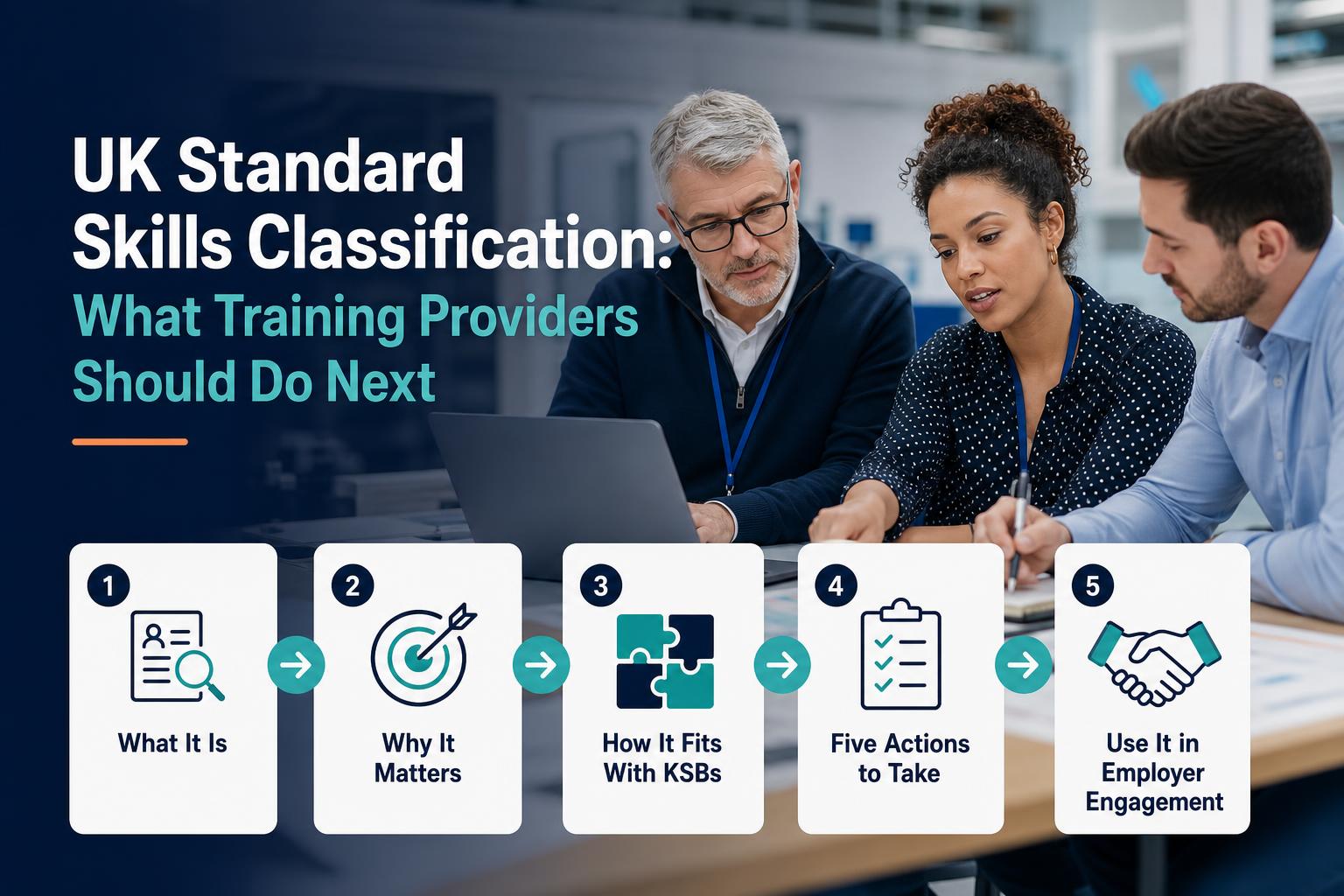
The UK Standard Skills Classification gives employers a better starting point for workforce planning. Instead of beginning with a course catalogue, employers can begin with work: which roles are changing, which tasks are becoming harder, which skills are missing, and which funded routes could close the gap.
This matters because employers often describe skills needs inconsistently. A manager might ask for "AI training", "better data skills", "more confident supervisors", or "digital transformation support". Those phrases are useful signals, but they are not yet a training plan. A shared skills language helps turn broad demand into specific capability requirements.
Why It Matters Commercially
Employers that can describe skills gaps clearly make better training decisions. They are less likely to buy generic learning, less likely to waste levy funds on poorly matched programmes, and more likely to brief providers accurately.
The classification also helps employers compare options. If a capability gap can be mapped to a full apprenticeship standard, that may be the right answer. If the gap is narrower, an apprenticeship unit, Skills Bootcamp, commercial short course, or internal programme may be more appropriate.
A Practical Mapping Process
1. Pick one role family. Do not map the whole organisation first. Start with a role group where capability matters now: team leaders, data analysts, engineers, customer service leads, compliance teams, or operations managers.
2. Identify changing tasks. Ask what people need to do differently. Are they using AI tools? Working with new compliance obligations? Managing new equipment? Interpreting more data? Supporting apprentices?
3. Describe the required skills. Translate those tasks into skills, knowledge, behaviours, and confidence levels. Use the classification to make the language consistent.
4. Assess current capability. Use manager input, learner self-assessment, work samples, performance data, and existing qualifications. Avoid relying on confidence scores alone.
5. Choose the training route. Match the gap to an apprenticeship, unit, Skills Bootcamp, commercial course, coaching pathway, or internal project.
The classification is a bridge
It does not replace apprenticeship KSBs or employer competency frameworks. It helps translate between job tasks, provider language, training routes, and workforce reports.
Connecting Skills to Funded Routes
The strongest use case is levy planning. Employers often have unspent levy funds but struggle to convert them into relevant programmes. A skills map makes that decision easier.
- Full apprenticeship: best when the role needs a broad occupational pathway and sustained development.
- Apprenticeship unit: best when the gap is narrower, urgent, and linked to a priority skill area.
- Skills Bootcamp: useful for intensive job-linked skills with employer outcomes.
- Commercial short course: useful when the gap is important but not eligible for public funding.
- Internal development: useful when the gap is process-specific and best taught inside the organisation.
Common Employer Mistakes
Starting from course titles. Course titles hide whether the training actually solves the work problem.
Mapping too much at once. Whole-workforce mapping projects often stall. Start with one role family and prove the model.
Ignoring managers. Managers know where work is changing. If they are not involved, the skills map will be too abstract.
Failing to connect evidence. A skills map should end in evidence: what changed, who improved, what work output proves it, and what gap remains.
Frequently Asked Questions
Does this replace a training needs analysis? No. It improves it by giving the analysis a consistent language for skills, tasks, and job requirements.
Can SMEs use it? Yes. SMEs should use a lighter version: one role family, one business problem, one skills gap, one route decision.
Should HR or L&D own it? L&D can coordinate it, but managers must validate the task and skill reality. Finance may also need to be involved where levy funding is being planned.